If you are looking for how to make hard surface cleaner, the starting point is choosing the right balance of cleaning agents and supporting ingredients for the surface you want to clean. A good hard surface cleaner should work quickly, remove everyday dirt and grease, and remain suitable for washable surfaces such as plastic, marble and tiles.
Typical formulations may use nonionic and anionic surfactants as the main cleaning agents, together with alcohols to improve cleaning performance. Phosphate or phosphonate derivatives can be used as supporting agents, while materials such as sodium carbonate or sodium hydroxide may be added for pH adjustment. Fragrance, dye and preservatives can also be included depending on the finished product.
Some hard surface cleaners are also developed with disinfecting properties, but these systems require careful formulation because ingredients such as sodium hypochlorite or hydrogen peroxide depend strongly on pH and overall product compatibility.

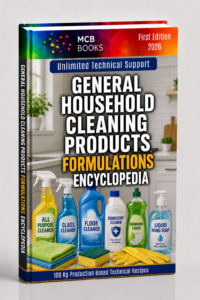
If you are developing hard surface or multi-purpose cleaning products,
the
ALL PURPOSE CLEANER FORMULATIONS & MANUFACTURING ENCYCLOPEDIA
provides practical formulation examples, raw material information and production guidance for a wide range of professional surface cleaners.
Main Ingredients in Hard Surface Cleaners
A hard surface cleaner usually combines surfactants with supporting ingredients that improve grease removal, wetting and overall cleaning performance. Depending on the product, alcohols, builders, pH adjusters, fragrance, dye and preservatives may also be included.
The exact balance changes according to the surface, cleaning strength and whether the product is designed as a general-purpose cleaner, spray cleaner or disinfecting system.
How Hard Surface Cleaner Is Produced
For anyone researching how to make hard surface cleaner, the production process is usually based on controlled mixing rather than a complicated reaction.
The main challenge is choosing compatible raw materials, using them in the right proportions and following a clear order of addition. This helps achieve a cleaner that is stable, easy to use and consistent from batch to batch.
Why the Formulation Matters
Knowing the ingredient names is only the beginning. A reliable hard surface cleaner needs the correct surfactant balance, pH range and supporting additives for the intended application.
For commercial production, a tested formulation and a repeatable manufacturing method are much more useful than a simple ingredient list.
Summary
If you want to move from basic information to practical formulas,
the
ALL PURPOSE CLEANER FORMULATIONS & MANUFACTURING ENCYCLOPEDIA
provides formulation examples, raw material guidance and production information for hard surface cleaners and other multi-purpose cleaning products.
https://makingchembooks.com/product/all-purpose-cleaner-formulations-manufacturing-encyclopedia/
For anyone planning to produce professional surface cleaners, this is the next step after understanding the basic ingredients and production logic.