
Zinc is one of the most important micronutrients used in plant nutrition, especially in intensive agricultural production systems. Chelated Zinc EDTA is preferred in many fertilizer applications because it helps keep zinc stable and available for plant uptake under different soil and water conditions. Compared to traditional zinc sources, chelated forms can provide more efficient nutrient delivery and more consistent performance.
Chelated Zinc EDTA is commonly used in foliar fertilizers, hydroponic systems and drip irrigation applications where balanced micronutrient nutrition is important for healthy plant development. These zinc systems are widely used to support leaf growth, root activity and overall crop quality in both greenhouse cultivation and open field farming.
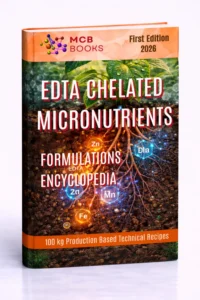
💥 WANT TO PRODUCE PROFESSIONAL CHELATED MICRONUTRIENT FERTILIZERS?
The EDTA CHELATED MICRONUTRIENTS FORMULATIONS ENCYCLOPEDIA
includes industrial formulation systems for Zinc EDTA, Iron EDTA, manganese, copper and advanced micronutrient fertilizer production.
✔ 100 kg production-based formulations
✔ Real raw materials and CAS numbers
✔ Step-by-step manufacturing methods
✔ Professional commercial fertilizer systems
👉 Start developing high-performance chelated micronutrient products today.
ADVANTAGES OF EDTA CHELATED ZINC FERTILIZERS
- Has highly and fully chelated zinc elements
- Is quickly taken in by plants since it requires low energy to absorb the nutrient
- Contains organic substance with a minimum salt index
- Contains highly and readily available nutrients
- It starts working right away
- Is highly compatible with nutrients and other fungicides
- Can be used both in hydroponics agriculture and for soil application
FEATURES AND PROPERTIES OF CHELATED ZINC EDTA
- Contains highly stable and fully chelated zinc elements
- Helps improve zinc availability in soil and water based fertilizer systems
- Supports rapid nutrient uptake by plants with lower energy consumption
- Provides highly available micronutrients for efficient plant nutrition
- Starts working quickly after application
- Has a low salt index which helps reduce plant stress risk
- Suitable for foliar fertilizers, drip irrigation and hydroponic systems
- Compatible with many fertilizer formulations and fungicide systems
- Helps support healthy leaf growth and chlorophyll formation
- Can be used in both greenhouse cultivation and open field agriculture
- Performs effectively under different soil pH conditions
- Commonly used in professional micronutrient fertilizer production systems