
Some lubricants are incompatible because of differences in additive chemistry that lead to undesirable chemical reactions. If these oils are mixed, insoluble material may form and then deposit onto sensitive machine surfaces. For a hydraulic fluid, this could lead to lubricant starvation, valve failure or increased wear.
A second form of lubricant incompatibility is more insidious because no visible changes occur when the products are mixed. The problem appears only after the mixture is used in a piece of equipment that consequently fails or loses performance. For example, hydraulic/tractor fluid that is contaminated by motor oil can lead to brake chatter and failure in farm equipment. Optimum performance requires carefully balanced frictional and antiwear properties in the finished product that are upset when the lubricants are mixed.
Some incompatible lubricant mixtures may also affect synthetic rubber seals. Lubricants are formulated to be neutral to seals or cause them to swell slightly. Too much seal swell, seal shrinkage or chemical deterioration may occur with some combinations of lubricants. Engine oils formulated with certain types of dispersants attack fluorocarbon seals. Lubricants contaminated by products containing ester base stocks may swell seals unacceptably. EP gear oils are known to deteriorate silicone seals.
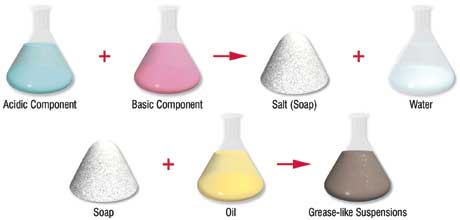
Lubricant incompatibility is a chemistry problem. It has nothing to do with the manufacturers of the oil; two oils made by the same manufacturer may be incompatible. The most common cause of lubricant incompatibility that results in the formation of harmful solids is the reaction of an acidic component in one oil with a basic component in another. The reaction is accelerated by water and heat.
Oils containing acidic rust inhibitors are incompatible with oils containing basic rust inhibitors. When the two oils are mixed, especially when some water is present, a solid forms in the oil that reacts further with the oil to form a grease-like insoluble substance. This can clog filters, form deposits that interfere with lubrication and interfere with demulsibility (water-oil separation).
One way to look at potential lubricant incompatibility is to classify lubricants as acidic or basic. Table 2 is not meant to be totally inclusive and some exceptions may occur. Different lubricant manufacturers may use different additive chemistries to accomplish the same function, so caution is warranted. Check with your manufacturer to be sure.
Lubricants that require good demulsibility (water separation) should never be mixed with lubricants that contain dispersants or high concentrations of detergents. Small amounts of oil with good emulsion characteristics will destroy the water shedding properties of a highly demulsible lubricant. Rarely can the demulsibility be restored with additive supplements.
Lubricants formulated with non-zinc antiwear and antioxidant additives such as railroad engine oils and ashless or low-ash gas engine oils will cause engine damage if they are contaminated with lubricants containing zinc additives.

any engine oil
LUBRICATING OIL
FORMULATIONS
ENCYCLOPEDİA
is enough.
LUBRICATING OIL FORMULATION ENCYCLOPEDIA has many formulations of greases, complex grease, lithium grease production,sodium greases formula, formulation,multigrade engine oils manufacturing process,motor oils making, gear oil production, synthetic engine oils,semi synthetic motor oils,gasoline oils,diesel oils production process,composition of turbine oils,transmission oil manufacturing, production of cycle motor engine, tractor oils,mineral based motor engine production,heat transfer oils, slideway oils formulation, formulations, cutting oils formula,formulas grinding oils,mould oils manufacturing process and etc.
All lubricating oils in the encyclopedia are producible easily.You need no help and no technıcal support. The encyclopedia is enough to produce lubricating oils and engine oils itself.
LUBRICATING OIL
FORMULATIONS
ENCYCLOPEDIA
is written clear and understandable.
HARD BOOK E BOOK
RELATED TAGS: What is engine oils,making synthetic diesel engine oil,semi synthetic engine oil manufacturing process,mineral based engine oil production, heavy duty engine oil formulation,high performance engine oil formula,formulas,properties of motor oils,synthetic motor oil msds, analysis,composition of engine oils,additives of motor oils, mineral engine oil formulation,make semi synthetic diesel engine oil, base oils,synthetic base oils,light neutral oil,heavy neutral oil,performance additives package, properties of diesel engine oil, how to formulate engine oils, types of engine oils, synthetic motor oils,ingredients of engine oils,compounds of engine oils, index of motor oil,characteristic of motor oils,application of motor oils,combination of synthetic engine oils.
SOLVERCHEM PUBLICATIONS