
Plants need water, carbon dioxide and a range of trace minerals known as ‘nutrients’ to grow. They obtain these nutrients, and most of their water, from the soil. Soil composition Soil is made up of three main things: clay, humus and sand. There are also many small organisms that live in the soil, and most of these are useful to the plants. Clay Clay is made from the breakdown and recombination of silicate rocks.
It is made up of alternating layers of silicon oxides then aluminium oxides, with various cations such as Ca2+ loosely bound in between the layers. Anions adsorb onto the oxide surfaces, with doubly and triply charged cations sticking better than singly charged ones. Clays are the main source of nutrients in the soil. Humus This is any organic matter in the soil – i.e. the products of the decay of plants and animals. It is mostly made up of aromatic compounds.
Over time it breaks down to carbon dioxide and water so it needs to be continually replaced. Humus is important in regulating the amount of water in the soil. Sand This is solid particles of ground up rock. A small amount of sand is necessary to ensure the correct water content in the soil. Sources of plant nutrients The nutrients available in a given soil ultimately depends on the rock from which the soil was made. If the plants grown from this soil die and decay where they have grown then their nutrients are recycled. However, if the plants have been grown for agriculture then they are removed from the area in which they have grown and their nutrients cannot be recycled. So in soils that are used for cropping, essential nutrients continually have to be replaced.
Replacement of plant nutrients This can be done either using manure or compost (which are relatively poor sources of nutrients) or a synthetic fertilizer. Synthetic fertilizers are usually used to replace nitrogen (in the form of urea, ammonium sulfate, ammonium nitrate or diammonium hydrogen phosphate), phosphorous, sulfur and potassium. The nitrogen is obtained from the air, the phosphorous is mined as Ca3(PO4)2, the sulfur is mined in elemental form and reacted with oxygen to form sulfate, and the potasium is obtained from seawater. Other minor nutrients are also sometimes replaced using specialised artificial fertilizers. Soil analysis If soil has an inappropriate composition for a given plant species then that plant will not thrive (or maybe will not grow at all) in that soil. To prevent this being a problem, samples of soil are often analysed so that nutrients can be added before seeds are planted.
Soil is commonly analysed for potassium, magnesium, calcium, nitrogen and phosphorous (the exact choice of elements to monitor depends on which plants are to be grown) and also for pH. Some of these tests are so simple they can be carried out at home (some examples are given at the end of the article) and others require specialised equipment.
ORGANİC FERTILIZERS AND PRODUCTIONS
any liquid and solid organic fertilizer,
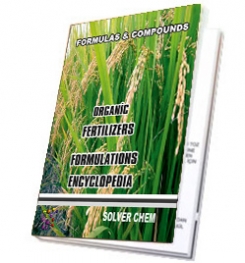
ORGANIC
FERTILIZERS
FORMULATIONS
ENCYCLOPEDİA
is enough.
This encyclopedia has many formulations about organic soil conditioner,humic acid productions,compositions,fulvic acid manufacturing,organic fertilizers,animal manure,amino acid organic fertilizers, organomineral powder fertilizers,organomineral liquid fertilizers productions,liquid root growth fertilizers formulas,granular root growth fertilizers,seaweed organic fertilizers,wermicompost fertilizers formulations,gel organic fertilizers,organomineral gel fertilizers manufacturing and any organic fertilizers etc.
All organic fertilizers in the encyclopedia are producible easily.You need no help and no technıcal support. The encyclopedia is enough to produce organic fertilizers itself.
ORGANIC
FERTILIZERS
FORMULATIONS
ENCYCLOPEDIA
is written clear and understandable.
RELATED TAGS: What is organic fertilizer,preparation of organic soil conditioner, liquid organic fertilizer manufacturing,animal manure manufacturing, manufacturing proces of animal manure,chicken manure,efficiency of humic acid in soil,effect of humic acid in plants, advantages of humic acid in agriculture, types of animal manure,seaweed fertilizer manufacturing process,production of liquid seaweed fertilizers, what is organic compost, preparation of organic compost,how to use organic compost,making organic compost, using of seaweed fertilizer,properties of seaweed organic fertilizers how to make liquid organic fertilizers, making organic compost,types of organic compost,manufacturing process of organic compost, how to make organic compost fertilizers, production of organic fertilizers,manufacturing process solid humic acid, formulation of humic acid,value of humic acid,manufacturing process of fulvic acid,how to produce humic acid,what is leoardite,where to use leonardite,types of leonardite,properties of leonardite,analyzes of leonardite,specification of leonardite, values of leonardite, what is leonardite humate,what is potassium humate, liquid humic acid preparation,powder humic acid production, granular soil conditioner manufacturing process, powder soil conditioner making,formulation of organic soil conditioner, making powder humic acid,humic acid production, composition of organic fertilizers,how to use organic fertilizers,why to use organic fertilizer,types of organic fertilizer,benefits of organic fertilizers,wermicompost fertilizers making, powder organic fertilizers,how to use organic fertilizers, making wermicompost fertilizer, formulation of seaweed fertilizers, amino acid fertilizer production,granular organic fertilizer,amino acid organic fertilizer manufacturing, properties of organic fertilizers, analyzes of organic fertilizer, specification of organic fertilizers, where to use organic fertilizers, what is soil amendments, humic acid making, how to make powder humic acid, manufacturing process of fulvic acid, herbal fulvic acid making, liquid humic acid process, formulation of humic acid,organic fertilizers for plants, organic fertilizers in agriculture, how to produce organic fertilizers, animal manure manufacturing process, herbal fertilizers, what is organic fertilizer compost, what is organic agriculture, how to make organic agriculture, advantages of organic fertilizers, effects of organic fertilizer, results of organic fertilizers, indications of organic fertilizers, symptoms of organic fertilizers, preparation of organic fertilizers, calculation of organic fertilizers, compounds of organic fertilizers,composition of liquid organic fertilizers, fertilization of organic fertilizers,why to use organic fertilizers.what is humate, types of humates,benefit of humate,potassium humate manufacturing process.,using powder soil conditioner, properties of granular soil conditioner,what is pellet organic soil conditioner.what is amino acid fertilizer, how to use organic amino acid fertilizsers,making amino acid fertilizers,formulation of amino acid fertilizers,manufacturing process of amino acid fertilizers, what is organic compost, where to use organic compost, types of organic compost in plants,benefits of organic compost in soil, preparation of organic compost in agriculture.
E – BOOKS AND HARD BOOKS
HOW TO BUY
AGRICULTURE ENCYCLOPEDIAS AND VIDEOS