
Moisture and temperature play a major role in the yield potential of crops, so understanding the interaction of weather and nutrients is an important step in achieving higher yields and environmental stewardship.
Moisture is essential for plant life. It is required for seed germination and plant development. When planning fertilizer applications, look at the short- and long-term weather forecast for your area. Timely and moderate rainfall can be beneficial to dissolve dry fertilizer and move nutrients into the soil rooting zone, but excessive rain can increase runoff potential and leaching potential of nutrients such as nitrate, sulfate, chloride, and boron.
Plant water availability and nutrient availability is also impacted by soil texture. Coarser textured soils do not have the water- or nutrient-holding capacity of silt loam soils. These soil types tend to dry out faster and have a higher risk for leaching, so required fertilizer should be split into 2-3 applications throughout the growing season.
In semi-arid and arid regions, irrigation programs provide a constant source of much-needed water which allows growers to regulate moisture and nutrient uptake. Nutrients such as potassium (K+) regulate water within the plant and help crops survive drought and/or drier climates. In contrast, areas that receive high rainfall amounts in short time periods or have or have subsoils with high clay content may require tile drainage to move water off the surface and out of the rooting zone in order to maintain good root and soil microbial health.
Temperature is also critical to plant physiology and nutrient uptake. It influences chemical and biological processes within the soil. Beginning with planting, temperature drives seed germination, root development, and nutrient uptake. Climates in southern regions of the U.S. warm before northern regions and allow for earlier planting dates and longer growing seasons. In contrast, northern climates may encounter cold springs that lead to slow seed germination, root and crop development, and slow nutrient uptake compared to warmer years. Warm temperatures promote rapid growth of above- and below- ground plant development, leading to root exploration for nutrient uptake.
Regardless of geography, working closely with an agronomist to achieve balanced crop nutrition is the best defense against the sudden and unexpected changes in the weather. Crops with proper nutrition are healthy and can withstand stresses incurred during the growing season.
any liquid and solid fertilizer,
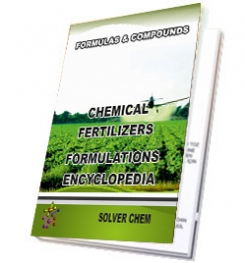
CHEMICAL
FERTILIZERS
FORMULATIONS
ENCYCLOPEDİA
is enough.
This encyclopedia has many formulas about NPK fertilizers,NP fertilizers,liquid poliar fertilizers, powder fertilizers, granulas fertilizers, calcium and potasium fertilizers, special fertilizers, dripping fertilizers,foliar fertilizers, edta chelated fertilizers, micronutrients fertilizers,macronutrients fertilizers,chelated fertilizers etc.
All chemical fertilizers in the encyclopedia are producible easily.You need no help and no technıcal support. The encyclopedia is enough to produce chemical fertilizers itself.
CHEMICAL
FERTILIZERS
FORMULATIONS
ENCYCLOPEDIA
is written clear and understandable.
RELATED TAGS: What is powder fertilizer,what is complete fertilizer,what is incomplete fertilizer,what is balanced fertilizers,making complete fertilizer,formulation of balanced fertilizer,what is double fertilization, importance of fertilization in plants, making phosphorus fertilizers, how to make liquid phosphoric acid fertilizers, making phosphate fertilizer, properties of solid fertilizers, effects of dripping fertilizers, benefits of granular fertilizer, advantages of foliar liquid fertilizers, formulations of liquid drip fertilizer,compounds of phosphorus fertilizers, powder powder nitrogen fertilizers making, properties of solid liquid balanced fertilizer, complex fertilizer composition,using liquid micronutrients fertilizers, solid microelement fertilizers,using micronutrient fertilizers,plants to calcium fertilizers, micronutrients fertilizers in agricultural, how to make microelement fertilizers,making powder micronutrient fertilizers,micro elements fertilizers,properties of edta chelated fertilizers, liquid foliar fertilizers, to make ammonium nitrate fertilizers, preparation of liquid phosphate fertilizers, production of copper fertilizers, NPK fertilizer production,productions, types of chemical fertilizers,fertilizer types, solid foliar fertilizers,micronutrient fertilizers, combi fertilizers, manufacturing fertilizers,how to use chemical fertilizers, foliar fertilizers, drip fertilizers, NPK fertilizers, balance fertilizers, to make balance fertilizers,powder fertilizers manufacturing,granules fertilizer making,compositions of fertilizers, formulations of fertilizers, how to programme of fertilizers, using fertilizers.
E – BOOKS AND HARD BOOKS
HOW TO BUY
AGRICULTURE ENCYCLOPEDIAS AND VIDEOS