Introduction
Liquid NPK fertilizer production is a key process in modern agriculture, allowing precise and efficient delivery of essential nutrients to plants. These fertilizers contain nitrogen (N), phosphorus (P), and potassium (K), which are the three primary nutrients required for plant growth and development.
Liquid formulations provide faster absorption, uniform nutrient distribution, and compatibility with irrigation systems, making them ideal for industrial-scale agricultural applications.
In this guide, you will learn liquid NPK fertilizer formulas, raw materials, and step-by-step manufacturing processes used in industrial production.
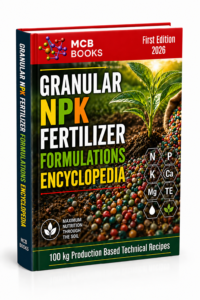
Discover advanced fertilizer formulations in the
GRANULAR NPK FERTILIZER FORMULATIONS ENCYCLOPEDIA,
developed by a chemical engineer with over 40 years of experience.
What is Liquid NPK Fertilizer?
Liquid NPK fertilizers are fully water-soluble nutrient solutions containing nitrogen, phosphorus, and potassium in balanced or customized ratios. These nutrients are essential for plant growth:
- Nitrogen (N): promotes leaf and vegetative growth
- Phosphorus (P): supports root development and flowering
- Potassium (K): improves overall plant strength and resistance
Liquid fertilizers are widely used in fertigation systems, greenhouses, and foliar applications.
Raw Materials Used in Liquid NPK Fertilizers
The formulation of liquid NPK fertilizers depends on high-quality raw materials:
Nitrogen Sources
- Urea
- Ammonium nitrate
- Ammonia
Phosphorus Sources
- Phosphoric acid
- Ammonium phosphate
Potassium Sources
- Potassium chloride (KCl)
- Potassium sulfate (K₂SO₄)
👉 NPK fertilizer raw materials:
https://makingchembooks.com/npk-fertilizer-production-raw-materials/
Liquid NPK Fertilizer Formula (Example)
A typical industrial liquid NPK fertilizer formulation may include:
- Nitrogen source (urea solution): 20–40%
- Phosphorus source (phosphoric acid): 10–20%
- Potassium source (KCl or KOH): 10–20%
- Water: balance
- Micronutrients (optional): small amounts
Different ratios such as 10-10-10, 20-20-20, or customized blends are used depending on crop requirements.
Liquid NPK Fertilizer Production Process
The industrial production process consists of several controlled stages:
1. Raw Material Preparation
All raw materials are carefully measured according to the required NPK ratio.
2. Dissolution and Mixing
Nitrogen, phosphorus, and potassium sources are dissolved in water under continuous stirring to form a homogeneous solution.
3. Chemical Reaction (if required)
In some processes, chemical reactions occur between acids and bases to form stable nutrient compounds.
4. Stabilization
Additives or stabilizers may be used to prevent precipitation and ensure long-term storage stability.
5. Filtration
The solution is filtered to remove impurities and ensure clarity.
6. Packaging
The final product is filled into containers suitable for transportation and application.
Industrial Equipment Used
Liquid fertilizer production requires:
- Mixing tanks
- Reaction vessels
- Filtration systems
- Storage tanks
- Filling and packaging machines
👉 how to make NPK fertilizer:
https://makingchembooks.com/how-to-make-npk-fertilizer/
Advantages of Liquid NPK Fertilizers
- Fast nutrient absorption
- Uniform nutrient distribution
- Easy application through irrigation systems
- High efficiency in plant uptake
- Customizable nutrient ratios
Applications of Liquid NPK Fertilizers
Liquid NPK fertilizers are widely used in:
- Greenhouse cultivation
- Drip irrigation systems
- Foliar feeding applications
- Commercial agriculture
👉 NPK fertilizer production equipment:
https://makingchembooks.com/npk-fertilizer-production-equipment/
Formulation Tips
- Maintain proper pH balance
- Ensure full solubility of raw materials
- Use compatible nutrient sources
- Prevent precipitation through stabilization
- Adjust formulation based on crop needs
Safety and Handling
- Handle acids and chemicals with care
- Use protective equipment
- Store in corrosion-resistant containers
- Follow industrial safety standards
Frequently Asked Questions (FAQ)
What is liquid NPK fertilizer?
It is a water-soluble fertilizer containing nitrogen, phosphorus, and potassium.
How is liquid fertilizer produced?
By dissolving nutrient sources in water and stabilizing the solution.
What are common NPK ratios?
Common ratios include 10-10-10 and 20-20-20.
Why use liquid fertilizers?
They provide faster absorption and more efficient nutrient delivery.
Author
This content is prepared by a professional chemical engineer with over 40 years of formulation experience.
SUMMARY
Liquid NPK fertilizer production is an essential process in modern agriculture, enabling efficient and precise nutrient delivery. By combining nitrogen, phosphorus, and potassium in water-soluble formulations, manufacturers can produce high-performance fertilizers suitable for a wide range of applications.
Understanding raw materials, formulation techniques, and production processes allows for the development of stable and effective liquid fertilizers for industrial use.