Introduction
Granulation is one of the most important stages in the industrial production of NPK fertilizers. During this process, fine powder raw materials containing nitrogen, phosphorus, and potassium are transformed into uniform and stable granules suitable for agricultural use. Granulation improves fertilizer handling, storage stability, and nutrient distribution in the field.
Modern fertilizer plants use advanced granulation technologies to ensure high production efficiency and consistent fertilizer quality.
👉 For a complete overview of industrial fertilizer manufacturing, see our guide on NPK Fertilizer Production Process.
Importance of Granulation in Fertilizer Production
Granulation plays a crucial role in fertilizer manufacturing because it converts powdered materials into solid particles with controlled size and structure.
The main advantages of fertilizer granulation include:
-
Improved nutrient distribution in soil
-
Reduced dust during transportation and storage
-
Better handling and application by farmers
-
Increased mechanical strength of fertilizer particles
-
Improved product appearance and quality
Granulated fertilizers are easier to spread evenly across agricultural fields.
Raw Materials Used in Granulation
Several raw materials are used during the production of NPK fertilizers. These materials provide essential nutrients required for plant growth.
Typical raw materials include:
Nitrogen Sources
-
Urea
-
Ammonium nitrate
-
Ammonium sulfate
Phosphorus Sources
-
Monoammonium phosphate (MAP)
-
Diammonium phosphate (DAP)
-
Phosphoric acid
Potassium Sources
-
Potassium chloride (MOP)
-
Potassium sulfate (SOP)
👉 Detailed information about fertilizer ingredients can be found in our article Raw Materials Used in NPK Fertilizer Production.
Granulation Methods Used in NPK Fertilizer Production
Different industrial technologies are used to produce fertilizer granules. The most common methods include rotary drum granulation, disc granulation, and fluidized bed granulation.
Rotary Drum Granulation
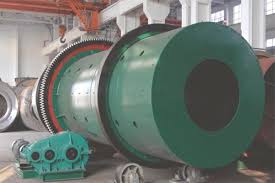
Rotary drum granulation is the most widely used technology in large fertilizer plants. In this system, raw materials enter a rotating drum where moisture and mechanical movement allow particles to agglomerate and grow into granules.
This technology enables continuous fertilizer production and high plant capacity.
Disc Granulation
Disc granulators, also called pan granulators, are commonly used in medium-scale fertilizer plants. Powder materials gradually roll and accumulate in the rotating disc, forming spherical fertilizer granules.
This process offers better particle size control.
Fluidized Bed Granulation
Fluidized bed granulation uses hot air streams to suspend particles during granule formation. This advanced technology is used in specialized fertilizer manufacturing processes.
Granule Growth and Particle Formation
During granulation, powder particles adhere together through moisture and binding forces. Over time, these particles grow in size as additional layers attach to the granule surface.
Granule formation depends on several key parameters:
-
Moisture level
-
Binder addition
-
Mixing intensity
-
Temperature conditions
-
Residence time in the granulator
Careful control of these parameters ensures uniform fertilizer granules with strong mechanical stability.
Drying and Cooling of Fertilizer Granules
After granulation, fertilizer granules contain excess moisture. Drying systems are used to remove this moisture and stabilize the fertilizer particles.
Rotary drum dryers are commonly used in fertilizer plants. After drying, cooling systems reduce the temperature of the granules before screening and packaging.
Proper drying and cooling improve fertilizer durability and storage stability.
Screening and Recycling Process
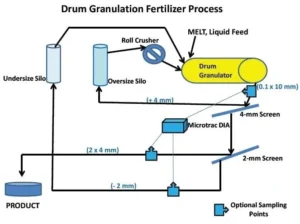
After cooling, fertilizer granules pass through screening machines that classify particles according to size.
Oversized granules are crushed and recycled back to the granulation stage. Undersized particles are also returned to the process to maximize production efficiency.
The final product consists of uniform fertilizer granules ready for agricultural application.
👉 You can learn more about industrial fertilizer machinery in our article Equipment Used in NPK Fertilizer Production.
Industrial Advantages of Granulated Fertilizers
Granulated fertilizers are widely used in modern agriculture because they offer several advantages compared to powdered fertilizers.
Key benefits include:
-
Easier transportation and storage
-
Reduced dust formation
-
Uniform field application
-
Improved nutrient availability
-
Increased fertilizer durability
These benefits make granulated fertilizers the preferred fertilizer form in global agriculture.
Industrial fertilizer production technologies and formulation principles are explained in detail in the Chemical Fertilizers Formulations Encyclopedia, which includes professional fertilizer formulations and manufacturing methods used in modern fertilizer plants.
SUMMARY
Granulation is a critical stage in the industrial production of NPK fertilizers. It converts powdered raw materials into stable fertilizer granules with uniform size and improved physical properties.
Industrial fertilizer plants use technologies such as rotary drum granulators, disc granulators, and fluidized bed systems to produce high-quality fertilizer products. Proper control of granulation parameters ensures efficient fertilizer production and consistent nutrient distribution.
Granulated NPK fertilizers provide better handling, storage stability, and agricultural performance, making them essential for modern crop production.
Related Articles About NPK Fertilizer Production
NPK Fertilizer Production Process
Raw Materials Used in NPK Fertilizer Production
Equipment Used in NPK Fertilizer Production
NPK 20-20-20 Fertilizer Production Process