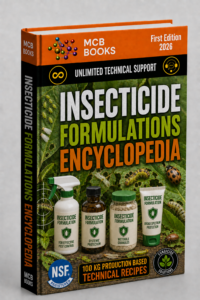
Complete Guide to Insecticide Formulations Encyclopedia
(Industrial Formulas Included)
Insecticide formulations are at the core of modern pest control, combining chemical science with industrial production techniques to create effective and reliable products. For professionals, manufacturers, and entrepreneurs in the agrochemical industry, having access to a comprehensive resource is essential. An insecticide formulations encyclopedia provides detailed insights into formulation types, raw materials, production processes, and real industrial formulas used in commercial applications.
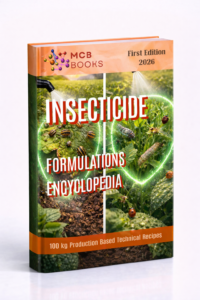
At the heart of any insecticide product is the active ingredient, the compound responsible for controlling or eliminating pests. However, the true performance of an insecticide depends on how this active ingredient is formulated. The encyclopedia approach covers all major formulation types, including Emulsifiable Concentrates (EC), Suspension Concentrates (SC), Wettable Powders (WP), Soluble Liquids (SL), and advanced systems such as microencapsulation and ULV formulations. Each system has unique advantages and is designed for specific application needs.
Industrial formulas included in such a guide provide practical, ready-to-use compositions that manufacturers can adapt for their own production. These formulas typically list raw materials, functional additives, and recommended processing steps. Understanding these formulations allows users to move beyond theory and apply real-world solutions in production environments.
Production methods are another key component of an insecticide formulations encyclopedia. From mixing and homogenization to milling and particle size control, each stage of production is explained in detail. Industrial equipment such as high-shear mixers, bead mills, and blending systems are essential for achieving consistent product quality. The encyclopedia format helps users understand not only what to use but also how to produce formulations efficiently at scale.
Stability and quality control are also emphasized. A high-quality insecticide must maintain its effectiveness over time, resist environmental degradation, and remain physically stable during storage. Topics such as pH optimization, use of stabilizers, and shelf life improvement are covered to ensure long-term product performance.
Another important aspect is regulatory compliance and safety. Industrial insecticide production must meet strict standards related to toxicity, environmental impact, and labeling. A comprehensive guide helps users navigate these requirements and develop formulations that are both effective and compliant with international regulations.
For businesses, an insecticide formulations encyclopedia is not just a technical resource but also a strategic tool. It enables faster product development, reduces trial-and-error costs, and supports the creation of competitive, high-performance products. Whether for large-scale manufacturing or small-scale production, access to industrial formulas provides a significant advantage.
In conclusion, a complete guide to insecticide formulations offers a structured and practical approach to understanding and producing insecticides. By combining formulation knowledge, industrial processes, and real formulas, it serves as an essential reference for anyone involved in the insecticide industry.