Disinfectant wet wipes are widely used for the rapid cleaning and disinfection of hard surfaces in homes, offices, hospitals, laboratories, schools, hotels, food-service areas, industrial facilities, and public spaces. Unlike ordinary cleaning wipes, disinfectant wipes must deliver a controlled amount of active solution while maintaining chemical stability, microbiological quality, material compatibility, and consistent performance throughout their shelf life.
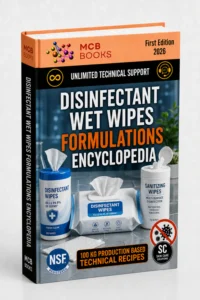
The DISINFECTANT WET WIPES FORMULATIONS ENCYCLOPEDIA has been prepared for manufacturers, formulation specialists, entrepreneurs, private-label producers, chemical suppliers, and investors seeking practical technical information about professional disinfectant wipes production formulas. The book focuses on formulation structure, raw material functions, manufacturing methods, quality control, nonwoven fabric selection, and commercial product development.
A professional disinfectant wet wipes formula usually contains purified water, one or more active antimicrobial ingredients, surfactants, solvents, chelating agents, pH regulators, stabilizers, corrosion inhibitors, fragrance materials, and other functional additives. The exact composition depends on the intended use, target microorganisms, surface type, product claims, regional regulations, and required contact time.
Alcohol-based disinfectant wipes may use ethanol or isopropyl alcohol as active ingredients or supporting solvents. These formulations can provide fast evaporation and convenient application on compatible surfaces. However, manufacturers must carefully control alcohol concentration, packaging compatibility, flammability risks, production ventilation, and moisture loss during storage.
Alcohol-free disinfectant wet wipes may be formulated with approved quaternary ammonium compounds or other suitable antimicrobial systems. These products are often developed for surfaces where rapid alcohol evaporation is undesirable. The active system must be compatible with surfactants, fragrances, nonwoven materials, packaging components, and the final pH of the formulation.
Surfactants help remove grease, dirt, organic residues, and surface contamination. Their concentration should be optimized because excessive surfactant levels may cause foaming, streaking, sticky residues, or interference with antimicrobial performance. Solvents and cleaning boosters may also be added to improve the removal of oily or difficult soils.
The DISINFECTANT WET WIPES FORMULATIONS ENCYCLOPEDIA provides professionally structured production concepts for alcohol-based, alcohol-free, antibacterial, antimicrobial, surface-cleaning, institutional, household, and industrial disinfectant wipes. The formulations can support manufacturers in organizing raw material quantities and scaling production batches according to equipment capacity.
During manufacturing, purified water is transferred into a clean stainless-steel mixing tank. Water-soluble ingredients are added under controlled agitation, followed by surfactants, active substances, solvents, stabilizers, and other additives in the appropriate sequence. Volatile or heat-sensitive ingredients should be incorporated under suitable temperature conditions to reduce evaporation and performance loss.
Before impregnation, the disinfectant solution should be tested for appearance, odor, pH, density, active ingredient concentration, stability, and microbiological quality. The solution is then dosed onto a compatible nonwoven fabric. The fabric must provide sufficient absorbency, wet strength, softness, and controlled liquid release.
Accurate lotion loading is essential. Insufficient liquid may prevent complete surface coverage, while excessive liquid can cause leakage, increased production costs, and packaging problems. The packaging must also limit evaporation and protect the product from contamination during storage and repeated consumer use.
Commercial disinfectant wipes production requires documented hygiene procedures, batch traceability, equipment sanitation, raw material control, finished-product testing, and suitable storage conditions. Performance claims should be supported by appropriate laboratory testing and prepared in accordance with applicable regulations.
The DISINFECTANT WET WIPES FORMULATIONS ENCYCLOPEDIA offers a practical technical foundation for companies developing professional disinfectant wipes. By combining reliable production formulas, suitable active ingredients, controlled manufacturing procedures, compatible nonwoven fabrics, protective packaging, and consistent quality testing, manufacturers can produce stable, effective, and commercially competitive disinfectant wet wipes for household, professional, institutional, and industrial markets.