Surface disinfectant wet wipes are ready-to-use products developed for cleaning and disinfecting hard, nonporous surfaces in commercial buildings, industrial facilities, offices, hotels, laboratories, warehouses, schools, healthcare environments, and public areas. These products combine a disinfectant solution with a compatible nonwoven substrate, allowing users to clean surfaces and apply a controlled quantity of active liquid in a single operation.
SURFACE DISINFECTANT WET WIPES FORMULATIONS FOR COMMERCIAL AND INDUSTRIAL CLEANING must be designed according to the intended application, target microorganisms, surface materials, required contact time, cleaning performance, and applicable regulations. A formulation intended for office furniture may differ significantly from a product developed for industrial machinery, healthcare equipment, food-processing areas, or heavily contaminated work surfaces.
Purified or deionized water is normally used as the primary carrier in water-based disinfectant wipes. The formulation may contain approved antimicrobial active ingredients, surfactants, solvents, chelating agents, pH regulators, stabilizers, corrosion inhibitors, and optional fragrance materials. The exact composition depends on the performance claims and legal classification of the finished product.
Common active technologies may include alcohols, quaternary ammonium compounds, hydrogen peroxide systems, organic acids, chlorine-releasing substances, or other authorized antimicrobial ingredients. Each system has different requirements related to concentration, contact time, stability, worker safety, packaging compatibility, and surface suitability. A disinfectant must remain on the treated surface for the contact time stated on its authorized label to achieve the validated performance.
Surfactants support cleaning by loosening grease, dirt, fingerprints, and organic residues. However, excessive surfactant concentrations may create foam, streaks, sticky deposits, or reduced compatibility with the antimicrobial system. Industrial formulations may also include solvents or cleaning boosters to improve the removal of oils and difficult soils from machinery, workbenches, tools, and other durable surfaces.
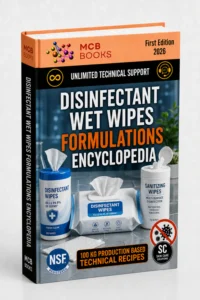
The DISINFECTANT WET WIPES FORMULATIONS ENCYCLOPEDIA provides practical technical information about active ingredients, supporting raw materials, manufacturing procedures, nonwoven selection, packaging, and quality control. It can assist manufacturers developing alcohol-based, alcohol-free, low-residue, heavy-duty, institutional, and industrial surface disinfectant wipes.
During manufacturing, purified water is transferred into a sanitized mixing tank. Water-soluble ingredients are incorporated under controlled agitation, followed by surfactants, active substances, solvents, pH regulators, and other functional additives. Volatile ingredients should be handled under suitable temperature and ventilation conditions. The finished solution should be homogeneous and free from unacceptable sedimentation, separation, discoloration, or odor changes.
The prepared liquid is tested for appearance, odor, pH, density, active ingredient concentration, chemical stability, and microbiological quality. The complete impregnated wipe must also undergo performance testing because the nonwoven material may influence active-ingredient retention and release.
Nonwoven fabric should provide sufficient absorbency, wet strength, abrasion performance, and controlled liquid delivery. Accurate impregnation is essential because each wipe must release enough solution to cover the intended area and keep it visibly wet for the required contact period. Larger surfaces may require more than one wipe.
Packaging may include canisters, soft packs, refill packs, buckets, or individually sealed sachets. It must prevent leakage, contamination, moisture loss, and active-ingredient evaporation throughout the product’s shelf life.
Commercial claims must be supported by recognized efficacy testing and the required market authorization. In the European regulatory system, products used to disinfect surfaces, materials, equipment, and furniture not intended for direct contact with food generally fall under Biocidal
The DISINFECTANT WET WIPES FORMULATIONS ENCYCLOPEDIA offers a professional starting point for developing effective surface disinfectant wipes. By combining compatible ingredients, validated efficacy, controlled production, appropriate fabric, protective packaging, and consistent quality testing, manufacturers can produce reliable and commercially competitive wipes for commercial and industrial cleaning applications.