 Commercial fertilizer production for drip irrigation systems is an important business opportunity in the modern agricultural industry. Farmers, greenhouse operators, fruit growers, nurseries, and hydroponic producers increasingly require highly soluble and technically reliable fertilizers that can be applied through fertigation systems. Manufacturers that use professional formulations, suitable raw materials, controlled production methods, and effective quality-control procedures can develop valuable products for this growing market.
Drip irrigation fertilizers are designed to deliver nutrients directly to the plant root zone through irrigation water. They may be produced as liquid concentrates, water-soluble powders, NPK fertilizers, micronutrient mixtures, calcium fertilizers, root-development products, flowering fertilizers, or high-potassium fruit-development formulas. Each product must dissolve efficiently and move through filters, pipes, and emitters without causing sediment, crystallization, or blockage.
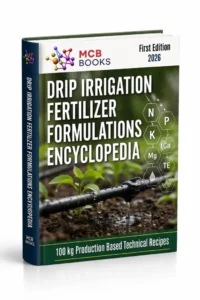
The Drip Irrigation Fertilizer Formulations Encyclopedia provides practical technical information for companies, entrepreneurs, investors, agricultural chemical producers, and professionals planning to manufacture commercial fertigation products. The book contains production-oriented fertilizer formulas, raw material functions, preparation methods, technical specifications, product characteristics, and application guidance.
The first step in commercial fertilizer development is identifying the target market and product purpose. Manufacturers should determine whether the fertilizer will be used for greenhouse vegetables, fruit trees, field crops, ornamental plants, nurseries, hydroponic systems, or general agricultural applications. The required nutrient ratio should then be selected according to crop needs and growth stages.
Nitrogen-rich fertilizers are commonly developed for vegetative growth, while phosphorus-rich products may support root development and early plant establishment. High-potassium formulations are generally preferred during flowering, fruit formation, ripening, and quality-development stages. Micronutrient fertilizers may contain iron, zinc, manganese, copper, boron, and molybdenum in mineral or chelated forms.
Raw material quality directly affects the performance of commercial fertilizer products. High-purity and highly soluble ingredients are preferred because insoluble impurities can reduce product stability and damage irrigation equipment. Common fertilizer raw materials include urea, potassium nitrate, calcium nitrate, monoammonium phosphate, monopotassium phosphate, magnesium sulfate, phosphoric acid, trace-element salts, chelating agents, organic acids, and purified water.
Chemical compatibility must be evaluated before production. Calcium compounds may react with phosphates or sulfates and form insoluble particles. Metal-based micronutrients may also react with carbonates, hydroxides, or phosphates. Incompatible components may need to be separated into different products or supplied through A and B fertilizer tanks.
The Drip Irrigation Fertilizer Formulations Encyclopedia helps manufacturers understand these compatibility principles and organize production according to professional technical requirements. Its standardized formulas can also simplify raw material calculations, batch planning, and the scaling of production from pilot batches to larger commercial quantities.
Liquid fertilizer manufacturing generally begins with the addition of purified water to a corrosion-resistant mixing tank. Raw materials are then added gradually under controlled agitation. Each ingredient should dissolve completely before the next component is introduced. Product temperature, pH, mixing speed, addition order, and dissolution time should be monitored throughout production.
Water-soluble powder fertilizers require accurate weighing, sieving, homogeneous blending, moisture control, and suitable packaging. Because many fertilizer salts are hygroscopic, poor storage conditions may cause caking and reduced flowability. Moisture-resistant packaging and technically appropriate anti-caking agents may therefore be necessary.
Commercial quality-control tests should include nutrient analysis, pH, density, electrical conductivity, appearance, solubility, dilution stability, moisture content, crystallization tendency, precipitation resistance, and storage stability. Manufacturers should also test products with different irrigation water samples before full-scale marketing.
The Drip Irrigation Fertilizer Formulations Encyclopedia can serve as a comprehensive production guide for businesses seeking to create stable, effective, and commercially applicable fertigation fertilizers. By combining professional formulations with controlled manufacturing and quality assurance, producers can expand their agricultural product range and meet the increasing demand for modern plant nutrition solutions.