Commercial production of EDTA chelated micronutrient fertilizers requires accurate formulations, suitable raw materials, controlled chelation procedures, reliable production equipment, and comprehensive quality-control systems. Iron, zinc, manganese, and copper are essential micronutrients that support chlorophyll formation, photosynthesis, enzyme activity, protein synthesis, root growth, flowering, and crop development. Chelation with EDTA helps maintain these metallic nutrients in stable and water-soluble forms suitable for professional agricultural applications.
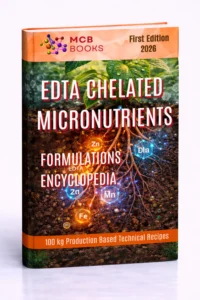
The EDTA CHELATED MICRONUTRIENTS FORMULATIONS ENCYCLOPEDIA is designed as a practical technical resource for fertilizer manufacturers, agricultural entrepreneurs, formulation specialists, and production managers. It supports the development of Fe-EDTA, Zn-EDTA, Mn-EDTA, Cu-EDTA, combined micronutrient blends, liquid concentrates, water-soluble powders, foliar products, fertigation fertilizers, and hydroponic nutrient components.
Raw-material selection is one of the most important stages of commercial production. Common materials include EDTA acid, disodium EDTA, tetrasodium EDTA, purified water, alkaline neutralizing agents, and suitable iron, zinc, manganese, or copper salts. The purity, assay, hydration form, moisture content, and solubility of each raw material must be considered during formulation calculations.
Production generally begins by adding clean water to a corrosion-resistant reaction vessel. The selected EDTA source is introduced under continuous agitation. When EDTA acid is used, a compatible alkaline agent may be added gradually to improve dissolution and establish the required reaction conditions. The selected micronutrient source is then incorporated slowly while pH, temperature, color, and solution clarity are monitored.
The EDTA-to-metal ratio must be calculated accurately. Insufficient EDTA may leave excessive free-metal ions and cause precipitation, sedimentation, or reduced stability. Excessive EDTA may increase production costs and alter the final fertilizer specification. Laboratory development and pilot-scale trials should therefore be completed before industrial manufacturing.
The EDTA CHELATED MICRONUTRIENTS FORMULATIONS ENCYCLOPEDIA can help producers establish standardized 100 kg formulas, ingredient functions, production sequences, pH controls, reaction conditions, and industrial scale-up procedures. Standardized formulas also simplify raw-material planning, batch costing, inventory control, and manufacturing documentation.
Liquid EDTA fertilizers should be filtered before packaging to remove insoluble particles that could block spray nozzles, irrigation filters, pipelines, or drip emitters. Powder products may require concentration, drying, grinding, sieving, cooling, and moisture-resistant packaging. The selected production method should provide good solubility, consistent nutrient concentration, and acceptable storage performance.
Quality-control testing should include appearance, color, odor, pH, density, total micronutrient content, chelated micronutrient percentage, free-metal concentration, solubility, insoluble matter, dilution stability, crystallization resistance, and storage stability. Powder fertilizers should also be tested for moisture, particle size, flowability, caking tendency, and dissolution time.
Commercial packaging must protect the fertilizer against moisture, contamination, sunlight, and extreme temperatures. Every package should include the nutrient declaration, application instructions, storage conditions, batch number, production date, and legally required safety information.
The EDTA CHELATED MICRONUTRIENTS FORMULATIONS ENCYCLOPEDIA provides a structured foundation for manufacturers seeking to produce stable and commercially valuable fertilizers. By combining technically correct formulations, controlled chelation, professional quality testing, and reliable packaging, producers can develop EDTA chelated micronutrient fertilizers for foliar spraying, fertigation, hydroponics, greenhouse cultivation, orchards, vegetables, and field crops.