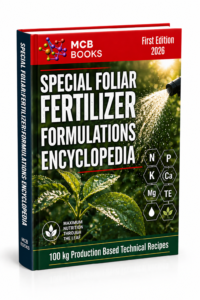
Standardized 100 kg micronutrient fertilizer formulas provide a practical foundation for professional and industrial fertilizer manufacturing. These formulations help producers calculate raw-material requirements, control production costs, maintain batch consistency, and scale validated products to larger manufacturing volumes. Micronutrient fertilizers commonly supply iron, zinc, manganese, copper, boron, molybdenum, and other trace elements required for healthy plant growth and crop development.

Although plants need micronutrients in relatively small amounts, deficiencies can reduce chlorophyll formation, photosynthesis, enzyme activity, root growth, flowering, fruit development, crop quality, and agricultural yield. For this reason, micronutrient fertilizer formulas must be designed carefully according to the target crop, application method, nutrient concentration, raw-material compatibility, and product form.
The MICRONUTRIENTS FERTILIZERS FORMULATIONS ENCYCLOPEDIA provides practical production concepts for liquid concentrates, water-soluble powders, suspension fertilizers, foliar sprays, fertigation products, hydroponic nutrients, chelated micronutrients, and multi-element fertilizer blends. Standardized 100 kg formulas can simplify raw-material purchasing, inventory management, production planning, quality control, and commercial scale-up.
Common raw materials used in micronutrient fertilizers include iron sulfate, zinc sulfate, manganese sulfate, copper sulfate, boric acid, boron ethanolamine, sodium borate, sodium molybdate, and ammonium molybdate. Chelating and complexing agents such as EDTA, DTPA, EDDHA, amino acids, lignosulfonates, and selected organic acids may also be included to improve nutrient solubility and stability.
Every ingredient quantity in a 100 kg formula must be calculated according to its purity, elemental nutrient content, hydration form, moisture level, and active concentration. Different grades of the same metallic salt may contain different percentages of the target nutrient. Manufacturers should therefore use supplier certificates of analysis when determining the required raw-material amounts.
Liquid micronutrient fertilizer production usually begins by adding clean, low-mineral water to a corrosion-resistant mixing tank. Agitation is started, and the raw materials are introduced gradually according to their solubility and compatibility. The pH, temperature, mixing speed, and order of addition should be controlled to prevent precipitation, sediment formation, crystallization, or colour changes.
Water-soluble powder formulations may be produced by dry blending compatible ingredients or by drying concentrated liquid products. Grinding, sieving, cooling, and moisture-resistant packaging may also be required. The finished powder should remain free-flowing, dissolve rapidly, and leave minimal insoluble residue.
A validated 100 kg formula can generally be converted into a 1,000 kg batch by multiplying each raw-material quantity by ten. However, industrial scale-up may require changes in mixing time, agitation efficiency, heating and cooling capacity, filtration rate, and raw-material addition speed. Pilot production should therefore be completed before full-scale manufacturing.
The MICRONUTRIENTS FERTILIZERS FORMULATIONS ENCYCLOPEDIA can help producers establish ingredient functions, production sequences, technical specifications, and quality-control procedures for professional fertilizer manufacturing. Each batch should be tested for appearance, pH, density, total nutrient content, water-soluble nutrient content, chelated nutrient percentage, solubility, sediment formation, dilution stability, moisture, particle size, and storage performance.
By combining accurate 100 kg formulas, compatible raw materials, controlled manufacturing procedures, reliable laboratory testing, and suitable packaging, manufacturers can develop stable and commercially valuable micronutrient fertilizers. The MICRONUTRIENTS FERTILIZERS FORMULATIONS ENCYCLOPEDIA provides a structured technical foundation for products intended for foliar spraying, fertigation, drip irrigation, hydroponic systems, greenhouse crops, orchards, vegetables, and field agriculture.