The quality and performance of amino acid organic fertilizers depend strongly on the raw materials used in their formulation. Commercial products may contain free amino acids, protein hydrolysates, peptides, organic nitrogen sources, humic substances, seaweed extracts, micronutrients, potassium compounds, organic acids, stabilizers, preservatives, and water. Understanding the function and compatibility of these ingredients is essential for developing stable and effective amino acid fertilizer formulations for professional agricultural production.
Free amino acids are among the most important components of amino acid organic fertilizers. They can be supplied individually or as complex mixtures obtained from protein hydrolysates. Amino acid sources may contribute organic nitrogen and other compounds used in plant nutrition and biostimulant formulations. Their concentration, solubility, origin, degree of hydrolysis, and overall quality can influence the physical and chemical properties of the finished fertilizer.
Protein hydrolysates are another major raw material category. They may contain free amino acids, short peptides, and soluble nitrogen-containing compounds. Depending on the production method, hydrolysates can vary considerably in amino acid profile, color, odor, pH, and concentration. Manufacturers should therefore select standardized raw materials to maintain consistent fertilizer quality between production batches.
Humic acid and fulvic acid are often incorporated into amino acid fertilizer formulations, particularly products intended for soil or root-zone application. These ingredients may complement plant nutrition programs and are frequently combined with amino acids in multifunctional fertilizers. Seaweed extracts can also be added to produce amino acid and seaweed biostimulant formulations designed for root development, vegetative growth, flowering, fruit production, or environmental stress management.
Micronutrients such as iron, zinc, manganese, boron, copper, and molybdenum may be included depending on the intended nutrient profile. Chelated or complexed micronutrients are commonly selected when improved solubility and formulation stability are required. Potassium sources may also be added to specialized products developed for flowering, fruit development, crop quality, or later stages of plant growth.
Organic acids can perform several technical functions within amino acid fertilizer formulations. They may be used for pH adjustment, nutrient compatibility, or stabilization. Wetting agents and surfactants may be incorporated into foliar products to improve spreading and coverage on plant surfaces. Stabilizers and suitable preservatives can help maintain product quality during storage, particularly in water-based formulations containing organic materials.
Water quality is equally important in liquid amino acid fertilizer production. Hardness, mineral content, pH, and microbial quality can affect solubility and storage stability. Manufacturers should therefore use water that meets suitable technical specifications.
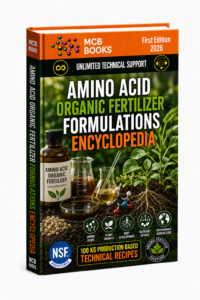
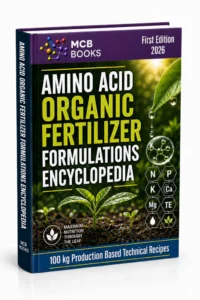
The AMINO ACID ORGANIC FERTILIZER FORMULATIONS ENCYCLOPEDIA provides practical information about amino acid fertilizer raw materials, their functions, formulation principles, production methods, manufacturing processes, and quality control. It is a useful reference for fertilizer manufacturers, formulators, agricultural companies, and entrepreneurs seeking to develop professional liquid amino acid fertilizers and organic plant nutrition products.