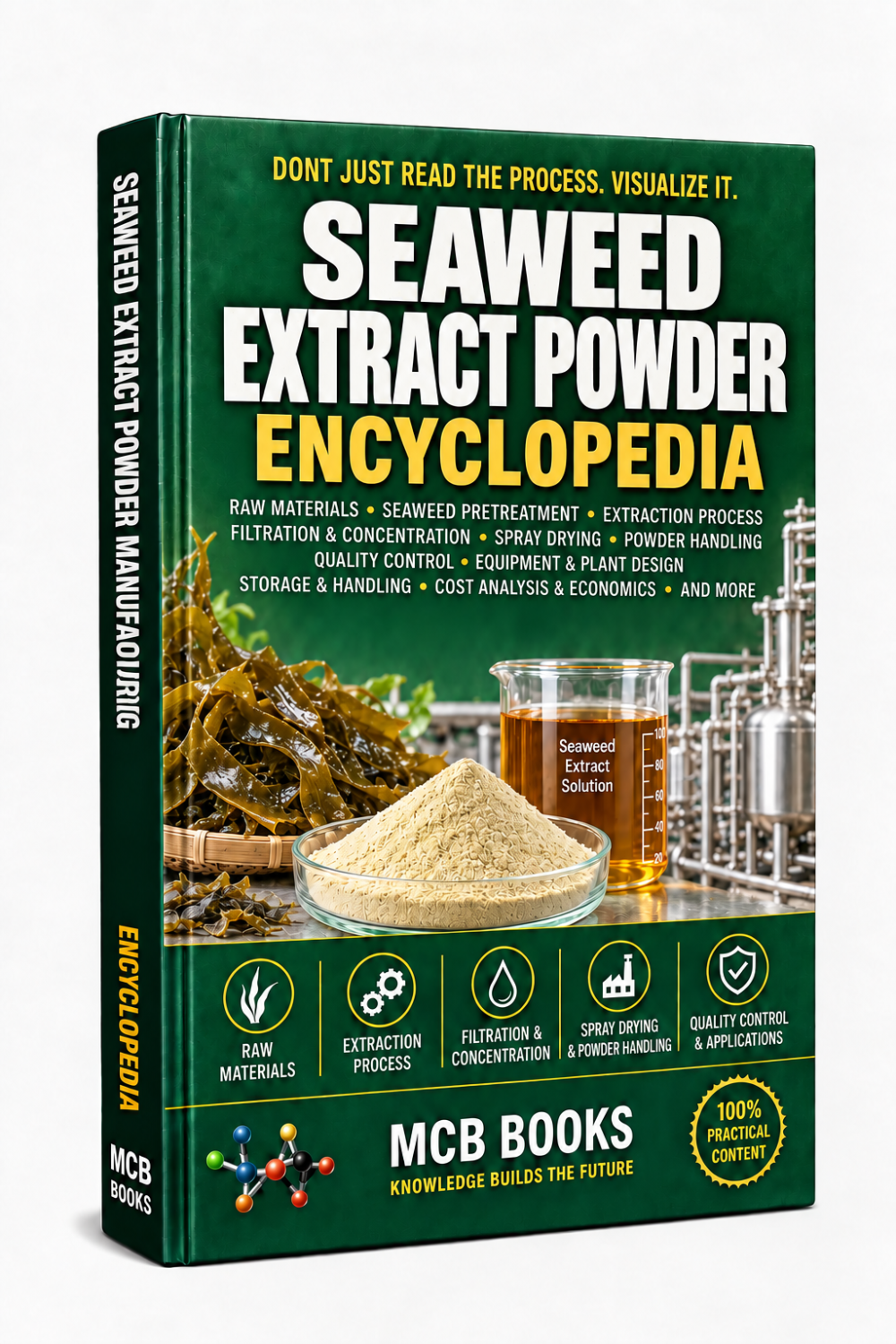
ALGINIC ACID POWDER MANUFACTURING ENCYCLOPEDIA
Book details
- Editor
- MCB BOOKS
- ISBN
- 978-625-91598-0-5
- Number of Pages
- 375 Pages
- Publication Date
- 2026
- Copyright
- MCB BOOKS
- Format
- Hard Book & E book (PDF)
- Language
- English
About the Encyclopedia
The ALGINIC ACID POWDER MANUFACTURING ENCYCLOPEDIA is a practical technical reference designed for manufacturers, engineers, technicians, formulators, and production professionals working with alginic acid and seaweed-derived materials. It covers major industrial production routes including brown seaweed extraction, sodium alginate conversion, acid precipitation, calcium alginate processing, direct acidification, purification, high-purity production, and fine milling. The encyclopedia also explains raw materials, process flow, quality control, product specifications, troubleshooting, and industrial equipment. It provides structured guidance for producing standard, food-grade, pharmaceutical-grade, purified, and high-purity alginic acid powder for different commercial and industrial applications.
Table of contents
01Page 1 Standard Alginic Acid Powder Manufacturing Process
- •Raw Materials And Process Flow
- •Production Process
- •Quality Control (QC)
- •Product Spesification
- •Product Characteristic
- •Troubleshooting
02Page 35 Brown Seaweed Extraction Alginic Acid Powder Manufacturing Process
- •Raw Materials And Process Flow
- •Production Process
- •Quality Control (QC)
- •Product Spesification
- •Product Characteristic
- •Troubleshooting
03Page 70 Sodium Alginate Conversion Alginic Acid Powder Manufacturing Process
- •Raw Materials And Process Flow
- •Production Process
- •Quality Control (QC)
- •Product Spesification
- •Product Characteristic
- •Troubleshooting
04Page 105 Acid Precipitation Alginic Acid Powder Manufacturing Process
- •Raw Materials And Process Flow
- •Production Process
- •Quality Control (QC)
- •Product Spesification
- •Product Characteristic
- •Troubleshooting
05Page 130 Calcium Alginate Intermediate Alginic Acid Powder Manufacturing Process
- •Raw Materials And Process Flow
- •Production Process
- •Quality Control (QC)
- •Product Spesification
- •Product Characteristic
- •Troubleshooting
06Page 175 Direct Acidification Alginic Acid Powder Manufacturing Process
- •Raw Materials And Process Flow
- •Production Process
- •Quality Control (QC)
- •Product Spesification
- •Product Characteristic
- •Troubleshooting
07Page 200 Purified Alginic Acid Powder Manufacturing Process
- •Raw Materials And Process Flow
- •Production Process
- •Quality Control (QC)
- •Product Spesification
- •Product Characteristic
- •Troubleshooting
08Page 225 High-Purity Alginic Acid Powder Manufacturing Process
- •Raw Materials And Process Flow
- •Production Process
- •Quality Control (QC)
- •Product Spesification
- •Product Characteristic
- •Troubleshooting
09Page 260 Food-Grade Alginic Acid Powder Manufacturing Process
- •Raw Materials And Process Flow
- •Production Process
- •Quality Control (QC)
- •Product Spesification
- •Product Characteristic
- •Troubleshooting
10Page 290 Pharmaceutical-Grade Alginic Acid Powder Manufacturing Process
- •Raw Materials And Process Flow
- •Production Process
- •Quality Control (QC)
- •Product Spesification
- •Product Characteristic
- •Troubleshooting
11Page 320 Fine-Milled Alginic Acid Powder Manufacturing Process
- •Raw Materials And Process Flow
- •Production Process
- •Quality Control (QC)
- •Product Spesification
- •Product Characteristic
- •Troubleshooting
12Page 350 Machinery and Equipment Used in Alginic Acid Powder Manufacturing
- •Brown Seaweed Washing System
- •Seaweed Cutting Machine
- •Extraction Tank
- •Alkali Extraction Reactor
- •Agitated Mixing Tank
- •Solid-Liquid Separation Unit
- •Rotary Drum Filter
- •Filter Press
- •Clarification Tank
- •Acidification Tank
- •Precipitation Reactor
- •Calcium Alginate Conversion Tank
- •Washing Tank
- •Neutralization Tank
- •Dewatering Centrifuge
- •Vacuum Filter
- •Tray Dryer
- •Vacuum Dryer
- •Fluid Bed Dryer
- •Hammer Mill
- •Pin Mill
- •Fine Grinding Machine
- •Vibrating Screening Machine
- •Powder Blender
- •Dust Collection System
- •Powder Storage Silo
- •Automatic Filling Machine
- •Packaging Machine
- •Laboratory and Quality Control Equipment
More about this book
What's Inside the Encyclopedia
The ALGINIC ACID POWDER MANUFACTURING ENCYCLOPEDIA includes practical information covering the main stages of industrial alginic acid production. Readers will find guidance on seaweed raw materials, pretreatment, alkaline extraction, solid-liquid separation, filtration, precipitation, purification, washing, dewatering, drying, milling, and powder finishing. The encyclopedia also explains different production methods, process flow, quality control, product specifications, common production problems, and troubleshooting. Its content is designed to give manufacturers, engineers, technicians, and entrepreneurs a clear understanding of how alginic acid powder is produced and controlled from raw material preparation to the finished product.
Why This Encyclopedia
The ALGINIC ACID POWDER MANUFACTURING ENCYCLOPEDIA is designed to make industrial production easier to understand and apply. Instead of focusing only on theory, it explains the production stages in a practical and structured way, from raw material preparation to the finished alginic acid powder. The processes are presented with clear production flow, quality control points, product specifications, and troubleshooting guidance. It is a useful reference for manufacturers, engineers, technicians, and entrepreneurs who want to understand different alginic acid production methods, improve process control, reduce production problems, and develop consistent product quality.
Manufacturing Methods
The ALGINIC ACID POWDER MANUFACTURING ENCYCLOPEDIA explains major industrial production methods including brown seaweed extraction, sodium alginate conversion, acid precipitation, calcium alginate intermediate processing, direct acidification, purification, drying, and fine milling. Each method focuses on raw material preparation, extraction, separation, washing, precipitation, dewatering, drying, grinding, and final product handling. The encyclopedia also addresses quality control, product specifications, troubleshooting, and equipment selection for standard, purified, food-grade, pharmaceutical-grade, and high-purity alginic acid powder manufacturing.
Troubleshooting
The ALGINIC ACID POWDER MANUFACTURING ENCYCLOPEDIA includes practical troubleshooting guidance for common production problems such as low extraction yield, incomplete precipitation, poor filtration, excessive moisture, dark color, high ash content, inconsistent purity, difficult dewatering, and unstable powder quality. It helps manufacturers evaluate possible causes related to seaweed quality, extraction conditions, pH control, acidification, washing, drying, and milling. Effective troubleshooting supports better process consistency, reduced production losses, improved purification efficiency, and reliable alginic acid powder quality for food, pharmaceutical, technical, and industrial applications.
Unlimited Technical Support
With the ALGINIC ACID POWDER MANUFACTURING ENCYCLOPEDIA, readers can receive technical support from the MCB BOOKS TEAM whenever additional guidance is needed. Support may include questions about brown seaweed extraction, sodium alginate conversion, acid precipitation, calcium alginate processing, purification, dewatering, drying, milling, quality control, product specifications, equipment selection, and troubleshooting. This technical support helps manufacturers, engineers, technicians, and production teams better understand alginic acid powder manufacturing processes and evaluate practical production challenges.
Featured Articles
How Is Alginic Acid Powder Manufactured? Industrial Production Process Explained
Alginic acid powder is mainly produced from brown seaweed through a sequence of extraction, separation, precipitation, washing, drying, and milling steps. The seaweed is first cleaned and prepared before alkaline extraction converts alginate compounds into a soluble form. After solid-liquid separation, the alginate solution is acidified to precipitate alginic acid. The precipitated material is washed, dewatered, dried, and milled into powder. Careful control of extraction efficiency, pH, washing, moisture, and particle size helps manufacturers achieve consistent alginic acid quality.
Related Tags: Alginic Acid Powder Manufacturing, Alginic Acid Production Process, Brown Seaweed Extraction, Alginate Manufacturing, Alginic Acid Processing, Seaweed Processing, Alginic Acid Powder Production, Industrial Alginic Acid, Alginate Extraction
Alginic Acid Powder Manufacturing Methods: Brown Seaweed Extraction, Precipitation and Purification
Industrial alginic acid powder manufacturing commonly begins with brown seaweed extraction to recover alginate compounds from the plant material. After extraction, insoluble residues are removed by filtration or separation. The clarified alginate solution is then treated under acidic conditions to precipitate alginic acid. Purification may include repeated washing, clarification, and removal of mineral residues or unwanted salts. The purified alginic acid is dewatered, dried, ground, and screened. These steps are important for producing stable powder with controlled purity, ash content, moisture, and particle size.
Related Tags: Alginic Acid Manufacturing Methods, Brown Seaweed Extraction, Alginic Acid Precipitation, Alginic Acid Purification, Alginate Processing, Seaweed Extraction Process, Alginic Acid Powder, Industrial Alginate Production, Alginic Acid Refining
Sodium Alginate Conversion to Alginic Acid Powder: Process, Drying and Quality Control
Sodium alginate can be converted into alginic acid through controlled acidification and precipitation. The sodium alginate solution is treated with a suitable acid so that insoluble alginic acid forms and separates from the liquid phase. The precipitated material is then washed to reduce residual salts and impurities before dewatering. Drying is carried out under controlled conditions to achieve the required moisture level without damaging product quality. Final milling and screening provide a uniform powder. Quality control typically evaluates purity, moisture, ash content, color, and particle size.
Related Tags: Sodium Alginate Conversion, Alginic Acid from Sodium Alginate, Alginic Acid Drying, Alginic Acid Quality Control, Alginate Conversion Process, Alginic Acid Powder Production, Sodium Alginate Processing, Alginic Acid Precipitation
High-Purity Alginic Acid Powder Production: Washing, Dewatering, Drying and Fine Milling
High-purity alginic acid powder production requires careful control of washing, dewatering, drying, and fine milling after precipitation. Washing helps remove residual salts, soluble impurities, and unwanted mineral components from the alginic acid precipitate. Efficient dewatering reduces the moisture load before drying and improves processing efficiency. Controlled drying helps protect product color and chemical quality, while fine milling produces a uniform powder with the desired particle size distribution. Final screening and quality testing help ensure consistent purity, moisture, ash content, and appearance.
Related Tags: High Purity Alginic Acid, Alginic Acid Washing, Alginic Acid Dewatering, Alginic Acid Drying, Fine Milled Alginic Acid, Alginic Acid Purification, High Purity Alginate, Alginic Acid Powder Processing, Alginate Quality Control
Alginic Acid Powder Manufacturing Troubleshooting: Common Problems and Process Solutions
Alginic acid powder manufacturing may encounter problems such as low extraction yield, incomplete precipitation, difficult filtration, excessive moisture, high ash content, dark color, poor drying, and inconsistent particle size. These issues may result from seaweed quality, extraction conditions, incorrect pH adjustment, insufficient washing, inefficient dewatering, or unsuitable drying conditions. Systematic monitoring of extraction, clarification, acidification, washing, drying, and milling stages helps identify process deviations. Effective troubleshooting improves product consistency, reduces production losses, and supports more reliable alginic acid powder quality.
Related Tags: Alginic Acid Troubleshooting, Alginic Acid Manufacturing Problems, Low Alginate Yield, Alginic Acid Filtration Problems, Alginic Acid Drying Problems, High Ash Alginic Acid, Alginate Process Control, Alginic Acid Quality Problems, Alginic Acid Process Solutions
Why Choose This Encyclopedia
ALGINIC ACID POWDER MANUFACTURING ENCYCLOPEDIA is prepared for manufacturers, formulators and R&D teams who want to produce commercially, not only to read about chemistry. Every product in the book follows the same structure: raw materials with their functions and quantities; the complete production process with charging order, mixing, temperature and control points; product specifications; and troubleshooting guidance that links common production problems to their causes.
The recipes are written as tested starting points: reproduce them at laboratory scale, confirm the specification, then scale up to pilot and full production. Readers planning a new line often combine this book with PROTEIN HYDROLYSATE MANUFACTURING ENCYCLOPEDIA, and our free articles offer further technical background.
Every MCB Books encyclopedia is available as a hard book and PDF — the PDF is delivered instantly, the printed edition ships worldwide — and all purchases include unlimited technical support. Questions before ordering? Contact the MCB Books team or write to us on WhatsApp; we reply the same day.
Related books