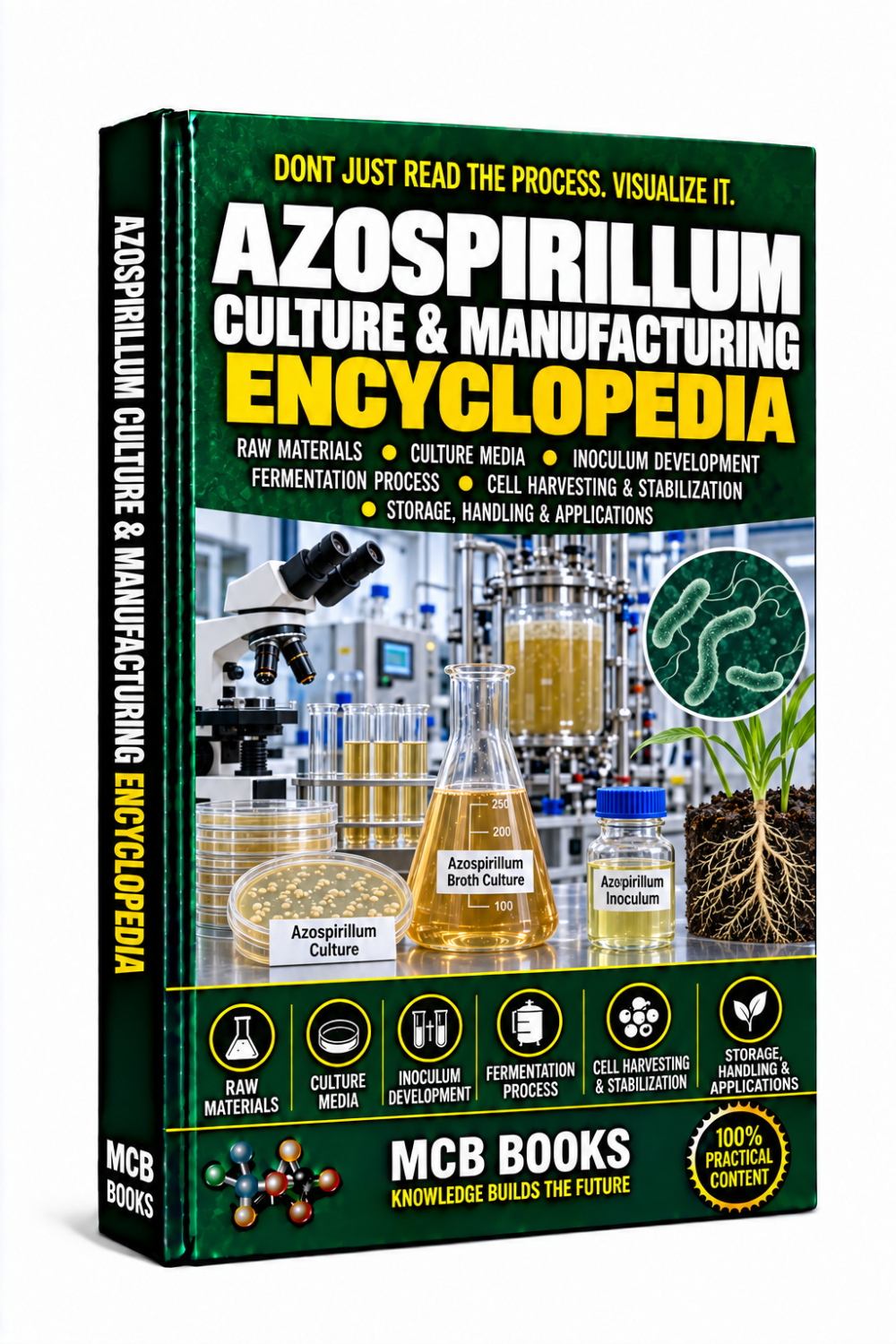
AZOTOBACTER CULTURE & MANUFACTURING ENCYCLOPEDIA
Book details
- Editor
- MCB BOOKS
- ISBN
- 978-605-88350-0-9
- Number of Pages
- 250 Pages
- Publication Date
- 2026
- Copyright
- MCB BOOKS
- Format
- Hard Book & E book (PDF)
- Language
- English
About the Encyclopedia
AZOTOBACTER CULTURE & MANUFACTURING ENCYCLOPEDIA is a practical technical reference focused on the cultivation and production of Azotobacter microorganisms for industrial and agricultural applications. The book covers strain selection, culture media preparation, inoculum development, seed culture propagation, fermentation, biomass production, cell harvesting, concentration, stabilization, storage, and quality control. It also introduces the machinery and equipment commonly used throughout Azotobacter production. Designed for manufacturers, researchers, formulation specialists, and biotechnology professionals, this encyclopedia provides a structured overview of the complete production workflow, helping readers better understand how Azotobacter cultures are developed, processed, stabilized, and prepared for further use in microbial products.
Table of contents
01Page 1 Azotobacter Strain Selection, Culture Media Preparation and Inoculum Development
- •Raw Materials And Process Flow
- •Production Process
- •Quality Control (QC)
- •Product Specification
- •Product Characteristic
- •Troubleshooting
02Page 45 Azotobacter Seed Culture Preparation and Biomass Propagation Process
- •Raw Materials And Process Flow
- •Production Process
- •Quality Control (QC)
- •Product Specification
- •Product Characteristic
- •Troubleshooting
03Page 90 Azotobacter Fermentation, Cell Growth and Biomass Production Process
- •Raw Materials And Process Flow
- •Production Process
- •Quality Control (QC)
- •Product Specification
- •Product Characteristic
- •Troubleshooting
04Page 130 Azotobacter Cell Harvesting, Concentration, Stabilization and Storage Process
- •Raw Materials And Process Flow
- •Production Process
- •Quality Control (QC)
- •Product Specification
- •Product Characteristic
- •Troubleshooting
05Page 185 Machinery and Equipment Used in Azotobacter Culture and Manufacturing
- •Culture Media Preparation Equipment
- •Inoculum Development Equipment
- •Fermentation Equipment
- •Cell Harvesting and Concentration Equipment
- •Stabilization and Storage Equipment
- •Laboratory and Quality Control Equipment
More about this book
What's Inside the Encyclopedia
The Azotobacter Culture & Manufacturing Encyclopedia provides practical technical information on Azotobacter production from culture development to stabilized microbial material. It covers strain selection, culture media preparation, inoculum development, seed culture propagation, fermentation, biomass production, cell harvesting, concentration, stabilization, storage, quality control, and production equipment. Designed for biotechnology professionals and microbial product manufacturers, the encyclopedia presents a structured overview of industrial Azotobacter cultivation and manufacturing processes for agricultural and commercial applications.
Why This Encyclopedia
The Azotobacter Culture & Manufacturing Encyclopedia is designed to provide a clear and practical reference for understanding industrial Azotobacter production. It brings together key information on culture media, inoculum development, fermentation, biomass production, stabilization, storage, quality control, and processing equipment. By organizing the complete manufacturing workflow in one technical resource, the encyclopedia helps biotechnology professionals, microbial product manufacturers, researchers, and agricultural input producers better understand and develop reliable Azotobacter culture production systems.
Manufacturing Methods
The Azotobacter Culture & Manufacturing Encyclopedia explains the main manufacturing methods used for industrial Azotobacter culture production. It covers culture media preparation, inoculum development, seed culture propagation, controlled fermentation, biomass growth, cell harvesting, concentration, stabilization, and storage. The content focuses on practical production workflows, process control, contamination management, and quality requirements. It is designed to help biotechnology professionals and microbial product manufacturers understand reliable Azotobacter manufacturing methods for agricultural and commercial microbial applications.
Troubleshooting
The Azotobacter Culture & Manufacturing Encyclopedia includes practical troubleshooting guidance for common problems encountered during Azotobacter production. It addresses contamination risks, weak microbial growth, low biomass yield, unstable fermentation conditions, culture media imbalance, poor inoculum performance, cell recovery difficulties, and storage-related viability losses. The troubleshooting section helps biotechnology professionals and microbial manufacturers identify process deviations, understand possible causes, and improve production consistency, culture stability, quality control, and overall Azotobacter manufacturing performance.
Unlimited Technical Support
The Azotobacter Culture & Manufacturing Encyclopedia is supported by the MCB BOOKS TEAM with unlimited technical assistance whenever needed. Readers can receive expert guidance on Azotobacter culture development, media preparation, inoculum production, fermentation, biomass recovery, stabilization, process control, equipment selection, and quality issues. This technical support helps manufacturers and biotechnology professionals better understand production challenges, evaluate process problems, and improve the consistency and reliability of their Azotobacter manufacturing operations.
Featured Articles
How Is Azotobacter Cultured for Industrial Production?
Azotobacter culture production begins with suitable strain selection and controlled preparation of nutrient-rich culture media. The microorganism is first developed through laboratory-scale inoculum stages before being transferred into larger fermentation systems. Temperature, pH, aeration, agitation, nutrient balance, and contamination control directly affect microbial growth and biomass yield. Industrial Azotobacter manufacturing also requires careful monitoring of culture purity, viable cell concentration, and process stability. Proper control of each production stage helps manufacturers obtain concentrated and stable Azotobacter cultures suitable for further processing and use in agricultural microbial products.
Related Tags: Azotobacter culture, Azotobacter production, Azotobacter manufacturing, microbial fermentation, bacterial culture, biofertilizer bacteria, microbial biomass, industrial microbiology
Azotobacter Culture Media Preparation and Inoculum Development
Culture media preparation is one of the most important stages in Azotobacter manufacturing. The medium must provide suitable carbon sources, minerals, trace nutrients, and other components required for effective bacterial growth. After sterilization, a pure Azotobacter culture is transferred through controlled inoculum development stages to generate sufficient biomass for fermentation. Strong inoculum quality supports faster growth, better fermentation performance, and improved production consistency. Careful control of media composition, sterilization, pH, temperature, and aseptic handling helps reduce contamination risks and supports reliable industrial Azotobacter culture production.
Related Tags: Azotobacter culture media, inoculum development, bacterial inoculum, microbial culture media, Azotobacter fermentation, bacterial propagation, industrial bacterial culture, microbiology manufacturing
Industrial Azotobacter Fermentation and Biomass Production
Industrial Azotobacter fermentation is designed to maximize viable bacterial biomass under controlled production conditions. Prepared inoculum is transferred into a sterilized fermenter containing suitable culture medium. During fermentation, aeration, agitation, dissolved oxygen, temperature, pH, nutrient availability, and foam formation must be carefully controlled. Because Azotobacter is an aerobic microorganism, oxygen transfer plays an important role in successful biomass development. Regular sampling and quality checks help monitor growth and culture purity. Effective fermentation management improves viable cell concentration, process consistency, and overall performance of industrial Azotobacter manufacturing.
Related Tags: Azotobacter fermentation, biomass production, bacterial fermentation, industrial fermentation, microbial biomass, aerobic fermentation, Azotobacter manufacturing, fermentation technology
Azotobacter Cell Harvesting, Concentration and Stabilization Process
After fermentation, Azotobacter biomass may require harvesting, concentration, and stabilization depending on the intended downstream application. Separation and concentration methods are selected to preserve viable bacterial cells while reducing unnecessary liquid volume. Stabilization can involve protective carriers, suitable additives, controlled cooling, drying approaches, or liquid preservation systems. The objective is to maintain microbial viability and product stability during handling and storage. Proper processing conditions are essential because excessive temperature, mechanical stress, unsuitable pH, or prolonged storage can reduce cell survival. Effective stabilization supports consistent Azotobacter culture quality.
Related Tags: Azotobacter harvesting, cell concentration, microbial stabilization, bacterial biomass recovery, Azotobacter storage, microbial viability, downstream processing, bacterial culture stabilization
Machinery and Equipment Used in Azotobacter Manufacturing
Azotobacter manufacturing requires specialized equipment for culture preparation, fermentation, biomass handling, and quality control. Typical systems include culture media preparation tanks, sterilization units, seed fermenters, production fermenters, aeration systems, agitators, pumps, filtration equipment, centrifuges, storage tanks, and laboratory instruments. Equipment must support hygienic operation, contamination prevention, accurate process control, and reproducible production conditions. Instrumentation for temperature, pH, dissolved oxygen, pressure, and agitation monitoring is especially important during fermentation. Correct equipment selection and maintenance help improve production efficiency, microbial quality, process reliability, and industrial-scale Azotobacter manufacturing performance.
Related Tags: Azotobacter equipment, fermentation equipment, microbial production equipment, bioreactor, seed fermenter, bacterial manufacturing equipment, industrial microbiology, Azotobacter production line
Why Choose This Encyclopedia
AZOTOBACTER CULTURE & MANUFACTURING ENCYCLOPEDIA is prepared for manufacturers, formulators and R&D teams who want to produce commercially, not only to read about chemistry. Every product in the book follows the same structure: raw materials with their functions and quantities; the complete production process with charging order, mixing, temperature and control points; product specifications; and troubleshooting guidance that links common production problems to their causes.
The recipes are written as tested starting points: reproduce them at laboratory scale, confirm the specification, then scale up to pilot and full production. Readers planning a new line often combine this book with our other encyclopedias, and our free articles offer further technical background.
Every MCB Books encyclopedia is available as a hard book and PDF — the PDF is delivered instantly, the printed edition ships worldwide — and all purchases include unlimited technical support. Questions before ordering? Contact the MCB Books team or write to us on WhatsApp; we reply the same day.