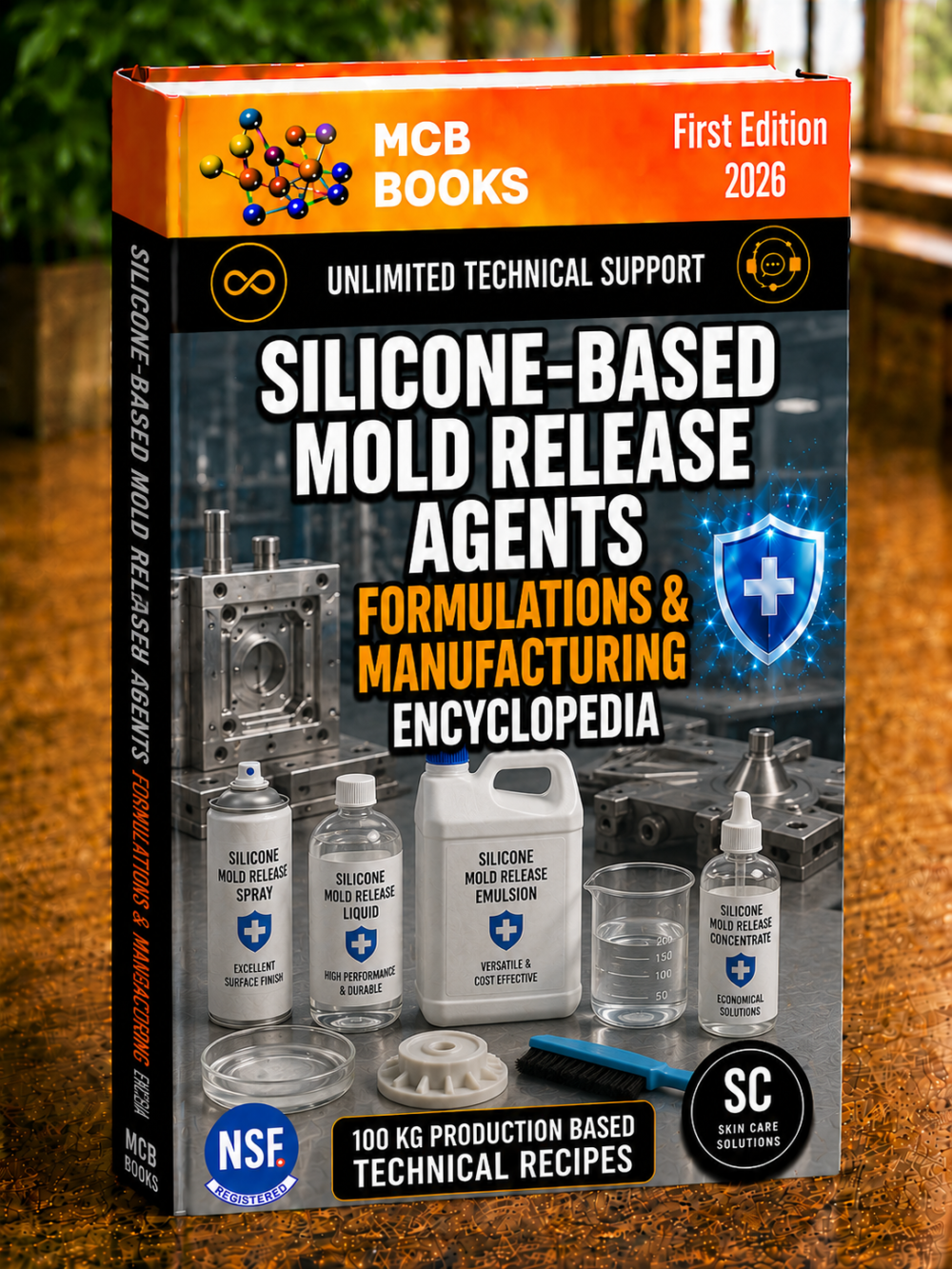
COMPOSITE MOLD RELEASE AGENTS FORMULATIONS & MANUFACTURING ENCYCLOPEDIA
Book details
- Editor
- MCB BOOKS
- ISBN
- 978-9944-0292-8-5
- Number of Pages
- 340 Pages
- Publication Date
- 2026
- Copyright
- MCB BOOKS
- Format
- Hard Book & E book (PDF)
- Language
- English
About the Encyclopedia
The Composite Mold Release Agents Formulations & Manufacturing Encyclopedia is a practical technical reference for manufacturers and formulators developing release agents for composite molding applications.
It brings together composite mold release agent formulations, raw material information and manufacturing methods for fiberglass, carbon fiber, epoxy, polyester, vinyl ester and other composite systems.
The encyclopedia covers conventional and advanced release technologies, including silicone, semi-permanent, permanent, water-based, solvent-based, PTFE and fluoropolymer systems.
It is suitable for chemical manufacturers, composite-industry suppliers and private-label producers developing release products for industrial composite processing.
Table of contents
01Page 1 Contents 200 formulations · 1–320
- 1Silicone Composite Mold Release Agent Formulation and Industrial Production Process 1
- 3Silicone Composite Mold Release Agent Formulation and Industrial Production Process 2
- 5Silicone Composite Mold Release Agent Formulation and Industrial Production Process 3
- 7Silicone Composite Mold Release Agent Special Specification
- 8Silicone Composite Mold Release Agent Technical Properties and Usage
- 9Semi-Permanent Composite Mold Release Agent Formulation and Industrial Production Process 1
- 11Semi-Permanent Composite Mold Release Agent Formulation and Industrial Production Process 2
- 13Semi-Permanent Composite Mold Release Agent Formulation and Industrial Production Process 3
- 15Semi-Permanent Composite Mold Release Agent Special Specification
- 16Semi-Permanent Composite Mold Release Agent Technical Properties and Usage
- 17Permanent Composite Mold Release Agent Formulation and Industrial Production Process 1
- 19Permanent Composite Mold Release Agent Formulation and Industrial Production Process 2
- 21Permanent Composite Mold Release Agent Formulation and Industrial Production Process 3
- 23Permanent Composite Mold Release Agent Special Specification
- 24Permanent Composite Mold Release Agent Technical Properties and Usage
- 25Water-Based Composite Mold Release Agent Formulation and Industrial Production Process 1
- 27Water-Based Composite Mold Release Agent Formulation and Industrial Production Process 2
- 29Water-Based Composite Mold Release Agent Formulation and Industrial Production Process 3
- 31Water-Based Composite Mold Release Agent Special Specification
- 32Water-Based Composite Mold Release Agent Technical Properties and Usage
- 33Solvent-Based Composite Mold Release Agent Formulation and Industrial Production Process 1
- 35Solvent-Based Composite Mold Release Agent Formulation and Industrial Production Process 2
- 37Solvent-Based Composite Mold Release Agent Formulation and Industrial Production Process 3
- 39Solvent-Based Composite Mold Release Agent Special Specification
- 40Solvent-Based Composite Mold Release Agent Technical Properties and Usage
- 41PTFE Composite Mold Release Agent Formulation and Industrial Production Process 1
- 43PTFE Composite Mold Release Agent Formulation and Industrial Production Process 2
- 45PTFE Composite Mold Release Agent Formulation and Industrial Production Process 3
- 47PTFE Composite Mold Release Agent Special Specification
- 48PTFE Composite Mold Release Agent Technical Properties and Usage
- 49Fluoropolymer Composite Mold Release Agent Formulation and Industrial Production Process 1
- 51Fluoropolymer Composite Mold Release Agent Formulation and Industrial Production Process 2
- 53Fluoropolymer Composite Mold Release Agent Formulation and Industrial Production Process 3
- 55Fluoropolymer Composite Mold Release Agent Special Specification
- 56Fluoropolymer Composite Mold Release Agent Technical Properties and Usage
- 57High Temperature Composite Mold Release Agent Formulation and Industrial Production Process 1
- 59High Temperature Composite Mold Release Agent Formulation and Industrial Production Process 2
- 61High Temperature Composite Mold Release Agent Formulation and Industrial Production Process 3
- 63High Temperature Composite Mold Release Agent Special Specification
- 64High Temperature Composite Mold Release Agent Technical Properties and Usage
- 65Carbon Fiber Composite Mold Release Agent Formulation and Industrial Production Process 1
- 67Carbon Fiber Composite Mold Release Agent Formulation and Industrial Production Process 2
- 69Carbon Fiber Composite Mold Release Agent Formulation and Industrial Production Process 3
- 71Carbon Fiber Composite Mold Release Agent Special Specification
- 72Carbon Fiber Composite Mold Release Agent Technical Properties and Usage
- 73Fiberglass Composite Mold Release Agent Formulation and Industrial Production Process 1
- 75Fiberglass Composite Mold Release Agent Formulation and Industrial Production Process 2
- 77Fiberglass Composite Mold Release Agent Formulation and Industrial Production Process 3
- 79Fiberglass Composite Mold Release Agent Special Specification
- 80Fiberglass Composite Mold Release Agent Technical Properties and Usage
- 81Epoxy Composite Mold Release Agent Formulation and Industrial Production Process 1
- 83Epoxy Composite Mold Release Agent Formulation and Industrial Production Process 2
- 85Epoxy Composite Mold Release Agent Formulation and Industrial Production Process 3
- 87Epoxy Composite Mold Release Agent Special Specification
- 88Epoxy Composite Mold Release Agent Technical Properties and Usage
- 89Polyester Composite Mold Release Agent Formulation and Industrial Production Process 1
- 91Polyester Composite Mold Release Agent Formulation and Industrial Production Process 2
- 93Polyester Composite Mold Release Agent Formulation and Industrial Production Process 3
- 95Polyester Composite Mold Release Agent Special Specification
- 96Polyester Composite Mold Release Agent Technical Properties and Usage
- 97Vinyl Ester Composite Mold Release Agent Formulation and Industrial Production Process 1
- 99Vinyl Ester Composite Mold Release Agent Formulation and Industrial Production Process 2
- 101Vinyl Ester Composite Mold Release Agent Formulation and Industrial Production Process 3
- 103Vinyl Ester Composite Mold Release Agent Special Specification
- 104Vinyl Ester Composite Mold Release Agent Technical Properties and Usage
- 105Gel Coat Mold Release Agent Formulation and Industrial Production Process 1
- 107Gel Coat Mold Release Agent Formulation and Industrial Production Process 2
- 109Gel Coat Mold Release Agent Formulation and Industrial Production Process 3
- 111Gel Coat Mold Release Agent Special Specification
- 112Gel Coat Mold Release Agent Technical Properties and Usage
- 113Vacuum Infusion Mold Release Agent Formulation and Industrial Production Process 1
- 115Vacuum Infusion Mold Release Agent Formulation and Industrial Production Process 2
- 117Vacuum Infusion Mold Release Agent Formulation and Industrial Production Process 3
- 119Vacuum Infusion Mold Release Agent Special Specification
- 120Vacuum Infusion Mold Release Agent Technical Properties and Usage
- 121Resin Transfer Molding (RTM) Release Agent Formulation and Industrial Production Process 1
- 123Resin Transfer Molding (RTM) Release Agent Formulation and Industrial Production Process 2
- 125Resin Transfer Molding (RTM) Release Agent Formulation and Industrial Production Process 3
- 127Resin Transfer Molding (RTM) Release Agent Special Specification
- 128Resin Transfer Molding (RTM) Release Agent Technical Properties and Usage
- 129Hand Lay-Up Composite Mold Release Agent Formulation and Industrial Production Process 1
- 131Hand Lay-Up Composite Mold Release Agent Formulation and Industrial Production Process 2
- 133Hand Lay-Up Composite Mold Release Agent Formulation and Industrial Production Process 3
- 135Hand Lay-Up Composite Mold Release Agent Special Specification
- 136Hand Lay-Up Composite Mold Release Agent Technical Properties and Usage
- 137Compression Molding Composite Release Agent Formulation and Industrial Production Process 1
- 139Compression Molding Composite Release Agent Formulation and Industrial Production Process 2
- 141Compression Molding Composite Release Agent Formulation and Industrial Production Process 3
- 143Compression Molding Composite Release Agent Special Specification
- 144Compression Molding Composite Release Agent Technical Properties and Usage
- 145Aerospace Composite Mold Release Agent Formulation and Industrial Production Process 1
- 147Aerospace Composite Mold Release Agent Formulation and Industrial Production Process 2
- 149Aerospace Composite Mold Release Agent Formulation and Industrial Production Process 3
- 151Aerospace Composite Mold Release Agent Special Specification
- 152Aerospace Composite Mold Release Agent Technical Properties and Usage
- 153Marine Composite Mold Release Agent Formulation and Industrial Production Process 1
- 155Marine Composite Mold Release Agent Formulation and Industrial Production Process 2
- 157Marine Composite Mold Release Agent Formulation and Industrial Production Process 3
- 159Marine Composite Mold Release Agent Special Specification
- 160Marine Composite Mold Release Agent Technical Properties and Usage
- 161Wind Turbine Blade Mold Release Agent Formulation and Industrial Production Process 1
- 163Wind Turbine Blade Mold Release Agent Formulation and Industrial Production Process 2
- 165Wind Turbine Blade Mold Release Agent Formulation and Industrial Production Process 3
- 167Wind Turbine Blade Mold Release Agent Special Specification
- 168Wind Turbine Blade Mold Release Agent Technical Properties and Usage
- 169Automotive Composite Mold Release Agent Formulation and Industrial Production Process 1
- 171Automotive Composite Mold Release Agent Formulation and Industrial Production Process 2
- 173Automotive Composite Mold Release Agent Formulation and Industrial Production Process 3
- 175Automotive Composite Mold Release Agent Special Specification
- 176Automotive Composite Mold Release Agent Technical Properties and Usage
- 177Sporting Goods Composite Mold Release Agent Formulation and Industrial Production Process 1
- 179Sporting Goods Composite Mold Release Agent Formulation and Industrial Production Process 2
- 181Sporting Goods Composite Mold Release Agent Formulation and Industrial Production Process 3
- 183Sporting Goods Composite Mold Release Agent Special Specification
- 184Sporting Goods Composite Mold Release Agent Technical Properties and Usage
- 185FRP Mold Release Agent Formulation and Industrial Production Process 1
- 187FRP Mold Release Agent Formulation and Industrial Production Process 2
- 189FRP Mold Release Agent Formulation and Industrial Production Process 3
- 191FRP Mold Release Agent Special Specification
- 192FRP Mold Release Agent Technical Properties and Usage
- 193Boat Hull Mold Release Agent Formulation and Industrial Production Process 1
- 195Boat Hull Mold Release Agent Formulation and Industrial Production Process 2
- 197Boat Hull Mold Release Agent Formulation and Industrial Production Process 3
- 199Boat Hull Mold Release Agent Special Specification
- 200Boat Hull Mold Release Agent Technical Properties and Usage
- 201Composite Pipe Mold Release Agent Formulation and Industrial Production Process 1
- 203Composite Pipe Mold Release Agent Formulation and Industrial Production Process 2
- 205Composite Pipe Mold Release Agent Formulation and Industrial Production Process 3
- 207Composite Pipe Mold Release Agent Special Specification
- 208Composite Pipe Mold Release Agent Technical Properties and Usage
- 209Composite Panel Mold Release Agent Formulation and Industrial Production Process 1
- 211Composite Panel Mold Release Agent Formulation and Industrial Production Process 2
- 213Composite Panel Mold Release Agent Formulation and Industrial Production Process 3
- 215Composite Panel Mold Release Agent Special Specification
- 216Composite Panel Mold Release Agent Technical Properties and Usage
- 217High Gloss Composite Mold Release Agent Formulation and Industrial Production Process 1
- 219High Gloss Composite Mold Release Agent Formulation and Industrial Production Process 2
- 221High Gloss Composite Mold Release Agent Formulation and Industrial Production Process 3
- 223High Gloss Composite Mold Release Agent Special Specification
- 224High Gloss Composite Mold Release Agent Technical Properties and Usage
- 225Low Residue Composite Mold Release Agent Formulation and Industrial Production Process 1
- 227Low Residue Composite Mold Release Agent Formulation and Industrial Production Process 2
- 229Low Residue Composite Mold Release Agent Formulation and Industrial Production Process 3
- 231Low Residue Composite Mold Release Agent Special Specification
- 232Low Residue Composite Mold Release Agent Technical Properties and Usage
- 233Anti-Build-Up Composite Mold Release Agent Formulation and Industrial Production Process 1
- 235Anti-Build-Up Composite Mold Release Agent Formulation and Industrial Production Process 2
- 237Anti-Build-Up Composite Mold Release Agent Formulation and Industrial Production Process 3
- 239Anti-Build-Up Composite Mold Release Agent Special Specification
- 240Anti-Build-Up Composite Mold Release Agent Technical Properties and Usage
- 241Multi-Cycle Composite Mold Release Agent Formulation and Industrial Production Process 1
- 243Multi-Cycle Composite Mold Release Agent Formulation and Industrial Production Process 2
- 245Multi-Cycle Composite Mold Release Agent Formulation and Industrial Production Process 3
- 247Multi-Cycle Composite Mold Release Agent Special Specification
- 248Multi-Cycle Composite Mold Release Agent Technical Properties and Usage
- 249Industrial Grade Composite Mold Release Agent Formulation and Industrial Production Process 1
- 251Industrial Grade Composite Mold Release Agent Formulation and Industrial Production Process 2
- 253Industrial Grade Composite Mold Release Agent Formulation and Industrial Production Process 3
- 255Industrial Grade Composite Mold Release Agent Special Specification
- 256Industrial Grade Composite Mold Release Agent Technical Properties and Usage
- 257Premium Composite Mold Release Agent Formulation and Industrial Production Process 1
- 259Premium Composite Mold Release Agent Formulation and Industrial Production Process 2
- 261Premium Composite Mold Release Agent Formulation and Industrial Production Process 3
- 263Premium Composite Mold Release Agent Special Specification
- 264Premium Composite Mold Release Agent Technical Properties and Usage
- 265Professional Composite Mold Release Agent Formulation and Industrial Production Process 1
- 267Professional Composite Mold Release Agent Formulation and Industrial Production Process 2
- 269Professional Composite Mold Release Agent Formulation and Industrial Production Process 3
- 271Professional Composite Mold Release Agent Special Specification
- 272Professional Composite Mold Release Agent Technical Properties and Usage
- 273Complete Composite Mold Release Agent System Formulation and Industrial Production Process 1
- 275Complete Composite Mold Release Agent System Formulation and Industrial Production Process 2
- 277Complete Composite Mold Release Agent System Formulation and Industrial Production Process 3
- 279Complete Composite Mold Release Agent System Special Specification
- 280Complete Composite Mold Release Agent System Technical Properties and Usage
- 281Complete Composite Mold Release Agent Manufacturing System Formulation and Industrial Production Process 1
- 283Complete Composite Mold Release Agent Manufacturing System Formulation and Industrial Production Process 2
- 285Complete Composite Mold Release Agent Manufacturing System Formulation and Industrial Production Process 3
- 287Complete Composite Mold Release Agent Manufacturing System Special Specification
- 288Complete Composite Mold Release Agent Manufacturing System Technical Properties and Usage
- 289Professional Composite Mold Release Agent Package Formulation and Industrial Production Process 1
- 291Professional Composite Mold Release Agent Package Formulation and Industrial Production Process 2
- 293Professional Composite Mold Release Agent Package Formulation and Industrial Production Process 3
- 295Professional Composite Mold Release Agent Package Special Specification
- 296Professional Composite Mold Release Agent Package Technical Properties and Usage
- 297Industrial Composite Mold Release Agents Collection Formulation and Industrial Production Process 1
- 299Industrial Composite Mold Release Agents Collection Formulation and Industrial Production Process 2
- 301Industrial Composite Mold Release Agents Collection Formulation and Industrial Production Process 3
- 303Industrial Composite Mold Release Agents Collection Special Specification
- 304Industrial Composite Mold Release Agents Collection Technical Properties and Usage
- 305Advanced Composite Mold Release Technologies Formulation and Industrial Production Process 1
- 307Advanced Composite Mold Release Technologies Formulation and Industrial Production Process 2
- 309Advanced Composite Mold Release Technologies Formulation and Industrial Production Process 3
- 311Advanced Composite Mold Release Technologies Special Specification
- 312Advanced Composite Mold Release Technologies Technical Properties and Usage
- 313Complete Composite Mold Release Agents Collection Formulation and Industrial Production Process 1
- 315Complete Composite Mold Release Agents Collection Formulation and Industrial Production Process 2
- 317Complete Composite Mold Release Agents Collection Formulation and Industrial Production Process 3
- 319Complete Composite Mold Release Agents Collection Special Specification
- 320Complete Composite Mold Release Agents Collection Technical Properties and Usage
More about this book
What's Inside the Encyclopedia
The encyclopedia covers a broad range of composite mold release agent formulations for different resin systems, molding technologies and end-use industries.
Readers can study release products for carbon fiber, fiberglass, epoxy, polyester, vinyl ester, gel coat and FRP applications.
The book also covers vacuum infusion, resin transfer molding (RTM), hand lay-up and compression molding release systems.
Application-specific sections include aerospace composites, marine products, wind turbine blades, automotive composites, sporting goods, boat hulls, composite pipes and composite panels.
Why This Encyclopedia
Composite manufacturing places very specific demands on mold release technology.
The release layer must separate the finished part cleanly from the mold while preserving surface quality and minimizing unwanted build-up.
Different resin systems can also behave very differently. An epoxy composite may require a different release approach from polyester, vinyl ester or gel coat.
The Composite Mold Release Agents Formulations & Manufacturing Encyclopedia brings different composite mold release agent formulations together in one technical source, helping manufacturers compare release systems across multiple composite technologies.
About Formulations
Composite Mold Release Agent Formulations, Fiberglass Mold Release Agents, Carbon Fiber Mold Release Agents, Epoxy Mold Release Agents, FRP Mold Release Agents, Semi-Permanent Composite Release Agents, Water-Based Composite Mold Release Agents, Solvent-Based Composite Release Agents, PTFE Composite Release Agents, Vacuum Infusion Release Agents, RTM Release Agents, High-Temperature Composite Release Agents
Manufacturing Methods
Each formulation is presented in a clear and practical structure showing the raw materials, CAS numbers, functions of each ingredient, and exact quantities required for production.
All formulations are calculated on a 100 kg production basis, making them easy to understand, compare, scale, and adapt for laboratory or industrial R&D work.
The book uses straightforward technical language so that readers can follow the formulations without needing advanced engineering knowledge.
The Production Process section explains the manufacturing sequence step by step, including charging order, mixing, dissolution, dispersion, temperature control, viscosity adjustment, filtration, and final filling.
Special attention is given to what happens at each production stage, helping the reader understand not only what to add, but when, how, and why it is added.
The formulations are presented as practical starting formulations for laboratory, in-house, R&D, product-development, and commercial production studies, with final validation and regulatory testing required before market use.
In this way, the encyclopedia guides the reader through the complete manufacturing workflow in a form that can be followed by formulators, technicians, production staff, entrepreneurs, and manufacturers alike.
Troubleshooting
The encyclopedia helps readers understand and identify common problems that may occur during production and application.
Issues such as incorrect viscosity, poor adhesion, slow or incomplete curing, premature thickening, air bubbles, poor dispersion, and moisture-related instability can be evaluated through the formulation and production guidance.
The production processes explain critical factors such as mixing order, temperature, moisture control, dispersion, degassing, viscosity adjustment, filtration, and packaging conditions that can directly influence the final product.
Readers can also understand how substrate preparation, mixing accuracy, bond-line thickness, curing conditions, and application environment affect adhesive performance.
By comparing the expected product properties with actual production results, users can more easily determine where a problem may have originated in the manufacturing process.
This practical approach helps reduce unnecessary trial and error and provides a clearer direction for corrective formulation adjustments and process optimization.
Troubleshooting therefore becomes part of the overall formulation-development process rather than a separate, complicated engineering task.
Unlimited Technical Support
Customers purchasing the Composite Mold Release Agents Formulations & Manufacturing Encyclopedia receive technical support from MCB BOOKS for questions related to the formulations and manufacturing information included in the book.
If you need help understanding a formulation, raw material function or production step, you can contact our technical team.
Technical support is available to help readers use the composite mold release agent formulations and manufacturing information more effectively during product development and production.
Featured Articles
1 – Composite Mold Release Agent Formulations for Industrial Manufacturing
Composite manufacturing includes many different resin systems and molding technologies.
Professional composite mold release agent formulations need to provide reliable separation while preserving the surface of both the mold and finished composite part.
Release chemistry can vary according to resin type, process temperature and required surface finish.
Epoxy, polyester and vinyl ester composites may each respond differently to a release system.
Semi-permanent products are often used where manufacturers want several release cycles from one applied film, while conventional systems may be reapplied more frequently.
The Composite Mold Release Agents Formulations & Manufacturing Encyclopedia provides formulation references for manufacturers developing release products across a broad range of composite applications.
TAGS: composite mold release agent formulations, composite mold release agents, composite manufacturing, industrial release agents, mold release manufacturing
2 – Fiberglass and FRP Mold Release Agents
Fiberglass and FRP production relies on reliable mold release to protect both the finished part and the tooling surface.
A fiberglass mold release agent should create a consistent release layer without interfering with surface quality.
Polyester and vinyl ester resins are common in FRP production and can place different demands on the release system.
Gel coat applications also require careful release performance because the molded surface is often visible on the finished part.
Semi-permanent and wax-based systems may be used depending on the molding process and production requirements.
The Composite Mold Release Agents Formulations & Manufacturing Encyclopedia includes composite mold release agent formulations for fiberglass and FRP manufacturing.
TAGS: fiberglass mold release agents, FRP mold release agents, composite mold release agents, gel coat release agent, composite manufacturing
3 – Carbon Fiber and Epoxy Composite Mold Release Systems
Carbon fiber and epoxy composites are widely used where high strength and low weight are important.
A carbon fiber mold release agent needs to provide clean release while maintaining high-quality mold and part surfaces.
Epoxy resin systems can create strong adhesion to tooling if the release layer is not suitable.
Semi-permanent and fluoropolymer-based systems may be used where repeated molding cycles and low residue are important.
High-temperature applications also require good thermal stability.
The Composite Mold Release Agents Formulations & Manufacturing Encyclopedia provides composite mold release agent formulations for carbon fiber and epoxy composite processing.
TAGS: carbon fiber mold release agents, epoxy mold release agents, composite mold release agent formulations, aerospace composites, high temperature release agents
4 – Release Agents for Vacuum Infusion and RTM
Vacuum infusion and resin transfer molding require release products that remain effective throughout resin flow and cure.
A vacuum infusion mold release agent should form a thin and uniform release layer without creating unwanted contamination on the mold surface.
RTM applications have similar requirements but operate within closed-mold systems where reliable demolding is especially important.
Film thickness and curing of semi-permanent systems can strongly affect performance.
The release agent should also remain compatible with the resin and mold-preparation process.
The Composite Mold Release Agents Formulations & Manufacturing Encyclopedia includes formulations for vacuum infusion, RTM, hand lay-up and compression molding applications.
TAGS: vacuum infusion mold release, RTM release agent, composite mold release agents, resin transfer molding, composite processing
5 – Semi-Permanent Mold Release Agents for Composite Production
Semi-permanent release agents are widely used in composite manufacturing where multiple demolding cycles are required.
A semi-permanent composite mold release agent forms a thin release film on the tooling surface.
When properly applied and cured, the film can provide repeated releases before reapplication becomes necessary.
This can reduce mold build-up and production interruptions compared with some conventional release systems.
Mold cleaning and preparation remain important because contamination can reduce film adhesion and shorten release life.
The Composite Mold Release Agents Formulations & Manufacturing Encyclopedia brings different semi-permanent and multi-cycle composite mold release agent formulations together for industrial product development.
TAGS: semi permanent mold release agents, composite mold release agents, multi cycle mold release, composite mold release agent formulations, release agent manufacturing
Some Raw Materials Used
Silicone Oils, Silicone Resins, Fluoropolymers, PTFE Dispersions, Waxes, Synthetic Waxes, Mineral Oils, Synthetic Oils, Fatty Acid Esters, Film-Forming Polymers, Emulsifiers, Nonionic Surfactants, Wetting Agents, Dispersing Agents, Crosslinking Agents, Stabilizers, Hydrocarbon Solvents, Alcohols, Deionized Water
Why Choose This Encyclopedia
The Composite Mold Release Agents Formulations & Manufacturing Encyclopedia is designed for manufacturers who want practical formulation and production information specifically for composite release technologies.
It combines composite mold release agent formulations, fiberglass and FRP systems, carbon fiber and epoxy release products, semi-permanent technologies, vacuum infusion, RTM and other composite molding applications in one technical reference.
The book contains 200 formulations across 340 pages, covering resin systems and molding applications ranging from fiberglass and epoxy to aerospace, marine, wind turbine, automotive and high-performance composites.
The formulations should first be evaluated at laboratory or pilot scale and then adjusted according to resin chemistry, mold material, process temperature, application method and required finished-surface characteristics.
Every MCB Books encyclopedia is available as a hard book and PDF — the PDF is delivered instantly, the printed edition ships worldwide — and all purchases include unlimited technical support. Questions before ordering? Contact the MCB Books team or write to us on WhatsApp; we reply the same day.
Related books