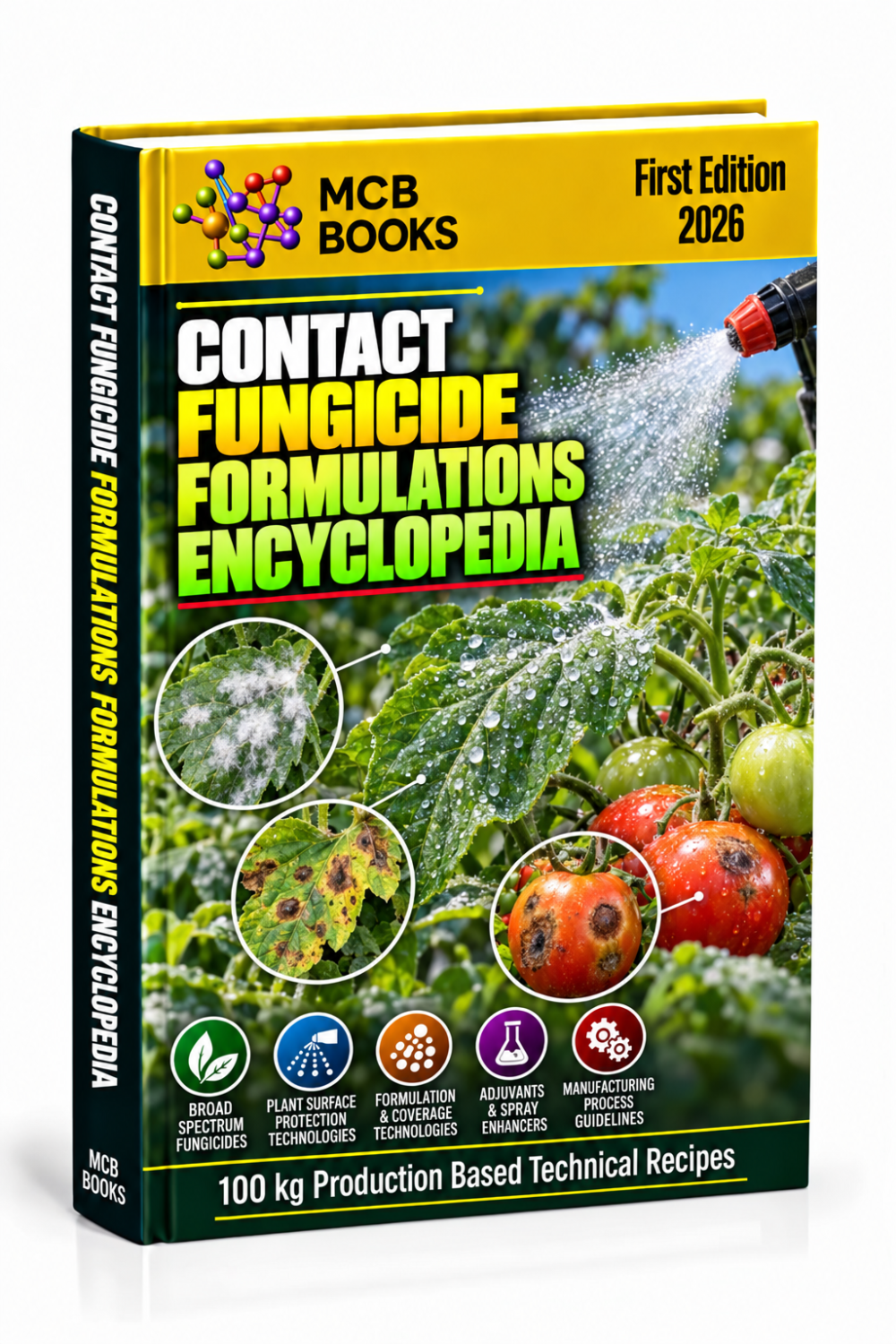
FUNGICIDE EMULSIFIABLE CONCENTRATE (EC) FORMULATIONS ENCYCLOPEDIA
Book details
- Author
- MCB BOOKS Technical Team
- Editor
- MCB BOOKS
- ISBN
- 978-605-81137-2-5
- Number of Pages
- 220 Pages
- Publication Date
- 2026
- Copyright
- MCB BOOKS
- Format
- Hard Book & E book (PDF)
- Language
- English
About the Encyclopedia
The Fungicide Emulsifiable Concentrate (EC) Formulations Encyclopedia is a practical technical reference for manufacturers developing solvent-based fungicide concentrates that form stable emulsions after dilution with water.
It brings together fungicide EC formulations, manufacturing methods and product-development information for different active ingredients, concentrations and emulsifier systems.
The focus is not simply on liquid fungicides. It is specifically on the chemistry and manufacturing of emulsifiable concentrate fungicides, giving manufacturers a more specialized route for building commercial crop-protection products.
Table of contents
01Page 1 Cyprodinil 300 Grams / Liter ( 300 Ec ) Fungicide 12 formulations · 1–12
- 1DEVELOPMENT FORMULATION 1
- 2PRODUCTION PROCESS 1
- 3DEVELOPMENT FORMULATION 2
- 4PRODUCTION PROCESS 2
- 5DEVELOPMENT FORMULATION 3
- 6PRODUCTION PROCESS 3
- 7APPLICATION PROGRAM
- 8PRODUCT SPECIFICATION
- 9PRODUCT CHARACTERISTICS AND QUALITY CONTROL
- 10TROUBLESHOOTING
- 11TARGET DISEASES – IMAGES AND IDENTIFICATION
- 12TARGET DISEASES – CHARACTERISTICS AND CROP DAMAGE
02Page 13 Difenoconazole 250 Grams / Liter ( 25 Ec ) Fungicide 12 formulations · 13–24
- 13DEVELOPMENT FORMULATION 1
- 14PRODUCTION PROCESS 1
- 15DEVELOPMENT FORMULATION 2
- 16PRODUCTION PROCESS 2
- 17DEVELOPMENT FORMULATION 3
- 18PRODUCTION PROCESS 3
- 19APPLICATION PROGRAM
- 20PRODUCT SPECIFICATION
- 21PRODUCT CHARACTERISTICS AND QUALITY CONTROL
- 22TROUBLESHOOTING
- 23TARGET DISEASES – IMAGES AND IDENTIFICATION
- 24TARGET DISEASES – CHARACTERISTICS AND CROP DAMAGE
03Page 25 Difenoconazole 150 Grams / Liter + Propiconazole 150 Grams / Liter ( 300 Ec ) Fungicide 12 formulations · 25–36
- 25DEVELOPMENT FORMULATION 1
- 26PRODUCTION PROCESS 1
- 27DEVELOPMENT FORMULATION 2
- 28PRODUCTION PROCESS 2
- 29DEVELOPMENT FORMULATION 3
- 30PRODUCTION PROCESS 3
- 31APPLICATION PROGRAM
- 32PRODUCT SPECIFICATION
- 33PRODUCT CHARACTERISTICS AND QUALITY CONTROL
- 34TROUBLESHOOTING
- 35TARGET DISEASES – IMAGES AND IDENTIFICATION
- 36TARGET DISEASES – CHARACTERISTICS AND CROP DAMAGE
04Page 37 Flusilazole 400 Grams / Liter ( 40 Ec ) Fungicide 12 formulations · 37–48
- 37DEVELOPMENT FORMULATION 1
- 38PRODUCTION PROCESS 1
- 39DEVELOPMENT FORMULATION 2
- 40PRODUCTION PROCESS 2
- 41DEVELOPMENT FORMULATION 3
- 42PRODUCTION PROCESS 3
- 43APPLICATION PROGRAM
- 44PRODUCT SPECIFICATION
- 45PRODUCT CHARACTERISTICS AND QUALITY CONTROL
- 46TROUBLESHOOTING
- 47TARGET DISEASES – IMAGES AND IDENTIFICATION
- 48TARGET DISEASES – CHARACTERISTICS AND CROP DAMAGE
05Page 49 Imazalil 500 Grams / Liter ( 50 Ec ) Fungicide 12 formulations · 49–60
- 49DEVELOPMENT FORMULATION 1
- 50PRODUCTION PROCESS 1
- 51DEVELOPMENT FORMULATION 2
- 52PRODUCTION PROCESS 2
- 53DEVELOPMENT FORMULATION 3
- 54PRODUCTION PROCESS 3
- 55APPLICATION PROGRAM
- 56PRODUCT SPECIFICATION
- 57PRODUCT CHARACTERISTICS AND QUALITY CONTROL
- 58TROUBLESHOOTING
- 59TARGET DISEASES – IMAGES AND IDENTIFICATION
- 60TARGET DISEASES – CHARACTERISTICS AND CROP DAMAGE
06Page 61 Myclobutanil 245 Grams / Liter ( 24 Ec ) Fungicide 12 formulations · 61–72
- 61DEVELOPMENT FORMULATION 1
- 62PRODUCTION PROCESS 1
- 63DEVELOPMENT FORMULATION 2
- 64PRODUCTION PROCESS 2
- 65DEVELOPMENT FORMULATION 3
- 66PRODUCTION PROCESS 3
- 67APPLICATION PROGRAM
- 68PRODUCT SPECIFICATION
- 69PRODUCT CHARACTERISTICS AND QUALITY CONTROL
- 70TROUBLESHOOTING
- 71TARGET DISEASES – IMAGES AND IDENTIFICATION
- 72TARGET DISEASES – CHARACTERISTICS AND CROP DAMAGE
07Page 73 Penconazole 100 Grams / Liter ( 100 Ec ) Fungicide 12 formulations · 73–84
- 73DEVELOPMENT FORMULATION 1
- 74PRODUCTION PROCESS 1
- 75DEVELOPMENT FORMULATION 2
- 76PRODUCTION PROCESS 2
- 77DEVELOPMENT FORMULATION 3
- 78PRODUCTION PROCESS 3
- 79APPLICATION PROGRAM
- 80PRODUCT SPECIFICATION
- 81PRODUCT CHARACTERISTICS AND QUALITY CONTROL
- 82TROUBLESHOOTING
- 83TARGET DISEASES – IMAGES AND IDENTIFICATION
- 84TARGET DISEASES – CHARACTERISTICS AND CROP DAMAGE
08Page 85 Prochloraz 450 Grams / Liter ( 45 Ec ) Fungicide 12 formulations · 85–96
- 85DEVELOPMENT FORMULATION 1
- 86PRODUCTION PROCESS 1
- 87DEVELOPMENT FORMULATION 2
- 88PRODUCTION PROCESS 2
- 89DEVELOPMENT FORMULATION 3
- 90PRODUCTION PROCESS 3
- 91APPLICATION PROGRAM
- 92PRODUCT SPECIFICATION
- 93PRODUCT CHARACTERISTICS AND QUALITY CONTROL
- 94TROUBLESHOOTING
- 95TARGET DISEASES – IMAGES AND IDENTIFICATION
- 96TARGET DISEASES – CHARACTERISTICS AND CROP DAMAGE
09Page 97 Prochloraz 400 Grams / Liter and Triadimenol 125 Grams / Liter 12 formulations · 97–108
- 97DEVELOPMENT FORMULATION 1
- 98PRODUCTION PROCESS 1
- 99DEVELOPMENT FORMULATION 2
- 100PRODUCTION PROCESS 2
- 101DEVELOPMENT FORMULATION 3
- 102PRODUCTION PROCESS 3
- 103APPLICATION PROGRAM
- 104PRODUCT SPECIFICATION
- 105PRODUCT CHARACTERISTICS AND QUALITY CONTROL
- 106TROUBLESHOOTING
- 107TARGET DISEASES – IMAGES AND IDENTIFICATION
- 108TARGET DISEASES – CHARACTERISTICS AND CROP DAMAGE
10Page 109 Propiconazole 250 Grams / Liter ( 250 Ec ) Fungicide 12 formulations · 109–120
- 109DEVELOPMENT FORMULATION 1
- 110PRODUCTION PROCESS 1
- 111DEVELOPMENT FORMULATION 2
- 112PRODUCTION PROCESS 2
- 113DEVELOPMENT FORMULATION 3
- 114PRODUCTION PROCESS 3
- 115APPLICATION PROGRAM
- 116PRODUCT SPECIFICATION
- 117PRODUCT CHARACTERISTICS AND QUALITY CONTROL
- 118TROUBLESHOOTING
- 119TARGET DISEASES – IMAGES AND IDENTIFICATION
- 120TARGET DISEASES – CHARACTERISTICS AND CROP DAMAGE
11Page 121 Propiconazole 125 Grams / Liter + Azoxystrobin 100 Grams / Liter + Cyproconazole 30 Grams / Liter 12 formulations · 121–132
- 121DEVELOPMENT FORMULATION 1
- 122PRODUCTION PROCESS 1
- 123DEVELOPMENT FORMULATION 2
- 124PRODUCTION PROCESS 2
- 125DEVELOPMENT FORMULATION 3
- 126PRODUCTION PROCESS 3
- 127APPLICATION PROGRAM
- 128PRODUCT SPECIFICATION
- 129PRODUCT CHARACTERISTICS AND QUALITY CONTROL
- 130TROUBLESHOOTING
- 131TARGET DISEASES – IMAGES AND IDENTIFICATION
- 132TARGET DISEASES – CHARACTERISTICS AND CROP DAMAGE
12Page 133 Propiconazole 90 Grams / Liter + Prochloraz 400 Grams / Liter ( 490 Ec ) Fungicide 12 formulations · 133–144
- 133DEVELOPMENT FORMULATION 1
- 134PRODUCTION PROCESS 1
- 135DEVELOPMENT FORMULATION 2
- 136PRODUCTION PROCESS 2
- 137DEVELOPMENT FORMULATION 3
- 138PRODUCTION PROCESS 3
- 139APPLICATION PROGRAM
- 140PRODUCT SPECIFICATION
- 141PRODUCT CHARACTERISTICS AND QUALITY CONTROL
- 142TROUBLESHOOTING
- 143TARGET DISEASES – IMAGES AND IDENTIFICATION
- 144TARGET DISEASES – CHARACTERISTICS AND CROP DAMAGE
13Page 145 Tetraconazole 100 Grams / Liter ( 10 Ec ) Fungicide 12 formulations · 145–156
- 145DEVELOPMENT FORMULATION 1
- 146PRODUCTION PROCESS 1
- 147DEVELOPMENT FORMULATION 2
- 148PRODUCTION PROCESS 2
- 149DEVELOPMENT FORMULATION 3
- 150PRODUCTION PROCESS 3
- 151APPLICATION PROGRAM
- 152PRODUCT SPECIFICATION
- 153PRODUCT CHARACTERISTICS AND QUALITY CONTROL
- 154TROUBLESHOOTING
- 155TARGET DISEASES – IMAGES AND IDENTIFICATION
- 156TARGET DISEASES – CHARACTERISTICS AND CROP DAMAGE
14Page 157 Tebuconazole 250 Grams / Liter ( 25 Ec ) Fungicide 12 formulations · 157–168
- 157DEVELOPMENT FORMULATION 1
- 158PRODUCTION PROCESS 1
- 159DEVELOPMENT FORMULATION 2
- 160PRODUCTION PROCESS 2
- 161DEVELOPMENT FORMULATION 3
- 162PRODUCTION PROCESS 3
- 163APPLICATION PROGRAM
- 164PRODUCT SPECIFICATION
- 165PRODUCT CHARACTERISTICS AND QUALITY CONTROL
- 166TROUBLESHOOTING
- 167TARGET DISEASES – IMAGES AND IDENTIFICATION
- 168TARGET DISEASES – CHARACTERISTICS AND CROP DAMAGE
15Page 169 Tebuconazole 100 Grams / Liter and Azoxystrobin 60 Grams / Liter 12 formulations · 169–180
- 169DEVELOPMENT FORMULATION 1
- 170PRODUCTION PROCESS 1
- 171DEVELOPMENT FORMULATION 2
- 172PRODUCTION PROCESS 2
- 173DEVELOPMENT FORMULATION 3
- 174PRODUCTION PROCESS 3
- 175APPLICATION PROGRAM
- 176PRODUCT SPECIFICATION
- 177PRODUCT CHARACTERISTICS AND QUALITY CONTROL
- 178TROUBLESHOOTING
- 179TARGET DISEASES – IMAGES AND IDENTIFICATION
- 180TARGET DISEASES – CHARACTERISTICS AND CROP DAMAGE
16Page 181 Triadimenol 250 Grams / Liter ( 250 Ec ) Fungicide 12 formulations · 181–192
- 181DEVELOPMENT FORMULATION 1
- 182PRODUCTION PROCESS 1
- 183DEVELOPMENT FORMULATION 2
- 184PRODUCTION PROCESS 2
- 185DEVELOPMENT FORMULATION 3
- 186PRODUCTION PROCESS 3
- 187APPLICATION PROGRAM
- 188PRODUCT SPECIFICATION
- 189PRODUCT CHARACTERISTICS AND QUALITY CONTROL
- 190TROUBLESHOOTING
- 191TARGET DISEASES – IMAGES AND IDENTIFICATION
- 192TARGET DISEASES – CHARACTERISTICS AND CROP DAMAGE
More about this book
What's Inside the Encyclopedia
The encyclopedia covers a wide range of fungicide EC technologies based on different active ingredients and concentration levels.
Readers can study EC products based on Difenoconazole, Flusilazole, Imazalil, Myclobutanil, Penconazole, Prochloraz, Propiconazole, Tetraconazole, Tebuconazole, Triadimenol and selected combination systems.
Each product section follows a practical structure including development formulations, production processes, application information, product specifications, quality control, troubleshooting and target-disease guidance.
This gives manufacturers a focused reference for comparing different solvent and emulsifier approaches within one formulation technology.
Why This Encyclopedia
A good EC fungicide needs to do two things well.
It must remain clear and stable in the original concentrate, and it must form a consistent emulsion when diluted with water.
That makes solvent selection, active-ingredient solubility and emulsifier balance critical.
A concentrate may look perfectly stable in the container but fail after dilution if the surfactant system is not correctly balanced.
The Fungicide EC Formulations Encyclopedia helps manufacturers develop EC products around these practical challenges and create several commercial grades rather than relying on one general liquid fungicide.
About Formulations
Fungicide EC Formulations, Emulsifiable Concentrate Fungicides, Solvent-Based Fungicides, Fungicide Concentrates, Single Active EC Fungicides, Combination EC Fungicides, Triazole EC Fungicides, Difenoconazole EC, Tebuconazole EC, Propiconazole EC, Penconazole EC, Prochloraz EC, Imazalil EC, Tetraconazole EC, Triadimenol EC, Professional Fungicide EC Systems
Manufacturing Methods
Each formulation is presented in a clear and practical structure showing the raw materials, CAS numbers, functions of each ingredient, and exact quantities required for production.
All formulations are calculated on a 100 kg production basis, making them easy to understand, compare, scale, and adapt for laboratory or industrial R&D work.
The book uses straightforward technical language so that readers can follow the formulations without needing advanced engineering knowledge.
The Production Process section explains the manufacturing sequence step by step, including charging order, mixing, dissolution, dispersion, temperature control, viscosity adjustment, filtration, and final filling.
Special attention is given to what happens at each production stage, helping the reader understand not only what to add, but when, how, and why it is added.
The formulations are presented as practical starting formulations for laboratory, in-house, R&D, product-development, and commercial production studies, with final validation and regulatory testing required before market use.
In this way, the encyclopedia guides the reader through the complete manufacturing workflow in a form that can be followed by formulators, technicians, production staff, entrepreneurs, and manufacturers alike.
Troubleshooting
The encyclopedia helps readers understand and identify common problems that may occur during production and application.
Issues such as incorrect viscosity, poor adhesion, slow or incomplete curing, premature thickening, air bubbles, poor dispersion, and moisture-related instability can be evaluated through the formulation and production guidance.
The production processes explain critical factors such as mixing order, temperature, moisture control, dispersion, degassing, viscosity adjustment, filtration, and packaging conditions that can directly influence the final product.
Readers can also understand how substrate preparation, mixing accuracy, bond-line thickness, curing conditions, and application environment affect adhesive performance.
By comparing the expected product properties with actual production results, users can more easily determine where a problem may have originated in the manufacturing process.
This practical approach helps reduce unnecessary trial and error and provides a clearer direction for corrective formulation adjustments and process optimization.
Troubleshooting therefore becomes part of the overall formulation-development process rather than a separate, complicated engineering task.
Unlimited Technical Support
Customers purchasing the Fungicide Emulsifiable Concentrate (EC) Formulations Encyclopedia receive technical support from MCB BOOKS for questions related to the formulations and manufacturing information included in the book.
If you need help understanding an EC formulation, solvent package, emulsifier system, active-ingredient solubility, emulsion stability or production step, you can contact our technical team.
Technical support helps manufacturers use the formulation information more confidently during laboratory development, pilot production and commercial scale-up.
Featured Articles
1 – Fungicide EC Formulations for Commercial Manufacturing
Professional fungicide EC formulations are built around a solvent system that keeps the active ingredient dissolved and an emulsifier package that allows the concentrate to disperse properly in water.
Both parts need to work together.
A concentrate that is stable in storage but produces a poor emulsion will still create problems for the customer.
For manufacturers, EC technology offers a specialized route for producing concentrated fungicides with different active ingredients and commercial strengths.
TAGS: fungicide EC formulations, emulsifiable concentrate fungicide, fungicide EC manufacturing, solvent based fungicide, EC pesticide formulation
2 – Choosing Solvents for Fungicide EC Products
Solvent selection is one of the most important parts of an EC fungicide formulation.
The solvent needs sufficient ability to dissolve the active ingredient while remaining compatible with the emulsifier system and other formulation components.
Temperature also matters.
A formulation that remains clear during production may crystallize during colder storage if solubility margins are too narrow.
For manufacturers, careful solvent selection improves both product stability and commercial reliability.
TAGS: fungicide solvent system, EC fungicide solvent, emulsifiable concentrate formulation, fungicide concentrate, fungicide EC formulations
3 – Emulsifier Systems for Stable Fungicide EC Formulations
The emulsifier package determines how the concentrate behaves when it is mixed with water.
A well-balanced system should create a consistent emulsion without rapid separation, excessive oiling or unstable creaming.
Nonionic and anionic surfactants can be combined according to the solvent and active-ingredient system.
Manufacturers also need to consider the quality and hardness of the dilution water.
A good EC product should perform reliably under the realistic conditions expected in the target market.
TAGS: fungicide emulsifier, EC emulsifier system, emulsifiable concentrate fungicide, emulsion stability, fungicide EC manufacturing
4 – Preventing Crystallization in EC Fungicides
Crystallization is one of the most common development problems in solvent-based pesticide concentrates.
It can appear after cold storage, prolonged storage or changes in concentration.
The cause is often related to insufficient active-ingredient solubility in the selected solvent package.
Manufacturers may need to adjust solvent balance, concentration or formulation composition to create a larger stability margin.
Cold-storage testing is therefore an important part of EC product development.
TAGS: EC fungicide crystallization, fungicide solubility, solvent based fungicide, EC formulation stability, fungicide concentrate
5 – Building a Commercial Fungicide EC Product Range
A commercial EC portfolio can contain several active ingredients and concentration levels while using the same basic formulation principle.
Manufacturers can develop single-active products together with selected combination systems for different crop-disease markets.
This creates opportunities to serve agricultural distributors with several related products while maintaining a clear technical identity around EC technology.
For companies specializing in liquid pesticide production, emulsifiable concentrates can therefore become a distinct and valuable product family.
TAGS: fungicide EC portfolio, EC fungicide products, fungicide EC manufacturing, emulsifiable concentrate pesticide, commercial fungicide formulations
Some Raw Materials Used
Fungicide Active Ingredients, Aromatic Solvents, Hydrocarbon Solvents, Polar Co-Solvents, Nonionic Emulsifiers, Anionic Emulsifiers, Surfactant Blends, Solubilizers, Glycols, Stabilizers, Antifoaming Agents, Antioxidants, Preservatives, Acidity Regulators
Why Choose This Encyclopedia
The Fungicide Emulsifiable Concentrate (EC) Formulations Encyclopedia is designed for manufacturers who want to specialize in solvent-based fungicide concentrates.
Rather than covering every type of liquid pesticide, it focuses on the practical problems that define EC manufacturing: active-ingredient solubility, solvent selection, emulsifier balance, concentrate stability and water-dilution performance.
Manufacturers can develop different EC products around multiple active ingredients, concentrations and combination systems.
This creates opportunities with pesticide manufacturers, crop-protection companies, agricultural distributors and private-label producers looking for specialized emulsifiable concentrate products.
The formulations should first be evaluated at laboratory and pilot scale, followed by physical stability, dilution, efficacy, crop-safety and regulatory assessment for the intended market.
Commercial fungicide manufacture, registration, labeling and sale must comply with the applicable pesticide regulations of the country where the product will be marketed.
Every MCB Books encyclopedia is available as a hard book and PDF — the PDF is delivered instantly, the printed edition ships worldwide — and all purchases include unlimited technical support. Questions before ordering? Contact the MCB Books team or write to us on WhatsApp; we reply the same day.
Related books