HEAVY-DUTY CLEANING WIPES FORMULATIONS ENCYCLOPEDIA
Book details
- Editor
- MCB BOOKS
- ISBN
- 978-625-95879-1-2
- Number of Pages
- 420 Pages
- Publication Date
- 2026
- Copyright
- MCB BOOKS
- Format
- Hard Book & E book (PDF)
- Language
- English
About the Encyclopedia
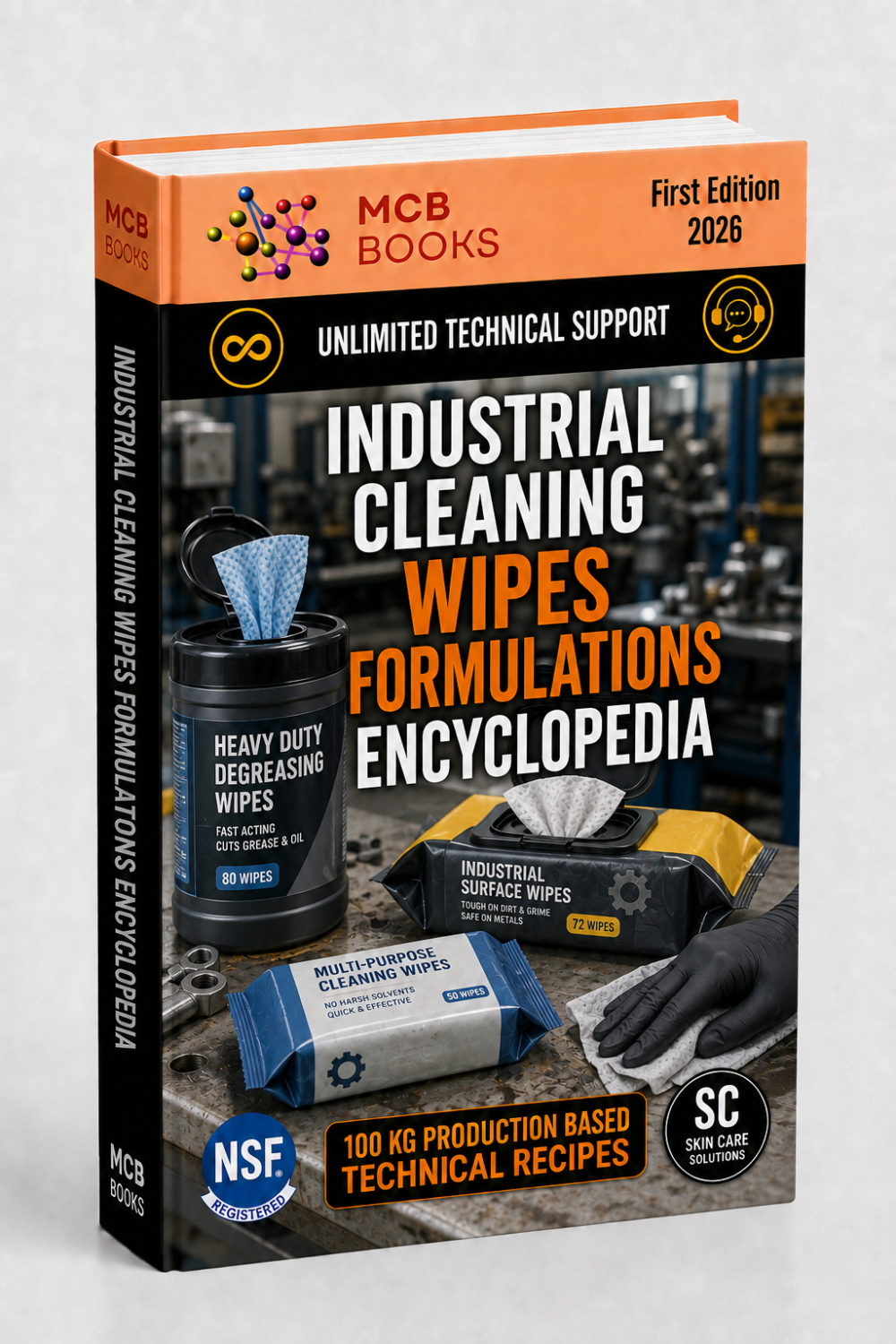
The Heavy-Duty Cleaning Wipes Formulations Encyclopedia is a practical technical reference for chemical manufacturers and product developers interested in producing cleaning wipes for demanding applications. It covers ready-to-use wipes designed to remove grease, oil, adhesive residues, paint marks, ink deposits and other stubborn contamination from tools, equipment and suitable surfaces.
Ordinary cleaning wipes are not always suitable for difficult cleaning jobs. Heavy grease, workshop dirt and dried residues can require different solvent systems, surfactants and cleaning methods. A wipe developed for removing lubricant from metal tools may not be appropriate for cleaning painted surfaces or sensitive electronic components. Understanding these differences is an important part of formulation development.
With 420 pages of technical content, this encyclopedia brings together 50 heavy-duty cleaning wipe product types and 150 formulation and production approaches. It is intended for manufacturers developing specialized cleaning products, expanding an existing wipes range or exploring new formulations for professional cleaning applications.
The focus is on heavy-duty cleaning performance, raw material selection, manufacturing procedures and finished-product requirements, giving readers a useful technical foundation for developing wipes for more demanding cleaning tasks.
Table of contents
01Page 1 Contents 250 formulations · 1–400
- 1Heavy-Duty Degreasing Cleaning Wipes Formulation and Production Process 1
- 3Heavy-Duty Degreasing Cleaning Wipes Formulation and Production Process 2
- 5Heavy-Duty Degreasing Cleaning Wipes Formulation and Production Process 3
- 7Heavy-Duty Degreasing Cleaning Wipes Product Analysis
- 8Heavy-Duty Degreasing Cleaning Wipes Product Properties
- 9Industrial Grease Removal Wipes Formulation and Production Process 1
- 11Industrial Grease Removal Wipes Formulation and Production Process 2
- 13Industrial Grease Removal Wipes Formulation and Production Process 3
- 15Industrial Grease Removal Wipes Product Analysis
- 16Industrial Grease Removal Wipes Product Properties
- 17Heavy Oil Removal Cleaning Wipes Formulation and Production Process 1
- 19Heavy Oil Removal Cleaning Wipes Formulation and Production Process 2
- 21Heavy Oil Removal Cleaning Wipes Formulation and Production Process 3
- 23Heavy Oil Removal Cleaning Wipes Product Analysis
- 24Heavy Oil Removal Cleaning Wipes Product Properties
- 25Carbon Deposit Cleaning Wipes Formulation and Production Process 1
- 27Carbon Deposit Cleaning Wipes Formulation and Production Process 2
- 29Carbon Deposit Cleaning Wipes Formulation and Production Process 3
- 31Carbon Deposit Cleaning Wipes Product Analysis
- 32Carbon Deposit Cleaning Wipes Product Properties
- 33Brake Dust Cleaning Wipes Formulation and Production Process 1
- 35Brake Dust Cleaning Wipes Formulation and Production Process 2
- 37Brake Dust Cleaning Wipes Formulation and Production Process 3
- 39Brake Dust Cleaning Wipes Product Analysis
- 40Brake Dust Cleaning Wipes Product Properties
- 41Tar and Asphalt Removal Wipes Formulation and Production Process 1
- 43Tar and Asphalt Removal Wipes Formulation and Production Process 2
- 45Tar and Asphalt Removal Wipes Formulation and Production Process 3
- 47Tar and Asphalt Removal Wipes Product Analysis
- 48Tar and Asphalt Removal Wipes Product Properties
- 49Adhesive Residue Removal Wipes Formulation and Production Process 1
- 51Adhesive Residue Removal Wipes Formulation and Production Process 2
- 53Adhesive Residue Removal Wipes Formulation and Production Process 3
- 55Adhesive Residue Removal Wipes Product Analysis
- 56Adhesive Residue Removal Wipes Product Properties
- 57Paint Residue Cleaning Wipes Formulation and Production Process 1
- 59Paint Residue Cleaning Wipes Formulation and Production Process 2
- 61Paint Residue Cleaning Wipes Formulation and Production Process 3
- 63Paint Residue Cleaning Wipes Product Analysis
- 64Paint Residue Cleaning Wipes Product Properties
- 65Ink Removal Cleaning Wipes Formulation and Production Process 1
- 67Ink Removal Cleaning Wipes Formulation and Production Process 2
- 69Ink Removal Cleaning Wipes Formulation and Production Process 3
- 71Ink Removal Cleaning Wipes Product Analysis
- 72Ink Removal Cleaning Wipes Product Properties
- 73Marker and Graffiti Removal Wipes Formulation and Production Process 1
- 75Marker and Graffiti Removal Wipes Formulation and Production Process 2
- 77Marker and Graffiti Removal Wipes Formulation and Production Process 3
- 79Marker and Graffiti Removal Wipes Product Analysis
- 80Marker and Graffiti Removal Wipes Product Properties
- 81Machinery Cleaning Wipes Formulation and Production Process 1
- 83Machinery Cleaning Wipes Formulation and Production Process 2
- 85Machinery Cleaning Wipes Formulation and Production Process 3
- 87Machinery Cleaning Wipes Product Analysis
- 88Machinery Cleaning Wipes Product Properties
- 89Heavy Equipment Cleaning Wipes Formulation and Production Process 1
- 91Heavy Equipment Cleaning Wipes Formulation and Production Process 2
- 93Heavy Equipment Cleaning Wipes Formulation and Production Process 3
- 95Heavy Equipment Cleaning Wipes Product Analysis
- 96Heavy Equipment Cleaning Wipes Product Properties
- 97Workshop Cleaning Wipes Formulation and Production Process 1
- 99Workshop Cleaning Wipes Formulation and Production Process 2
- 101Workshop Cleaning Wipes Formulation and Production Process 3
- 103Workshop Cleaning Wipes Product Analysis
- 104Workshop Cleaning Wipes Product Properties
- 105Factory Maintenance Cleaning Wipes Formulation and Production Process 1
- 107Factory Maintenance Cleaning Wipes Formulation and Production Process 2
- 109Factory Maintenance Cleaning Wipes Formulation and Production Process 3
- 111Factory Maintenance Cleaning Wipes Product Analysis
- 112Factory Maintenance Cleaning Wipes Product Properties
- 113Metal Surface Heavy Cleaning Wipes Formulation and Production Process 1
- 115Metal Surface Heavy Cleaning Wipes Formulation and Production Process 2
- 117Metal Surface Heavy Cleaning Wipes Formulation and Production Process 3
- 119Metal Surface Heavy Cleaning Wipes Product Analysis
- 120Metal Surface Heavy Cleaning Wipes Product Properties
- 121Stainless Steel Degreasing Wipes Formulation and Production Process 1
- 123Stainless Steel Degreasing Wipes Formulation and Production Process 2
- 125Stainless Steel Degreasing Wipes Formulation and Production Process 3
- 127Stainless Steel Degreasing Wipes Product Analysis
- 128Stainless Steel Degreasing Wipes Product Properties
- 129Tool Cleaning Wipes Formulation and Production Process 1
- 131Tool Cleaning Wipes Formulation and Production Process 2
- 133Tool Cleaning Wipes Formulation and Production Process 3
- 135Tool Cleaning Wipes Product Analysis
- 136Tool Cleaning Wipes Product Properties
- 137Engine Parts Cleaning Wipes Formulation and Production Process 1
- 139Engine Parts Cleaning Wipes Formulation and Production Process 2
- 141Engine Parts Cleaning Wipes Formulation and Production Process 3
- 143Engine Parts Cleaning Wipes Product Analysis
- 144Engine Parts Cleaning Wipes Product Properties
- 145Hydraulic Oil Cleaning Wipes Formulation and Production Process 1
- 147Hydraulic Oil Cleaning Wipes Formulation and Production Process 2
- 149Hydraulic Oil Cleaning Wipes Formulation and Production Process 3
- 151Hydraulic Oil Cleaning Wipes Product Analysis
- 152Hydraulic Oil Cleaning Wipes Product Properties
- 153Lubricant Residue Removal Wipes Formulation and Production Process 1
- 155Lubricant Residue Removal Wipes Formulation and Production Process 2
- 157Lubricant Residue Removal Wipes Formulation and Production Process 3
- 159Lubricant Residue Removal Wipes Product Analysis
- 160Lubricant Residue Removal Wipes Product Properties
- 161Solvent-Based Heavy-Duty Cleaning Wipes Formulation and Production Process 1
- 163Solvent-Based Heavy-Duty Cleaning Wipes Formulation and Production Process 2
- 165Solvent-Based Heavy-Duty Cleaning Wipes Formulation and Production Process 3
- 167Solvent-Based Heavy-Duty Cleaning Wipes Product Analysis
- 168Solvent-Based Heavy-Duty Cleaning Wipes Product Properties
- 169Water-Based Heavy-Duty Cleaning Wipes Formulation and Production Process 1
- 171Water-Based Heavy-Duty Cleaning Wipes Formulation and Production Process 2
- 173Water-Based Heavy-Duty Cleaning Wipes Formulation and Production Process 3
- 175Water-Based Heavy-Duty Cleaning Wipes Product Analysis
- 176Water-Based Heavy-Duty Cleaning Wipes Product Properties
- 177Fast Drying Heavy-Duty Cleaning Wipes Formulation and Production Process 1
- 179Fast Drying Heavy-Duty Cleaning Wipes Formulation and Production Process 2
- 181Fast Drying Heavy-Duty Cleaning Wipes Formulation and Production Process 3
- 183Fast Drying Heavy-Duty Cleaning Wipes Product Analysis
- 184Fast Drying Heavy-Duty Cleaning Wipes Product Properties
- 185Low VOC Heavy-Duty Cleaning Wipes Formulation and Production Process 1
- 187Low VOC Heavy-Duty Cleaning Wipes Formulation and Production Process 2
- 189Low VOC Heavy-Duty Cleaning Wipes Formulation and Production Process 3
- 191Low VOC Heavy-Duty Cleaning Wipes Product Analysis
- 192Low VOC Heavy-Duty Cleaning Wipes Product Properties
- 193Anti-Residue Heavy-Duty Cleaning Wipes Formulation and Production Process 1
- 195Anti-Residue Heavy-Duty Cleaning Wipes Formulation and Production Process 2
- 197Anti-Residue Heavy-Duty Cleaning Wipes Formulation and Production Process 3
- 199Anti-Residue Heavy-Duty Cleaning Wipes Product Analysis
- 200Anti-Residue Heavy-Duty Cleaning Wipes Product Properties
- 201Heavy-Duty Hand Cleaning Wipes Formulation and Production Process 1
- 203Heavy-Duty Hand Cleaning Wipes Formulation and Production Process 2
- 205Heavy-Duty Hand Cleaning Wipes Formulation and Production Process 3
- 207Heavy-Duty Hand Cleaning Wipes Product Analysis
- 208Heavy-Duty Hand Cleaning Wipes Product Properties
- 209Heavy-Duty Surface Cleaning Wipes Formulation and Production Process 1
- 211Heavy-Duty Surface Cleaning Wipes Formulation and Production Process 2
- 213Heavy-Duty Surface Cleaning Wipes Formulation and Production Process 3
- 215Heavy-Duty Surface Cleaning Wipes Product Analysis
- 216Heavy-Duty Surface Cleaning Wipes Product Properties
- 217Heavy-Duty Multi-Surface Cleaning Wipes Formulation and Production Process 1
- 219Heavy-Duty Multi-Surface Cleaning Wipes Formulation and Production Process 2
- 221Heavy-Duty Multi-Surface Cleaning Wipes Formulation and Production Process 3
- 223Heavy-Duty Multi-Surface Cleaning Wipes Product Analysis
- 224Heavy-Duty Multi-Surface Cleaning Wipes Product Properties
- 225Heavy-Duty Kitchen Degreasing Wipes Formulation and Production Process 1
- 227Heavy-Duty Kitchen Degreasing Wipes Formulation and Production Process 2
- 229Heavy-Duty Kitchen Degreasing Wipes Formulation and Production Process 3
- 231Heavy-Duty Kitchen Degreasing Wipes Product Analysis
- 232Heavy-Duty Kitchen Degreasing Wipes Product Properties
- 233Heavy-Duty Floor Cleaning Wipes Formulation and Production Process 1
- 235Heavy-Duty Floor Cleaning Wipes Formulation and Production Process 2
- 237Heavy-Duty Floor Cleaning Wipes Formulation and Production Process 3
- 239Heavy-Duty Floor Cleaning Wipes Product Analysis
- 240Heavy-Duty Floor Cleaning Wipes Product Properties
- 241Heavy-Duty Industrial Equipment Wipes Formulation and Production Process 1
- 243Heavy-Duty Industrial Equipment Wipes Formulation and Production Process 2
- 245Heavy-Duty Industrial Equipment Wipes Formulation and Production Process 3
- 247Heavy-Duty Industrial Equipment Wipes Product Analysis
- 248Heavy-Duty Industrial Equipment Wipes Product Properties
- 249Heavy-Duty Electronic Equipment Cleaning Wipes Formulation and Production Process 1
- 251Heavy-Duty Electronic Equipment Cleaning Wipes Formulation and Production Process 2
- 253Heavy-Duty Electronic Equipment Cleaning Wipes Formulation and Production Process 3
- 255Heavy-Duty Electronic Equipment Cleaning Wipes Product Analysis
- 256Heavy-Duty Electronic Equipment Cleaning Wipes Product Properties
- 257Heavy-Duty Electrical Panel Cleaning Wipes Formulation and Production Process 1
- 259Heavy-Duty Electrical Panel Cleaning Wipes Formulation and Production Process 2
- 261Heavy-Duty Electrical Panel Cleaning Wipes Formulation and Production Process 3
- 263Heavy-Duty Electrical Panel Cleaning Wipes Product Analysis
- 264Heavy-Duty Electrical Panel Cleaning Wipes Product Properties
- 265Heavy-Duty Conveyor Belt Cleaning Wipes Formulation and Production Process 1
- 267Heavy-Duty Conveyor Belt Cleaning Wipes Formulation and Production Process 2
- 269Heavy-Duty Conveyor Belt Cleaning Wipes Formulation and Production Process 3
- 271Heavy-Duty Conveyor Belt Cleaning Wipes Product Analysis
- 272Heavy-Duty Conveyor Belt Cleaning Wipes Product Properties
- 273Heavy-Duty Warehouse Cleaning Wipes Formulation and Production Process 1
- 275Heavy-Duty Warehouse Cleaning Wipes Formulation and Production Process 2
- 277Heavy-Duty Warehouse Cleaning Wipes Formulation and Production Process 3
- 279Heavy-Duty Warehouse Cleaning Wipes Product Analysis
- 280Heavy-Duty Warehouse Cleaning Wipes Product Properties
- 281Heavy-Duty Automotive Cleaning Wipes Formulation and Production Process 1
- 283Heavy-Duty Automotive Cleaning Wipes Formulation and Production Process 2
- 285Heavy-Duty Automotive Cleaning Wipes Formulation and Production Process 3
- 287Heavy-Duty Automotive Cleaning Wipes Product Analysis
- 288Heavy-Duty Automotive Cleaning Wipes Product Properties
- 289Heavy-Duty Marine Equipment Cleaning Wipes Formulation and Production Process 1
- 291Heavy-Duty Marine Equipment Cleaning Wipes Formulation and Production Process 2
- 293Heavy-Duty Marine Equipment Cleaning Wipes Formulation and Production Process 3
- 295Heavy-Duty Marine Equipment Cleaning Wipes Product Analysis
- 296Heavy-Duty Marine Equipment Cleaning Wipes Product Properties
- 297Heavy-Duty Aerospace Equipment Cleaning Wipes Formulation and Production Process 1
- 299Heavy-Duty Aerospace Equipment Cleaning Wipes Formulation and Production Process 2
- 301Heavy-Duty Aerospace Equipment Cleaning Wipes Formulation and Production Process 3
- 303Heavy-Duty Aerospace Equipment Cleaning Wipes Product Analysis
- 304Heavy-Duty Aerospace Equipment Cleaning Wipes Product Properties
- 305Heavy-Duty Food Processing Equipment Cleaning Wipes Formulation and Production Process 1
- 307Heavy-Duty Food Processing Equipment Cleaning Wipes Formulation and Production Process 2
- 309Heavy-Duty Food Processing Equipment Cleaning Wipes Formulation and Production Process 3
- 311Heavy-Duty Food Processing Equipment Cleaning Wipes Product Analysis
- 312Heavy-Duty Food Processing Equipment Cleaning Wipes Product Properties
- 313Heavy-Duty Pharmaceutical Facility Cleaning Wipes Formulation and Production Process 1
- 315Heavy-Duty Pharmaceutical Facility Cleaning Wipes Formulation and Production Process 2
- 317Heavy-Duty Pharmaceutical Facility Cleaning Wipes Formulation and Production Process 3
- 319Heavy-Duty Pharmaceutical Facility Cleaning Wipes Product Analysis
- 320Heavy-Duty Pharmaceutical Facility Cleaning Wipes Product Properties
- 321Heavy-Duty Cleanroom Cleaning Wipes Formulation and Production Process 1
- 323Heavy-Duty Cleanroom Cleaning Wipes Formulation and Production Process 2
- 325Heavy-Duty Cleanroom Cleaning Wipes Formulation and Production Process 3
- 327Heavy-Duty Cleanroom Cleaning Wipes Product Analysis
- 328Heavy-Duty Cleanroom Cleaning Wipes Product Properties
- 329Antibacterial Heavy-Duty Cleaning Wipes Formulation and Production Process 1
- 331Antibacterial Heavy-Duty Cleaning Wipes Formulation and Production Process 2
- 333Antibacterial Heavy-Duty Cleaning Wipes Formulation and Production Process 3
- 335Antibacterial Heavy-Duty Cleaning Wipes Product Analysis
- 336Antibacterial Heavy-Duty Cleaning Wipes Product Properties
- 337Industrial Disinfectant Heavy-Duty Wipes Formulation and Production Process 1
- 339Industrial Disinfectant Heavy-Duty Wipes Formulation and Production Process 2
- 341Industrial Disinfectant Heavy-Duty Wipes Formulation and Production Process 3
- 343Industrial Disinfectant Heavy-Duty Wipes Product Analysis
- 344Industrial Disinfectant Heavy-Duty Wipes Product Properties
- 345Biodegradable Heavy-Duty Cleaning Wipes Formulation and Production Process 1
- 347Biodegradable Heavy-Duty Cleaning Wipes Formulation and Production Process 2
- 349Biodegradable Heavy-Duty Cleaning Wipes Formulation and Production Process 3
- 351Biodegradable Heavy-Duty Cleaning Wipes Product Analysis
- 352Biodegradable Heavy-Duty Cleaning Wipes Product Properties
- 353Eco-Friendly Heavy-Duty Cleaning Wipes Formulation and Production Process 1
- 355Eco-Friendly Heavy-Duty Cleaning Wipes Formulation and Production Process 2
- 357Eco-Friendly Heavy-Duty Cleaning Wipes Formulation and Production Process 3
- 359Eco-Friendly Heavy-Duty Cleaning Wipes Product Analysis
- 360Eco-Friendly Heavy-Duty Cleaning Wipes Product Properties
- 361Plant-Based Heavy-Duty Cleaning Wipes Formulation and Production Process 1
- 363Plant-Based Heavy-Duty Cleaning Wipes Formulation and Production Process 2
- 365Plant-Based Heavy-Duty Cleaning Wipes Formulation and Production Process 3
- 367Plant-Based Heavy-Duty Cleaning Wipes Product Analysis
- 368Plant-Based Heavy-Duty Cleaning Wipes Product Properties
- 369Professional Heavy-Duty Cleaning Wipes Formulation and Production Process 1
- 371Professional Heavy-Duty Cleaning Wipes Formulation and Production Process 2
- 373Professional Heavy-Duty Cleaning Wipes Formulation and Production Process 3
- 375Professional Heavy-Duty Cleaning Wipes Product Analysis
- 376Professional Heavy-Duty Cleaning Wipes Product Properties
- 377Premium Heavy-Duty Cleaning Wipes Formulation and Production Process 1
- 379Premium Heavy-Duty Cleaning Wipes Formulation and Production Process 2
- 381Premium Heavy-Duty Cleaning Wipes Formulation and Production Process 3
- 383Premium Heavy-Duty Cleaning Wipes Product Analysis
- 384Premium Heavy-Duty Cleaning Wipes Product Properties
- 385OEM Heavy-Duty Cleaning Wipes Formulation and Production Process 1
- 387OEM Heavy-Duty Cleaning Wipes Formulation and Production Process 2
- 389OEM Heavy-Duty Cleaning Wipes Formulation and Production Process 3
- 391OEM Heavy-Duty Cleaning Wipes Product Analysis
- 392OEM Heavy-Duty Cleaning Wipes Product Properties
- 393Ultra Strength Heavy-Duty Cleaning Wipes Formulation and Production Process 1
- 395Ultra Strength Heavy-Duty Cleaning Wipes Formulation and Production Process 2
- 397Ultra Strength Heavy-Duty Cleaning Wipes Formulation and Production Process 3
- 399Ultra Strength Heavy-Duty Cleaning Wipes Product Analysis
- 400Ultra Strength Heavy-Duty Cleaning Wipes Product Properties
More about this book
What's Inside the Encyclopedia
The Heavy-Duty Cleaning Wipes Formulations Encyclopedia contains 50 different cleaning wipe product types, with three formulations and production processes for each, providing 150 formulation approaches. Each product group also includes product analysis and product properties, bringing the collection to 250 technical entries.
The book covers heavy-duty degreasing wipes, industrial grease removal, heavy oil cleaning, carbon deposits, brake dust, tar and asphalt, adhesive residues, paint deposits, printing ink and graffiti removal. It also includes formulations intended for cleaning tools, engine parts, metal surfaces, stainless steel and equipment exposed to persistent contamination.
Readers can examine solvent-based and water-based heavy-duty wipes, fast-drying formulations, low-VOC product concepts and cleaning solutions developed to minimize unwanted residue. Other sections address heavy-duty hand cleaning, workshop maintenance, automotive cleaning, conveyor belts, electronic equipment and professional surface cleaning.
The encyclopedia also covers industrial maintenance applications, food processing equipment, pharmaceutical facilities, cleanrooms, biodegradable ingredient concepts and private-label cleaning wipe products. These product groups address different application requirements, including chemical compatibility, cleaning performance and finished-product quality.
Throughout the collection, the emphasis is on developing cleaning wipes for specific residues and surfaces rather than relying on one general-purpose formulation.
Why This Encyclopedia
Heavy-duty cleaning wipes need to deal with contamination that ordinary wet wipes may not remove effectively. Grease, oil, adhesive residues and dried deposits can behave very differently, making the selection of cleaning ingredients particularly important.
The Heavy-Duty Cleaning Wipes Formulations Encyclopedia provides manufacturers with different formulation approaches for these cleaning challenges. Its coverage extends beyond one type of degreaser or workshop wipe, allowing readers to compare products developed for specific soils, cleaning conditions and materials.
With 150 formulation approaches, the book is useful for cleaning chemical manufacturers, professional maintenance product suppliers, formulation engineers and private-label producers interested in expanding their product ranges.
It is particularly relevant to companies that want to manufacture several specialized cleaning wipes rather than offer one general-purpose product. The information can support laboratory development, raw material comparison and manufacturing planning for heavy-duty cleaning applications.
About Formulations
Heavy-Duty Cleaning Wipes Formulations, Heavy-Duty Degreasing Wipes, Grease Removal Cleaning Wipes, Heavy Oil Removal Wipes, Adhesive Residue Cleaning Wipes, Tar and Asphalt Removal Wipes, Paint Residue Cleaning Wipes, Ink and Marker Removal Wipes, Carbon Deposit Cleaning Wipes, Brake Dust Cleaning Wipes, Solvent-Based Heavy-Duty Cleaning Wipes, Water-Based Heavy-Duty Wipes, Fast-Drying Heavy-Duty Wipes, Low-Residue Cleaning Wipes, Heavy-Duty Workshop Wipes, Tool Cleaning Wipes, Engine Parts Cleaning Wipes, Stainless Steel Degreasing Wipes, Professional Heavy-Duty Surface Wipes, Heavy-Duty Cleaning Lotion Preparation, Nonwoven Wipe Impregnation, Heavy-Duty Cleaning Wipes Production
Manufacturing Methods
Each formulation is presented in a clear and practical structure showing the raw materials, CAS numbers, functions of each ingredient, and exact quantities required for production.
All formulations are calculated on a 100 kg production basis, making them easy to understand, compare, scale, and adapt for laboratory or industrial R&D work.
The book uses straightforward technical language so that readers can follow the formulations without needing advanced engineering knowledge.
The Production Process section explains the manufacturing sequence step by step, including charging order, mixing, dissolution, dispersion, temperature control, viscosity adjustment, filtration, and final filling.
Special attention is given to what happens at each production stage, helping the reader understand not only what to add, but when, how, and why it is added.
The formulations are presented as practical starting formulations for laboratory, in-house, R&D, product-development, and commercial production studies, with final validation and regulatory testing required before market use.
In this way, the encyclopedia guides the reader through the complete manufacturing workflow in a form that can be followed by formulators, technicians, production staff, entrepreneurs, and manufacturers alike.
Troubleshooting
The encyclopedia helps readers understand and identify common problems that may occur during production and application.
Issues such as incorrect viscosity, poor adhesion, slow or incomplete curing, premature thickening, air bubbles, poor dispersion, and moisture-related instability can be evaluated through the formulation and production guidance.
The production processes explain critical factors such as mixing order, temperature, moisture control, dispersion, degassing, viscosity adjustment, filtration, and packaging conditions that can directly influence the final product.
Readers can also understand how substrate preparation, mixing accuracy, bond-line thickness, curing conditions, and application environment affect adhesive performance.
By comparing the expected product properties with actual production results, users can more easily determine where a problem may have originated in the manufacturing process.
This practical approach helps reduce unnecessary trial and error and provides a clearer direction for corrective formulation adjustments and process optimization.
Troubleshooting therefore becomes part of the overall formulation-development process rather than a separate, complicated engineering task.
Unlimited Technical Support
When you purchase the Heavy-Duty Cleaning Wipes Formulations Encyclopedia, you can contact our technical team for assistance with formulation questions, raw material selection, ingredient alternatives and manufacturing procedures.
Whether you are developing heavy-duty degreasing wipes, adhesive residue removers, workshop cleaning products or professional maintenance wipes, our team is available to discuss the technical subjects covered in the encyclopedia.
The book is available in hard book and PDF e-book formats. The PDF edition provides digital access after purchase, making it convenient for manufacturers and technical teams working internationally.
For purchasing information, sample pages or formulation-related questions, contact us directly through WhatsApp.
Featured Articles
1. HOW TO MAKE HEAVY-DUTY CLEANING WIPES FOR GREASE AND STUBBORN DIRT
Heavy-duty cleaning wipes are developed for jobs that require more cleaning action than ordinary surface wipes. They are used to remove grease, oil, adhesive marks, workshop dirt and other deposits from suitable equipment and surfaces. For manufacturers, the challenge is selecting a cleaning system that works on the intended contamination without creating unnecessary compatibility problems.
A typical heavy-duty cleaning wipe combines a formulated cleaning liquid with a durable nonwoven fabric. The liquid may contain water, organic solvents, surfactants and selected additives. The exact composition depends on the type of residue being removed and the surfaces on which the product will be used.
Grease and heavy oil deposits often require ingredients that can interact with oily materials. Selected surfactants can help loosen and disperse contamination, while compatible solvents may assist with more persistent residues.
Manufacturing begins with preparing the cleaning liquid under controlled conditions. Water-based ingredients are incorporated according to their solubility, and solvent-containing components are blended using equipment suitable for their chemical characteristics. The formulation should be evaluated for clarity or uniformity, storage stability and cleaning behavior.
Once the liquid has been prepared, it is applied to the selected nonwoven material. Fabric strength and lotion loading are important because heavy-duty wipes may be used with considerable wiping pressure. A weak fabric can tear during cleaning, while insufficient liquid may reduce practical effectiveness.
The finished wipes are packaged in containers or resealable packs selected to protect the formulation during storage. Solvent-containing products may require particular attention to packaging compatibility and evaporation.
Quality control should include cleaning trials using representative grease, oil or other deposits. Manufacturers should also check whether the formulation affects painted, coated or plastic surfaces.
The Heavy-Duty Cleaning Wipes Formulations Encyclopedia provides 150 formulation and production approaches for different cleaning requirements, including degreasing, oil removal, workshop maintenance and specialized residue cleaning.
For companies planning to manufacture heavy-duty cleaning wipes, the book offers practical information on raw material selection, liquid preparation and finished-product development.
TAGS: how to make heavy duty cleaning wipes, heavy duty cleaning wipes manufacturing process, grease removal wipes formulation, heavy duty cleaning wipes production
2. HEAVY-DUTY DEGREASING WIPES: SOLVENTS, SURFACTANTS AND RAW MATERIAL SELECTION
Developing heavy-duty degreasing wipes begins with understanding the type of grease or oil that needs to be removed. Fresh lubricating oil, thick industrial grease and aged oily deposits may behave differently during cleaning. A formulation that works well on one type of contamination may require changes before it can be used for another.
Heavy-duty degreasing wipes formulations may contain selected solvents, surfactants, water and other functional ingredients. Each component serves a different purpose, and the complete mixture must be evaluated rather than relying on the cleaning strength of one ingredient.
Organic solvents can help soften or dissolve certain oily materials. Depending on the application, manufacturers may consider selected glycol ethers, hydrocarbon solvents or ester-based ingredients. Their suitability depends on chemical compatibility, evaporation behavior, safety requirements and the surface being cleaned.
Surfactants are particularly important in water-based degreasing systems. They help the cleaning liquid wet contaminated surfaces and assist the removal or dispersion of oily residues. Nonionic surfactants are used in many cleaning formulations, although the most suitable type depends on the full ingredient system.
Chelating agents, pH adjusters and other additives may also be considered. Their inclusion should be based on a specific formulation need rather than adding unnecessary complexity.
Manufacturing usually involves preparing the cleaning base, incorporating compatible ingredients and evaluating the liquid for physical stability. The finished formulation is then applied to a suitable nonwoven fabric.
The fabric should have enough wet strength for the intended cleaning task and release the cleaning liquid during use. Packaging must also be compatible with the formulation.
Surface compatibility is an essential part of product testing. Some solvents and alkaline cleaning systems can affect paint, coatings, plastics or certain metals.
The Heavy-Duty Cleaning Wipes Formulations Encyclopedia covers degreasing wipes, heavy oil removal, lubricant residue cleaning, stainless steel degreasing and other demanding cleaning applications.
For manufacturers comparing degreasing ingredients, it provides different formulation and production approaches for developing specialized cleaning wipes.
TAGS: heavy duty degreasing wipes formulations, grease cleaning wipes ingredients, heavy duty wipes raw materials, oil removal wipes manufacturing
3. ADHESIVE, TAR AND PAINT REMOVAL WIPES: FORMULATION CONSIDERATIONS
Adhesive residue, tar, asphalt and paint contamination can be difficult to remove with conventional cleaning wipes. These materials differ considerably in chemical composition, and their removal may require formulations developed around the specific residue.
Adhesive residue removal wipes are used for certain sticky deposits left by labels, tapes and other adhesive materials. The ingredients must be selected according to the adhesive chemistry and the surface on which the residue remains.
Tar and asphalt deposits introduce different challenges. These materials may contain complex hydrocarbon components that do not respond adequately to mild aqueous cleaners. Selected solvent systems can be considered, provided that they are compatible with the surface being cleaned.
Paint residue cleaning also requires a defined application. Fresh paint splashes, partially dried coatings and fully cured paint films can behave very differently. A formulation that removes uncured contamination may have little effect on a fully hardened coating.
Solvent strength alone does not determine product suitability. Aggressive ingredients may soften or discolor plastics, painted surfaces and protective coatings. Manufacturers should evaluate both residue removal and potential surface damage.
The formulation may include suitable organic solvents, surfactants, coupling agents and other additives selected for the cleaning task. Water-miscible systems can require additional attention to ingredient compatibility and phase stability.
Manufacturing generally involves controlled blending of the cleaning ingredients, followed by quality checks before impregnation into a nonwoven fabric.
The wipe material should be strong enough to withstand the intended cleaning procedure. Packaging must also be assessed because some solvents can interact with plastic containers, seals or adhesive components.
Finished-product testing should use representative residues and surfaces. Cleaning time, remaining deposits and changes in surface appearance may all be relevant evaluation criteria.
The Heavy-Duty Cleaning Wipes Formulations Encyclopedia includes formulations for adhesive residue, tar, asphalt, paint, ink, marker and graffiti removal.
These product groups provide chemical manufacturers with different approaches to developing specialized heavy-duty residue removal wipes for commercial applications.
TAGS: adhesive remover wipes formulations, tar removal cleaning wipes manufacturing, paint residue removal wipes, heavy duty residue cleaning wipes
4. HEAVY-DUTY WORKSHOP CLEANING WIPES FOR TOOLS AND EQUIPMENT
Workshops and maintenance facilities deal with contamination that can be more difficult to remove than everyday household dirt. Tools, machine parts and work surfaces may accumulate lubricants, grease, cutting fluids, dust and other deposits during normal operation. Cleaning wipes developed for these environments need to address the contamination without creating unnecessary problems for the equipment.
Heavy-duty workshop cleaning wipes can be formulated for different maintenance tasks, including tool cleaning, engine part cleaning, machinery maintenance and removal of oily residues from suitable metal surfaces.
The first step in product development is identifying the intended surface and contamination. A wipe used to remove lubricant from a steel tool may have different requirements from one intended for painted machinery or plastic equipment components.
Water-based degreasing systems may contain suitable surfactants and additives selected to help remove oily deposits. Solvent-containing formulations may be considered for certain stubborn residues, depending on the required cleaning characteristics and material compatibility.
The nonwoven material is particularly important for workshop applications. Frequent wiping against rough surfaces can place additional demands on fabric strength, thickness and resistance to tearing. The wipe also needs to retain and release an appropriate amount of cleaning liquid.
Manufacturing typically involves preparing the cleaning formulation, checking its physical characteristics and impregnating the selected fabric under controlled conditions. The finished product is then packaged in a format appropriate for professional use.
Resealable tubs, large wipe rolls and other packaging systems may be suitable for different markets. The packaging should help protect the product against moisture loss and maintain compatibility with its ingredients.
Quality control should include tests using representative workshop residues. Manufacturers should also evaluate surface compatibility, cleaning liquid stability, fabric durability and package integrity.
Products intended for electrical or electronic equipment require additional application-specific evaluation. A general workshop cleaner should never be assumed safe for energized equipment.
The Heavy-Duty Cleaning Wipes Formulations Encyclopedia includes tool cleaning, machinery cleaning, heavy equipment maintenance, engine parts cleaning, hydraulic oil removal and related product groups.
For manufacturers supplying professional cleaning markets, these formulations offer different starting points for developing heavy-duty maintenance wipes.
TAGS: heavy duty workshop cleaning wipes, tool cleaning wipes formulations, machinery maintenance cleaning wipes, professional equipment cleaning wipes manufacturing
5. MANUFACTURING HEAVY-DUTY CLEANING WIPES FOR COMMERCIAL AND PRIVATE-LABEL BRANDS
Heavy-duty cleaning wipes can be developed for different commercial markets, including automotive maintenance, workshop cleaning, professional degreasing and specialized residue removal. For manufacturers planning a new product line, deciding which cleaning problems to address is an important part of the development process.
A successful product range does not need to rely on one cleaning formulation for every application. Grease removal, adhesive cleaning, paint residue removal and low-residue equipment cleaning can require different ingredient combinations and performance specifications.
The first stage is defining the finished product. Manufacturers should identify the residue, target surface, intended users and packaging format before selecting raw materials.
The cleaning liquid may be based on water, compatible solvents, surfactants or a combination of these ingredients. The formulation should be developed around the required cleaning task, with attention to physical stability, material compatibility and safe handling.
Nonwoven fabric selection affects the performance and commercial presentation of the finished product. Fabric thickness, absorbency and wet strength influence how the wipe behaves during cleaning. The manufacturer must also establish suitable liquid loading and impregnation conditions.
Packaging options may include resealable tubs, refill packs and individual wipe sachets. Different formats place different demands on production equipment and shelf-life evaluation.
Manufacturing generally involves liquid preparation, quality checks, fabric impregnation, converting and packaging. Consistent dosing is important because unevenly impregnated wipes can produce inconsistent cleaning results.
Finished-product testing should include actual cleaning trials, as well as stability, packaging compatibility and relevant safety evaluations. Products containing volatile or flammable solvents may require additional precautions and appropriate packaging controls.
Private-label manufacturers must also consider labeling requirements and the evidence needed for product claims. Descriptions such as biodegradable, low-VOC, antibacterial or suitable for sensitive surfaces should only be used when supported by appropriate testing.
The Heavy-Duty Cleaning Wipes Formulations Encyclopedia includes professional, premium, OEM, solvent-based, water-based and specialized heavy-duty cleaning wipe products.
With 50 product types and 150 formulation approaches, it offers manufacturers a broad technical collection for developing new heavy-duty wipes rather than relying on a single general-purpose cleaning product.
TAGS: heavy duty cleaning wipes private label, OEM heavy duty cleaning wipes, commercial heavy duty wipes manufacturing, heavy duty cleaning wipes product development
Some Raw Materials Used
Deionized Water, Purified Water, Isopropyl Alcohol, Ethanol, Dipropylene Glycol Monomethyl Ether, Propylene Glycol Monomethyl Ether, Propylene Glycol n-Butyl Ether, Dibasic Esters, Ethyl Lactate, Fatty Acid Methyl Esters, Methyl Soyate, D-Limonene, Selected Aliphatic Hydrocarbon Solvents, Dearomatized Hydrocarbon Solvents, Alkyl Polyglucosides, Fatty Alcohol Ethoxylates, Low-Foaming Nonionic Surfactants, Sodium Citrate, Sodium Gluconate, Sodium Carbonate, Sodium Bicarbonate, Sodium Metasilicate, Citric Acid, Chelating Agents, Hydrotropes, Emulsifying Agents, Solvent Coupling Agents, Corrosion Inhibitors, pH Adjusting Agents, Preservatives, Formulation Stabilizers.
Why Choose This Encyclopedia
The Heavy-Duty Cleaning Wipes Formulations Encyclopedia provides 420 pages of technical content covering 50 cleaning wipe product types and 150 formulation and production approaches. Each product group includes three formulations, production procedures, product analysis and product properties.
Its contents cover heavy-duty degreasing, grease and oil removal, adhesive residue cleaning, tar and asphalt removal, paint and ink cleaning, tool maintenance and specialized surface cleaning applications.
The book is designed for cleaning chemical manufacturers, formulation engineers, professional maintenance product suppliers and private-label businesses interested in developing heavy-duty cleaning wipes. Rather than providing only one general cleaning solution, it offers different formulation approaches for specific types of contamination.
Unlike a household cleaning wipes reference, this encyclopedia concentrates on difficult residues, stronger cleaning systems, cleaning performance and compatibility with different surfaces. Manufacturers can use the technical content to compare ingredient combinations, study production procedures and plan new products for demanding cleaning applications.
Available as a PDF e-book or hard book, the encyclopedia is suitable for laboratory formulation work, raw material evaluation and manufacturing planning. It is particularly relevant to businesses looking to add specialized degreasing or residue removal wipes to an existing cleaning chemical product range.
For purchasing information, sample pages or formulation-related assistance, contact the MCB BOOKS technical team directly through WhatsApp.
Related books