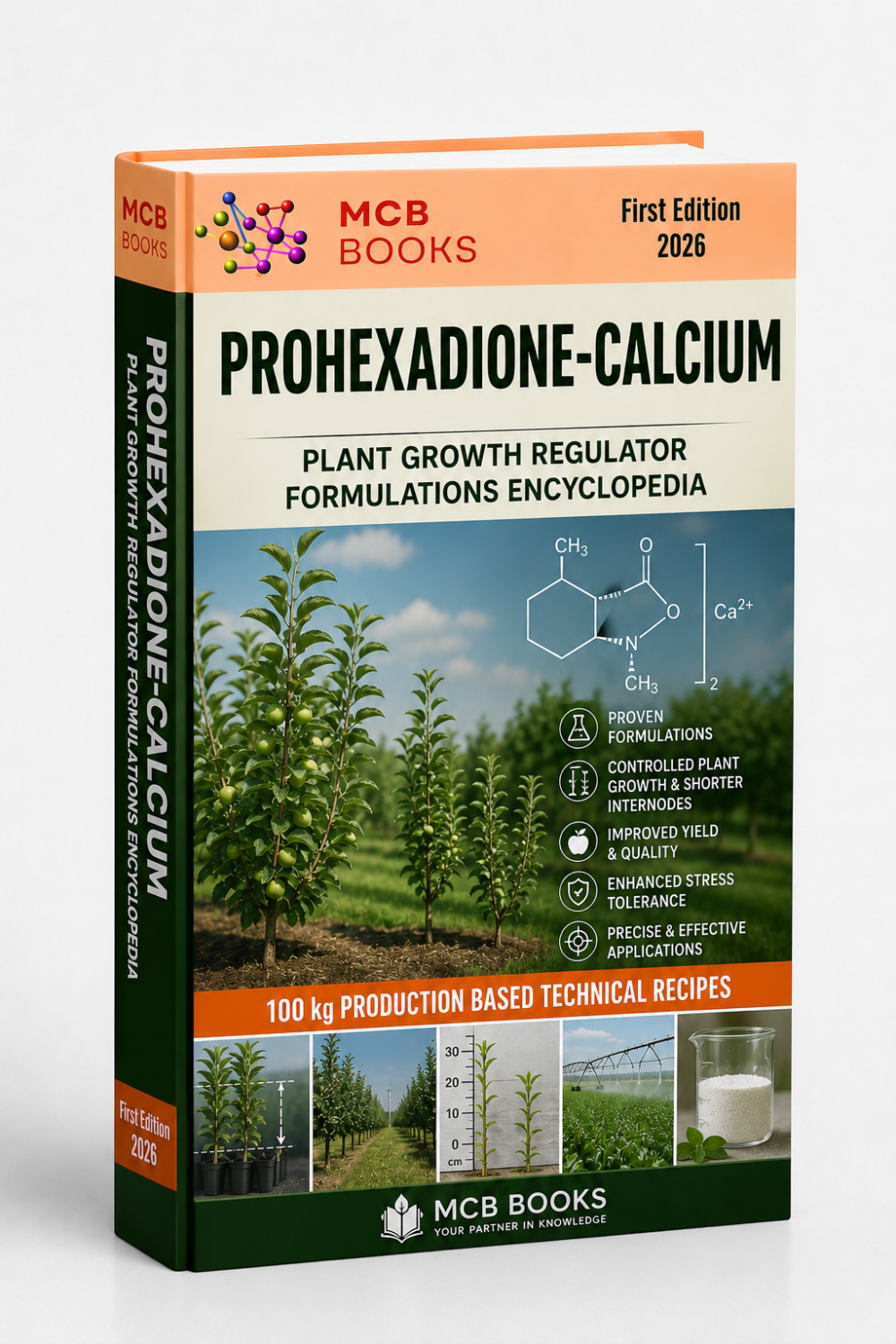
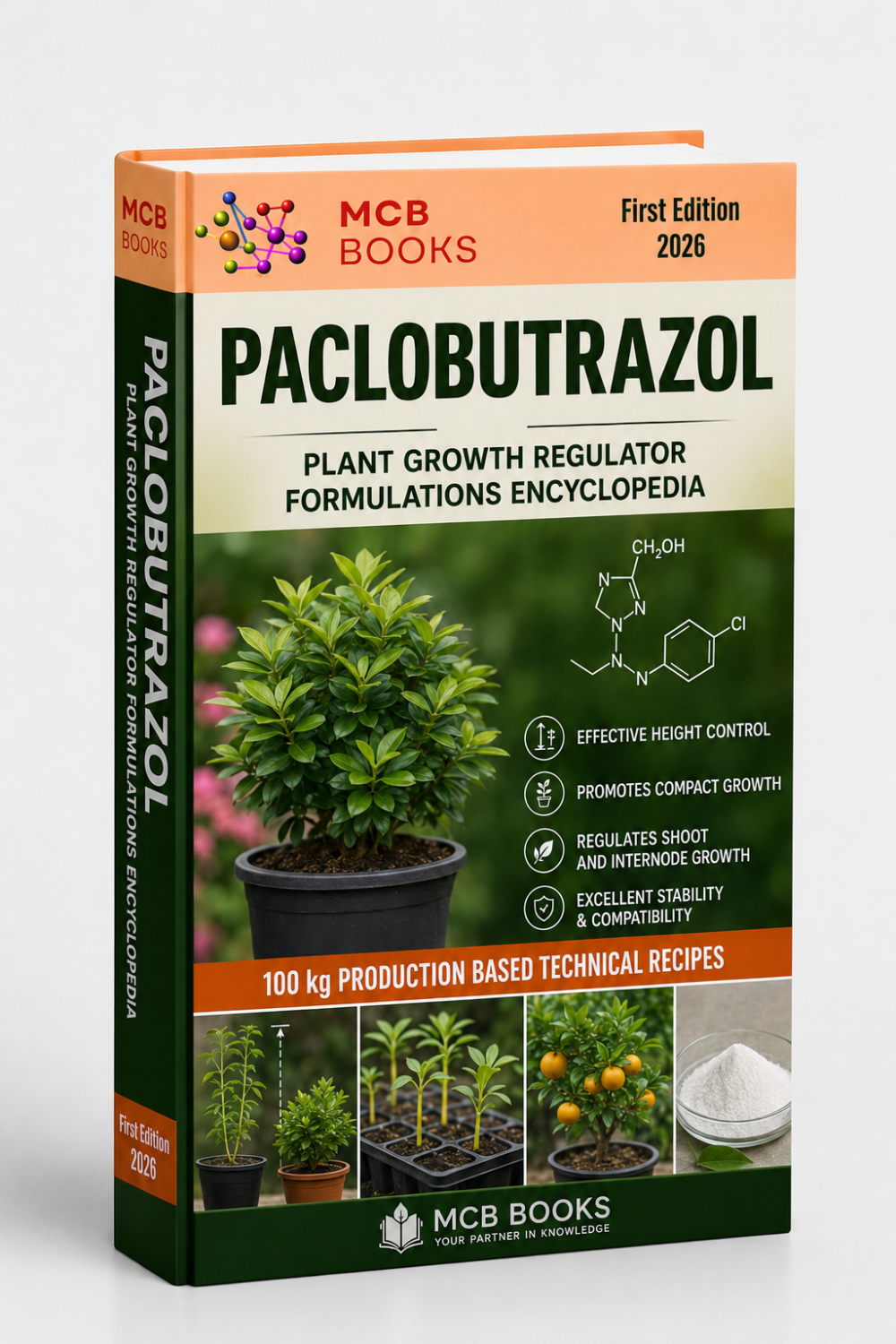
INDOLE-3-ACETIC ACID (IAA) PLANT GROWTH REGULATOR FORMULATIONS ENCYCLOPEDIA
Book details
- Editor
- MCB BOOKS
- ISBN
- 978-6058-8350-5-4
- Number of Pages
- 370 Pages
- Publication Date
- 2026
- Copyright
- MCB BOOKS
- Format
- Hard Book & E book (PDF)
- Language
- English
About the Encyclopedia
Indole-3-Acetic Acid (IAA) Plant Growth Regulator Formulations Encyclopedia is a professional technical reference prepared for agricultural chemical manufacturers, plant growth regulator producers, fertilizer companies, formulators, propagation specialists, tissue culture laboratories and R&D professionals developing commercial IAA-based products.
Indole-3-Acetic Acid, commonly known as IAA, is one of the principal naturally occurring auxins involved in plant growth and development. It plays important physiological roles in root initiation, root development, cell elongation, shoot development, vascular differentiation, apical dominance, fruit setting and overall plant development.
The encyclopedia provides a broad technical collection of IAA formulation technologies, raw-material systems, manufacturing concepts and application-oriented product-development approaches.
Commercial IAA products can be developed as liquid concentrates, soluble formulations, water-based products, powder systems, rooting preparations, propagation products and specialized tissue culture formulations.
Because IAA can be sensitive to factors such as light, excessive heat, oxidation and unsuitable pH conditions, successful commercial formulation requires careful selection of solvents, carriers, stabilizers, antioxidants, buffers and packaging systems.
The encyclopedia is designed to help manufacturers evaluate different IAA product technologies for agriculture, horticulture, nurseries, propagation and plant tissue culture.
It provides a practical technical foundation for laboratory development, pilot-scale production, formulation optimization, quality control and professional commercial manufacturing.
Table of contents
01Page 1 Contents 210 formulations · 1–336
- 1General Purpose Indole-3-Acetic Acid (IAA) Plant Growth Regulator Formulation and Industrial Production Process 1
- 3General Purpose Indole-3-Acetic Acid (IAA) Plant Growth Regulator Formulation and Industrial Production Process 2
- 5General Purpose Indole-3-Acetic Acid (IAA) Plant Growth Regulator Formulation and Industrial Production Process 3
- 7General Purpose Indole-3-Acetic Acid (IAA) Plant Growth Regulator Application Guidelines and Field Usage Program For Maximum Efficiency
- 8General Purpose Indole-3-Acetic Acid (IAA) Plant Growth Regulator Technical Properties and Usage
- 9High Purity IAA Plant Growth Regulator Formulation and Industrial Production Process 1
- 11High Purity IAA Plant Growth Regulator Formulation and Industrial Production Process 2
- 13High Purity IAA Plant Growth Regulator Formulation and Industrial Production Process 3
- 15High Purity IAA Plant Growth Regulator Application Guidelines and Field Usage Program For Maximum Efficiency
- 16High Purity IAA Plant Growth Regulator Technical Properties and Usage
- 17Water Soluble IAA Formulation and Industrial Production Process 1
- 19Water Soluble IAA Formulation and Industrial Production Process 2
- 21Water Soluble IAA Formulation and Industrial Production Process 3
- 23Water Soluble IAA Application Guidelines and Field Usage Program For Maximum Efficiency
- 24Water Soluble IAA Technical Properties and Usage
- 25Soluble Concentrate IAA Formulation and Industrial Production Process 1
- 27Soluble Concentrate IAA Formulation and Industrial Production Process 2
- 29Soluble Concentrate IAA Formulation and Industrial Production Process 3
- 31Soluble Concentrate IAA Application Guidelines and Field Usage Program For Maximum Efficiency
- 32Soluble Concentrate IAA Technical Properties and Usage
- 33Suspension Concentrate IAA Formulation and Industrial Production Process 1
- 35Suspension Concentrate IAA Formulation and Industrial Production Process 2
- 37Suspension Concentrate IAA Formulation and Industrial Production Process 3
- 39Suspension Concentrate IAA Application Guidelines and Field Usage Program For Maximum Efficiency
- 40Suspension Concentrate IAA Technical Properties and Usage
- 41Emulsifiable Concentrate IAA Formulation and Industrial Production Process 1
- 43Emulsifiable Concentrate IAA Formulation and Industrial Production Process 2
- 45Emulsifiable Concentrate IAA Formulation and Industrial Production Process 3
- 47Emulsifiable Concentrate IAA Application Guidelines and Field Usage Program For Maximum Efficiency
- 48Emulsifiable Concentrate IAA Technical Properties and Usage
- 49Wettable Powder IAA Formulation and Industrial Production Process 1
- 51Wettable Powder IAA Formulation and Industrial Production Process 2
- 53Wettable Powder IAA Formulation and Industrial Production Process 3
- 55Wettable Powder IAA Application Guidelines and Field Usage Program For Maximum Efficiency
- 56Wettable Powder IAA Technical Properties and Usage
- 57Water Dispersible Granule IAA Formulation and Industrial Production Process 1
- 59Water Dispersible Granule IAA Formulation and Industrial Production Process 2
- 61Water Dispersible Granule IAA Formulation and Industrial Production Process 3
- 63Water Dispersible Granule IAA Application Guidelines and Field Usage Program For Maximum Efficiency
- 64Water Dispersible Granule IAA Technical Properties and Usage
- 65Soluble Powder IAA Formulation and Industrial Production Process 1
- 67Soluble Powder IAA Formulation and Industrial Production Process 2
- 69Soluble Powder IAA Formulation and Industrial Production Process 3
- 71Soluble Powder IAA Application Guidelines and Field Usage Program For Maximum Efficiency
- 72Soluble Powder IAA Technical Properties and Usage
- 73Liquid IAA Plant Growth Regulator Formulation and Industrial Production Process 1
- 75Liquid IAA Plant Growth Regulator Formulation and Industrial Production Process 2
- 77Liquid IAA Plant Growth Regulator Formulation and Industrial Production Process 3
- 79Liquid IAA Plant Growth Regulator Application Guidelines and Field Usage Program For Maximum Efficiency
- 80Liquid IAA Plant Growth Regulator Technical Properties and Usage
- 81Root Development IAA Formulation and Industrial Production Process 1
- 83Root Development IAA Formulation and Industrial Production Process 2
- 85Root Development IAA Formulation and Industrial Production Process 3
- 87Root Development IAA Application Guidelines and Field Usage Program For Maximum Efficiency
- 88Root Development IAA Technical Properties and Usage
- 89Root Induction IAA Formulation and Industrial Production Process 1
- 91Root Induction IAA Formulation and Industrial Production Process 2
- 93Root Induction IAA Formulation and Industrial Production Process 3
- 95Root Induction IAA Application Guidelines and Field Usage Program For Maximum Efficiency
- 96Root Induction IAA Technical Properties and Usage
- 97Root Growth Promotion IAA Formulation and Industrial Production Process 1
- 99Root Growth Promotion IAA Formulation and Industrial Production Process 2
- 101Root Growth Promotion IAA Formulation and Industrial Production Process 3
- 103Root Growth Promotion IAA Application Guidelines and Field Usage Program For Maximum Efficiency
- 104Root Growth Promotion IAA Technical Properties and Usage
- 105Rooting Hormone IAA Formulation and Industrial Production Process 1
- 107Rooting Hormone IAA Formulation and Industrial Production Process 2
- 109Rooting Hormone IAA Formulation and Industrial Production Process 3
- 111Rooting Hormone IAA Application Guidelines and Field Usage Program For Maximum Efficiency
- 112Rooting Hormone IAA Technical Properties and Usage
- 113Cell Elongation IAA Formulation and Industrial Production Process 1
- 115Cell Elongation IAA Formulation and Industrial Production Process 2
- 117Cell Elongation IAA Formulation and Industrial Production Process 3
- 119Cell Elongation IAA Application Guidelines and Field Usage Program For Maximum Efficiency
- 120Cell Elongation IAA Technical Properties and Usage
- 121Shoot Development IAA Formulation and Industrial Production Process 1
- 123Shoot Development IAA Formulation and Industrial Production Process 2
- 125Shoot Development IAA Formulation and Industrial Production Process 3
- 127Shoot Development IAA Application Guidelines and Field Usage Program For Maximum Efficiency
- 128Shoot Development IAA Technical Properties and Usage
- 129Vegetative Growth IAA Formulation and Industrial Production Process 1
- 131Vegetative Growth IAA Formulation and Industrial Production Process 2
- 133Vegetative Growth IAA Formulation and Industrial Production Process 3
- 135Vegetative Growth IAA Application Guidelines and Field Usage Program For Maximum Efficiency
- 136Vegetative Growth IAA Technical Properties and Usage
- 137Flower Development IAA Formulation and Industrial Production Process 1
- 139Flower Development IAA Formulation and Industrial Production Process 2
- 141Flower Development IAA Formulation and Industrial Production Process 3
- 143Flower Development IAA Application Guidelines and Field Usage Program For Maximum Efficiency
- 144Flower Development IAA Technical Properties and Usage
- 145Fruit Set Improvement IAA Formulation and Industrial Production Process 1
- 147Fruit Set Improvement IAA Formulation and Industrial Production Process 2
- 149Fruit Set Improvement IAA Formulation and Industrial Production Process 3
- 151Fruit Set Improvement IAA Application Guidelines and Field Usage Program For Maximum Efficiency
- 152Fruit Set Improvement IAA Technical Properties and Usage
- 153Fruit Development IAA Formulation and Industrial Production Process 1
- 155Fruit Development IAA Formulation and Industrial Production Process 2
- 157Fruit Development IAA Formulation and Industrial Production Process 3
- 159Fruit Development IAA Application Guidelines and Field Usage Program For Maximum Efficiency
- 160Fruit Development IAA Technical Properties and Usage
- 161Fruit Retention IAA Formulation and Industrial Production Process 1
- 163Fruit Retention IAA Formulation and Industrial Production Process 2
- 165Fruit Retention IAA Formulation and Industrial Production Process 3
- 167Fruit Retention IAA Application Guidelines and Field Usage Program For Maximum Efficiency
- 168Fruit Retention IAA Technical Properties and Usage
- 169Nursery IAA Formulation and Industrial Production Process 1
- 171Nursery IAA Formulation and Industrial Production Process 2
- 173Nursery IAA Formulation and Industrial Production Process 3
- 175Nursery IAA Application Guidelines and Field Usage Program For Maximum Efficiency
- 176Nursery IAA Technical Properties and Usage
- 177Greenhouse IAA Formulation and Industrial Production Process 1
- 179Greenhouse IAA Formulation and Industrial Production Process 2
- 181Greenhouse IAA Formulation and Industrial Production Process 3
- 183Greenhouse IAA Application Guidelines and Field Usage Program For Maximum Efficiency
- 184Greenhouse IAA Technical Properties and Usage
- 185Hydroponic IAA Formulation and Industrial Production Process 1
- 187Hydroponic IAA Formulation and Industrial Production Process 2
- 189Hydroponic IAA Formulation and Industrial Production Process 3
- 191Hydroponic IAA Application Guidelines and Field Usage Program For Maximum Efficiency
- 192Hydroponic IAA Technical Properties and Usage
- 193Tissue Culture IAA Formulation and Industrial Production Process 1
- 195Tissue Culture IAA Formulation and Industrial Production Process 2
- 197Tissue Culture IAA Formulation and Industrial Production Process 3
- 199Tissue Culture IAA Application Guidelines and Field Usage Program For Maximum Efficiency
- 200Tissue Culture IAA Technical Properties and Usage
- 201Seed Treatment IAA Formulation and Industrial Production Process 1
- 203Seed Treatment IAA Formulation and Industrial Production Process 2
- 205Seed Treatment IAA Formulation and Industrial Production Process 3
- 207Seed Treatment IAA Application Guidelines and Field Usage Program For Maximum Efficiency
- 208Seed Treatment IAA Technical Properties and Usage
- 209Foliar Spray IAA Formulation and Industrial Production Process 1
- 211Foliar Spray IAA Formulation and Industrial Production Process 2
- 213Foliar Spray IAA Formulation and Industrial Production Process 3
- 215Foliar Spray IAA Application Guidelines and Field Usage Program For Maximum Efficiency
- 216Foliar Spray IAA Technical Properties and Usage
- 217Root Dip IAA Formulation and Industrial Production Process 1
- 219Root Dip IAA Formulation and Industrial Production Process 2
- 221Root Dip IAA Formulation and Industrial Production Process 3
- 223Root Dip IAA Application Guidelines and Field Usage Program For Maximum Efficiency
- 224Root Dip IAA Technical Properties and Usage
- 225Transplant Shock Reduction IAA Formulation and Industrial Production Process 1
- 227Transplant Shock Reduction IAA Formulation and Industrial Production Process 2
- 229Transplant Shock Reduction IAA Formulation and Industrial Production Process 3
- 231Transplant Shock Reduction IAA Application Guidelines and Field Usage Program For Maximum Efficiency
- 232Transplant Shock Reduction IAA Technical Properties and Usage
- 233Stress Recovery IAA Formulation and Industrial Production Process 1
- 235Stress Recovery IAA Formulation and Industrial Production Process 2
- 237Stress Recovery IAA Formulation and Industrial Production Process 3
- 239Stress Recovery IAA Application Guidelines and Field Usage Program For Maximum Efficiency
- 240Stress Recovery IAA Technical Properties and Usage
- 241Citrus IAA Formulation and Industrial Production Process 1
- 243Citrus IAA Formulation and Industrial Production Process 2
- 245Citrus IAA Formulation and Industrial Production Process 3
- 247Citrus IAA Application Guidelines and Field Usage Program For Maximum Efficiency
- 248Citrus IAA Technical Properties and Usage
- 249Apple IAA Formulation and Industrial Production Process 1
- 251Apple IAA Formulation and Industrial Production Process 2
- 253Apple IAA Formulation and Industrial Production Process 3
- 255Apple IAA Application Guidelines and Field Usage Program For Maximum Efficiency
- 256Apple IAA Technical Properties and Usage
- 257Pear IAA Formulation and Industrial Production Process 1
- 259Pear IAA Formulation and Industrial Production Process 2
- 261Pear IAA Formulation and Industrial Production Process 3
- 263Pear IAA Application Guidelines and Field Usage Program For Maximum Efficiency
- 264Pear IAA Technical Properties and Usage
- 265Grape IAA Formulation and Industrial Production Process 1
- 267Grape IAA Formulation and Industrial Production Process 2
- 269Grape IAA Formulation and Industrial Production Process 3
- 271Grape IAA Application Guidelines and Field Usage Program For Maximum Efficiency
- 272Grape IAA Technical Properties and Usage
- 273Olive IAA Formulation and Industrial Production Process 1
- 275Olive IAA Formulation and Industrial Production Process 2
- 277Olive IAA Formulation and Industrial Production Process 3
- 279Olive IAA Application Guidelines and Field Usage Program For Maximum Efficiency
- 280Olive IAA Technical Properties and Usage
- 281Tomato IAA Formulation and Industrial Production Process 1
- 283Tomato IAA Formulation and Industrial Production Process 2
- 285Tomato IAA Formulation and Industrial Production Process 3
- 287Tomato IAA Application Guidelines and Field Usage Program For Maximum Efficiency
- 288Tomato IAA Technical Properties and Usage
- 289Pepper IAA Formulation and Industrial Production Process 1
- 291Pepper IAA Formulation and Industrial Production Process 2
- 293Pepper IAA Formulation and Industrial Production Process 3
- 295Pepper IAA Application Guidelines and Field Usage Program For Maximum Efficiency
- 296Pepper IAA Technical Properties and Usage
- 297Cucumber IAA Formulation and Industrial Production Process 1
- 299Cucumber IAA Formulation and Industrial Production Process 2
- 301Cucumber IAA Formulation and Industrial Production Process 3
- 303Cucumber IAA Application Guidelines and Field Usage Program For Maximum Efficiency
- 304Cucumber IAA Technical Properties and Usage
- 305Strawberry IAA Formulation and Industrial Production Process 1
- 307Strawberry IAA Formulation and Industrial Production Process 2
- 309Strawberry IAA Formulation and Industrial Production Process 3
- 311Strawberry IAA Application Guidelines and Field Usage Program For Maximum Efficiency
- 312Strawberry IAA Technical Properties and Usage
- 313Cotton IAA Formulation and Industrial Production Process 1
- 315Cotton IAA Formulation and Industrial Production Process 2
- 317Cotton IAA Formulation and Industrial Production Process 3
- 319Cotton IAA Application Guidelines and Field Usage Program For Maximum Efficiency
- 320Cotton IAA Technical Properties and Usage
- 321Rice IAA Formulation and Industrial Production Process 1
- 323Rice IAA Formulation and Industrial Production Process 2
- 325Rice IAA Formulation and Industrial Production Process 3
- 327Rice IAA Application Guidelines and Field Usage Program For Maximum Efficiency
- 328Rice IAA Technical Properties and Usage
- 329Wheat IAA Formulation and Industrial Production Process 1
- 331Wheat IAA Formulation and Industrial Production Process 2
- 333Wheat IAA Formulation and Industrial Production Process 3
- 335Wheat IAA Application Guidelines and Field Usage Program For Maximum Efficiency
- 336Wheat IAA Technical Properties and Usage
More about this book
What's Inside the Encyclopedia
The encyclopedia contains a comprehensive collection of Indole-3-Acetic Acid plant growth regulator formulation technologies and production concepts developed for different agricultural, horticultural and laboratory applications.
Manufacturers can study liquid IAA concentrates, water-compatible formulations, soluble products, powder systems and specialized rooting preparations.
The content covers important auxin-related applications including root initiation, root development, cell elongation, shoot growth, vascular development, plant establishment and fruit setting.
A significant part of IAA formulation development is associated with propagation and nursery applications. Specialized products may be developed for seedlings, cuttings, transplant establishment and other situations where rapid and uniform root initiation is an important objective.
Plant tissue culture represents another important application area. IAA-based products can be incorporated into culture programs where auxin concentration and auxin-to-cytokinin balance influence rooting, callus development, organ formation and plant regeneration.
The encyclopedia also addresses formulation stability. Because IAA can be affected by environmental conditions, manufacturers must consider antioxidant systems, pH control, temperature management, suitable packaging and protection from excessive light.
Industrial production information includes preparation of solvent and carrier phases, incorporation of active ingredients, addition of stabilizers and surfactants, homogenization, filtration, pH adjustment and final quality-control procedures.
This broad structure provides manufacturers with a professional reference for developing multiple commercial IAA products instead of relying on one general-purpose formulation.
Why This Encyclopedia
Developing a commercial IAA formulation requires careful technical control because Indole-3-Acetic Acid has formulation and stability characteristics that can influence finished-product performance.
Solubility, solvent selection, pH, oxidation, light exposure, temperature and interaction with other formulation ingredients should all be considered during product development.
A rooting formulation may require a different carrier and concentration system from an IAA product intended for tissue culture, foliar application or fruit-development programs.
For this reason, manufacturers benefit from comparing multiple formulation approaches.
The encyclopedia provides professional information concerning solvent systems, co-solvents, surfactants, wetting agents, stabilizers, antioxidants, buffers, preservatives, dispersing agents and other formulation auxiliaries.
It can be used during laboratory formulation work, product stabilization, manufacturing-process development, quality-control planning and pilot-scale production.
Manufacturers can also use the information to evaluate suitable packaging and storage conditions for protecting sensitive IAA products during their commercial shelf life.
For companies developing auxin-based plant growth regulators, the encyclopedia provides a practical technical foundation covering both conventional agricultural products and specialized propagation or tissue culture applications.
About Formulations
Indole-3-Acetic Acid Formulations, IAA plant growth regulators, auxin formulations, liquid IAA concentrates, water soluble IAA formulations, water based products, powder formulations, rooting preparations, root initiation formulations, root development products, cell elongation formulations, shoot development products, vascular development formulations, plant establishment products, fruit setting formulations, nursery applications, propagation formulations, transplant establishment, tissue culture formulations, callus development products, rooting culture products, agricultural IAA formulations, horticultural IAA products, stabilized IAA formulations, commercial production processes
Manufacturing Methods
Each formulation is presented in a clear and practical structure showing the raw materials, CAS numbers, functions of each ingredient, and exact quantities required for production.
All formulations are calculated on a 100 kg production basis, making them easy to understand, compare, scale, and adapt for laboratory or industrial R&D work.
The book uses straightforward technical language so that readers can follow the formulations without needing advanced engineering knowledge.
The Production Process section explains the manufacturing sequence step by step, including charging order, mixing, dissolution, dispersion, temperature control, viscosity adjustment, filtration, and final filling.
Special attention is given to what happens at each production stage, helping the reader understand not only what to add, but when, how, and why it is added.
The formulations are presented as practical starting formulations for laboratory, in-house, R&D, product-development, and commercial production studies, with final validation and regulatory testing required before market use.
In this way, the encyclopedia guides the reader through the complete manufacturing workflow in a form that can be followed by formulators, technicians, production staff, entrepreneurs, and manufacturers alike.
Troubleshooting
The encyclopedia helps readers understand and identify common problems that may occur during production and application.
Issues such as incorrect viscosity, poor adhesion, slow or incomplete curing, premature thickening, air bubbles, poor dispersion, and moisture-related instability can be evaluated through the formulation and production guidance.
The production processes explain critical factors such as mixing order, temperature, moisture control, dispersion, degassing, viscosity adjustment, filtration, and packaging conditions that can directly influence the final product.
Readers can also understand how substrate preparation, mixing accuracy, bond-line thickness, curing conditions, and application environment affect adhesive performance.
By comparing the expected product properties with actual production results, users can more easily determine where a problem may have originated in the manufacturing process.
This practical approach helps reduce unnecessary trial and error and provides a clearer direction for corrective formulation adjustments and process optimization.
Troubleshooting therefore becomes part of the overall formulation-development process rather than a separate, complicated engineering task.
Unlimited Technical Support
Customers purchasing the Indole-3-Acetic Acid (IAA) Plant Growth Regulator Formulations Encyclopedia can contact our technical team for support concerning the formulations and production processes included in the book.
Technical support may include questions related to raw-material selection, solvent systems, formulation structure, stabilizer selection, manufacturing sequence, mixing conditions, product form selection and general formulation-development considerations.
The formulations included in the encyclopedia can serve as professional starting points for laboratory development, pilot production and commercial product development.
Manufacturers should complete appropriate quality-control testing, storage-stability studies, crop or laboratory validation and all applicable regulatory procedures before commercializing finished IAA plant growth regulator products.
Featured Articles
1. How to Make Indole-3-Acetic Acid (IAA) Plant Growth Regulator Formulations
Indole-3-Acetic Acid, commonly known as IAA, is one of the most important naturally occurring auxins involved in plant growth and development. Commercial IAA products may be developed for agricultural, horticultural, propagation, nursery and plant tissue culture applications.
Common formulation forms include liquid concentrates, soluble preparations, water-based systems, powder products and specialized rooting formulations.
The first stage of product development is determining the required active ingredient concentration and final commercial product form.
IAA formulation development requires particular attention to stability. The active ingredient can be affected by light, oxidation, excessive temperature and unsuitable pH conditions, meaning that the formulation system must be designed carefully.
Depending on the product, manufacturers may use selected solvents, co-solvents, surfactants, wetting agents, antioxidants, stabilizers, buffers, preservatives and dispersing agents.
Liquid production generally begins with preparation of the selected solvent or carrier phase. IAA is then incorporated gradually under controlled agitation until the required level of dissolution or dispersion is achieved.
Supporting formulation components are added according to the selected manufacturing sequence.
Temperature and pH should be monitored carefully throughout production. Excessive processing temperatures should generally be avoided where they could accelerate degradation.
Depending on the formulation, homogenization, filtration and final pH adjustment may also be required.
Finished products should be evaluated for active ingredient concentration, appearance, pH, density, solubility, viscosity, dilution stability, storage stability and packaging compatibility.
The Indole-3-Acetic Acid Plant Growth Regulator Formulations Encyclopedia provides manufacturers with a broad technical foundation for developing stable and commercially suitable IAA formulations for multiple agricultural and horticultural applications.
TAGS: Indole-3-Acetic Acid formulation, IAA formulation, IAA plant growth regulator, IAA manufacturing, auxin formulation, IAA production process, plant growth regulator formulation, agricultural IAA
2. IAA Formulations for Root Initiation and Root Development
Root development is one of the most important physiological areas associated with Indole-3-Acetic Acid and represents a major commercial application for IAA-based plant growth regulator products.
Auxins influence the formation and development of roots, including adventitious and lateral root systems. For this reason, IAA formulations may be developed for propagation, seedlings, cuttings, nursery crops and transplant-establishment programs.
The commercial product form should be selected according to concentration, method of application and target market.
Liquid rooting products can provide convenient dilution and application, while concentrated or powder-based systems may offer different storage and distribution advantages.
Formulation stability is particularly important because IAA should remain uniformly distributed and protected against conditions that could accelerate degradation.
Suitable solvents, co-solvents, antioxidants, stabilizers, surfactants and buffers may therefore be incorporated into the formulation.
During manufacturing, the carrier or solvent phase is prepared first. IAA is added under controlled mixing conditions before supporting raw materials are incorporated.
The finished formulation should be checked for active ingredient concentration, pH, appearance, solubility and storage stability.
Rooting performance must be evaluated independently through suitable plant trials because response can differ according to species, cutting type, developmental stage and environmental conditions.
Products intended for nursery or propagation use should therefore have application recommendations developed for their specific target market.
The IAA Plant Growth Regulator Formulations Encyclopedia provides manufacturers with technical approaches for developing rooting and root-development products for professional propagation, horticultural and agricultural markets.
TAGS: IAA root development, IAA rooting formulation, Indole-3-Acetic Acid rooting, root initiation formulation, auxin rooting hormone, nursery rooting product, propagation PGR, IAA root promoter
3. IAA Formulations for Cell Elongation, Shoot Growth and Plant Development
Cell elongation is one of the major physiological processes associated with auxin activity and is therefore an important area in IAA plant growth regulator development.
Indole-3-Acetic Acid influences cellular growth processes that contribute to stem, root and tissue development. IAA is also associated with shoot development, apical dominance and vascular differentiation.
Commercial formulations may therefore be developed for plant-growth programs targeting balanced vegetative development and crop establishment.
The appropriate product technology depends on the intended application system.
Liquid concentrates and soluble formulations may be selected for foliar or general agricultural application, while other systems may be developed for nursery and propagation markets.
Manufacturers should pay close attention to IAA stability when designing these products.
Suitable antioxidant systems, buffers, solvents and stabilizing materials can help protect the active ingredient from unfavorable processing or storage conditions.
Production begins with preparation of the carrier phase under controlled conditions. IAA is gradually incorporated while mixing is maintained, followed by surfactants, stabilizers and other required formulation auxiliaries.
Finished formulations may be evaluated for active content, appearance, pH, density, solubility and storage behavior.
Agricultural performance should then be validated according to target crop, developmental stage and environmental conditions.
Plant-growth regulator products should not rely on a universal application concentration because physiological responses can vary substantially between plant species.
The encyclopedia provides several formulation concepts associated with cell elongation, shoot development, vascular differentiation and general plant growth, allowing manufacturers to build specialized products within a broader auxin-based portfolio.
TAGS: IAA cell elongation, shoot growth formulation, auxin plant growth, IAA shoot development, vascular development formulation, plant growth promoter, IAA vegetative growth, Indole-3-Acetic Acid PGR
4. IAA Formulations for Fruit Setting and Fruit Development
Fruit setting is another important area in which auxin activity plays a significant physiological role.
Indole-3-Acetic Acid is involved in early fruit-development processes and can be incorporated into plant growth regulator programs designed around fruit initiation and subsequent development.
Commercial IAA formulations for fruit-related applications can be produced in liquid, soluble or other suitable systems depending on target concentration and application strategy.
The product should maintain consistent active ingredient distribution and suitable chemical stability throughout storage.
Solvents, surfactants, stabilizers, antioxidants and pH-adjusting materials should be selected carefully because degradation of the active ingredient can affect finished-product quality.
During manufacturing, IAA is incorporated into a prepared carrier phase under controlled agitation.
Remaining formulation materials are subsequently added according to the required sequence, and the batch may undergo homogenization, filtration or final pH adjustment where appropriate.
Quality-control testing should confirm active ingredient content, appearance, pH, solubility, density and stability.
Fruit-set responses are strongly influenced by crop species, cultivar, flowering stage, pollination, environmental conditions and application timing.
Therefore, formulation concentration and agricultural application rate should always be considered separately.
Crop-specific trials are essential for establishing suitable use recommendations.
The Indole-3-Acetic Acid (IAA) Plant Growth Regulator Formulations Encyclopedia provides a technical foundation for manufacturers interested in developing IAA-based fruit-setting and fruit-development products as part of a broader auxin plant growth regulator range.
These products may complement formulations aimed at root development, vegetative growth and other plant-development applications.
TAGS: IAA fruit set, Indole-3-Acetic Acid fruit setting, fruit development formulation, auxin fruit set, IAA fruit development, plant growth regulator fruit set, fruit initiation formulation, agricultural auxin product
5. IAA Formulations for Plant Tissue Culture, Nurseries and Propagation
Plant tissue culture and professional propagation represent highly specialized application areas for IAA.
In tissue culture systems, auxins are important because their concentration and balance with cytokinins can influence root formation, callus development, organogenesis and plant regeneration.
IAA formulations can therefore be developed as laboratory-oriented concentrates, stock preparations or other specialized systems designed for incorporation into tissue culture media.
Because tissue culture applications require accurate concentration control, formulation uniformity and chemical stability are particularly important.
Manufacturers should select high-quality raw materials and carefully controlled solvent systems.
Suitable buffers, stabilizers and antioxidants may be included where required to protect IAA during production and storage.
Light-protective packaging may also be appropriate because IAA can be sensitive to environmental degradation.
Nursery and propagation products represent another important commercial area.
IAA formulations may be developed for cuttings, seedlings, transplant establishment and professional rooting applications where uniform early plant development is required.
The production process generally involves controlled preparation of the solvent or carrier phase followed by incorporation of IAA and supporting formulation ingredients.
Finished products should be tested for active concentration, pH, clarity or appearance, solubility, storage stability and packaging compatibility.
For tissue culture applications, compatibility with culture media should also be evaluated.
The IAA Plant Growth Regulator Formulations Encyclopedia provides professional information for companies serving agriculture, horticulture, tissue culture laboratories, nurseries and commercial propagation facilities.
By covering both field-oriented and laboratory-oriented formulations, the encyclopedia enables manufacturers to develop a broader IAA portfolio serving several specialized plant-production markets.
TAGS: IAA tissue culture, Indole-3-Acetic Acid tissue culture, IAA propagation, nursery rooting formulation, auxin tissue culture, IAA callus formation, micropropagation PGR, plant tissue culture formulation
Some Raw Materials Used
Indole-3-Acetic Acid (IAA), Ethanol, Isopropyl Alcohol, Methanol, Dimethyl Sulfoxide, Propylene Glycol, Polyethylene Glycol, Purified Water, Deionized Water, Nonionic Surfactants, Anionic Surfactants, Solubilizing Agents, Wetting Agents, Dispersing Agents, Antioxidants, Stabilizers, Buffering Agents, pH Adjusting Agents, Preservatives, Chelating Agents, Humectants, Water-Soluble Carriers, Powder Carriers, Cellulose Derivatives, Thickening Agents, Antifoaming Agents, Light-Protective Packaging Systems
Why Choose This Encyclopedia
INDOLE-3-ACETIC ACID (IAA) PLANT GROWTH REGULATOR FORMULATIONS ENCYCLOPEDIA is prepared for manufacturers, formulators and R&D teams who want to produce commercially, not only to read about chemistry. Every product in the book follows the same structure: raw materials with their functions and quantities; the complete production process with charging order, mixing, temperature and control points; product specifications; and troubleshooting guidance that links common production problems to their causes.
The recipes are written as tested starting points: reproduce them at laboratory scale, confirm the specification, then scale up to pilot and full production. Readers planning a new line often combine this book with 6-BENZYLAMINOPURINE (6-BA/BAP) PLANT GROWTH REGULATOR FORMULATIONS ENCYCLOPEDIA, and our free articles offer further technical background.
Every MCB Books encyclopedia is available as a hard book and PDF — the PDF is delivered instantly, the printed edition ships worldwide — and all purchases include unlimited technical support. Questions before ordering? Contact the MCB Books team or write to us on WhatsApp; we reply the same day.
Related books