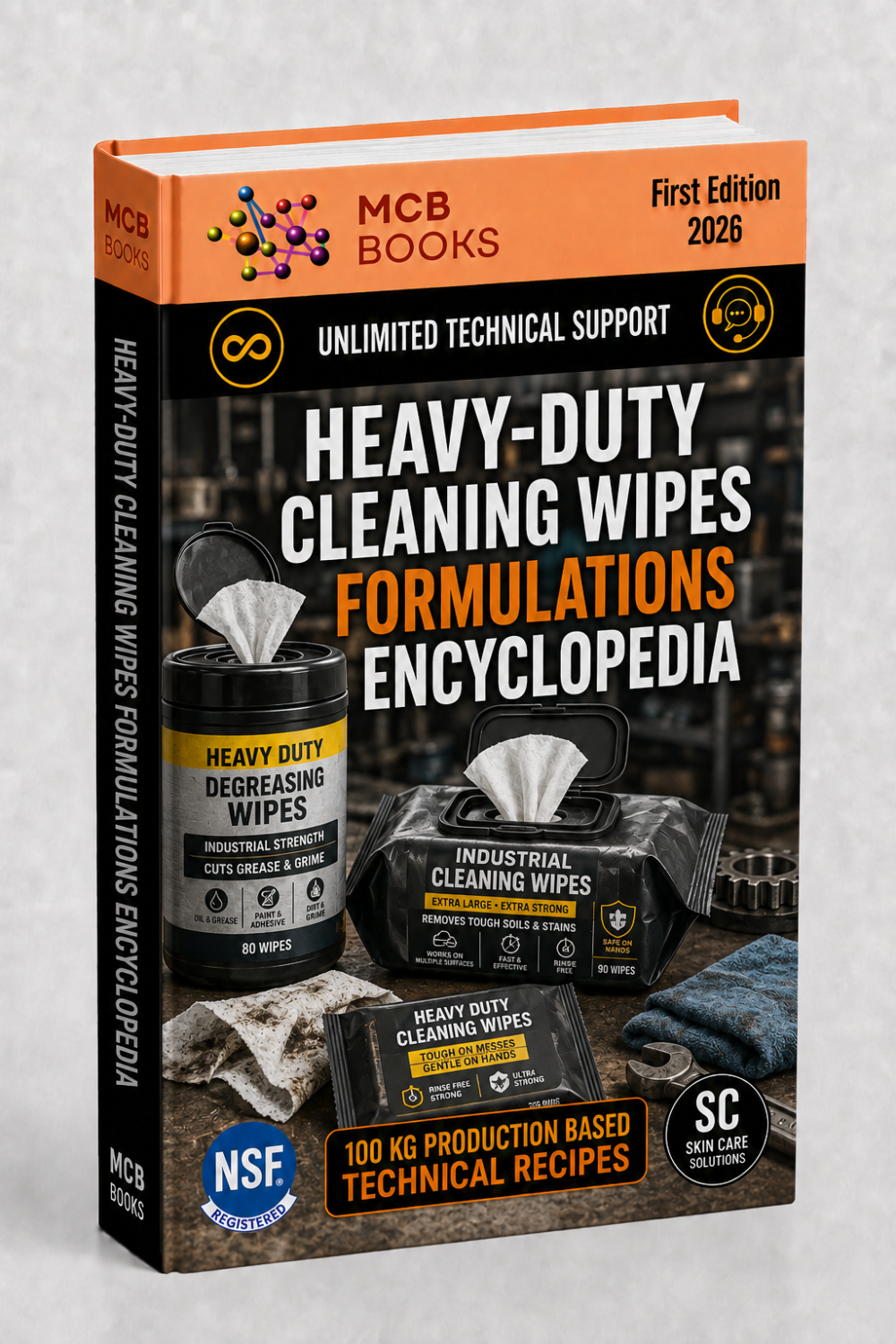
INDUSTRIAL CLEANING WIPES FORMULATIONS ENCYCLOPEDIA
Book details
- Editor
- MCB BOOKS
- ISBN
- 978-625-95879-1-2
- Number of Pages
- 425 Pages
- Publication Date
- 2026
- Copyright
- MCB BOOKS
- Format
- Hard Book & E book (PDF)
- Language
- English
About the Encyclopedia
The Industrial Cleaning Wipes Formulations Encyclopedia is a technical reference for chemical manufacturers and businesses developing ready-to-use cleaning wipes for factories, workshops and industrial facilities. It covers cleaning products used on machinery, production equipment, metal surfaces, conveyor systems and other areas where regular maintenance and reliable cleaning are part of daily operations.
Industrial cleaning is not the same in every workplace. A wipe used to clean stainless steel equipment in a food processing facility has different requirements from one developed for machine maintenance or electrical components. The materials being cleaned, the type of contamination and the working environment all influence the formulation.
The Industrial Cleaning Wipes Formulations Encyclopedia brings these different applications together in one collection. It helps manufacturers explore water-based and solvent-based cleaning systems, equipment-compatible ingredients, nonwoven materials and production methods used in developing industrial cleaning wipes.
With 425 pages of technical content, the book covers 50 industrial cleaning wipe products, each with three formulation and manufacturing approaches. It is intended for manufacturers who want to produce their own industrial wipes, introduce new products or expand an existing range of maintenance and cleaning chemicals.
Table of contents
01Page 1 Contents 250 formulations · 1–400
- 1Heavy-Duty Industrial Cleaning Wipes Formulation and Production Process 1
- 3Heavy-Duty Industrial Cleaning Wipes Formulation and Production Process 2
- 5Heavy-Duty Industrial Cleaning Wipes Formulation and Production Process 3
- 7Heavy-Duty Industrial Cleaning Wipes Product Analysis
- 8Heavy-Duty Industrial Cleaning Wipes Product Properties
- 9General Purpose Industrial Cleaning Wipes Formulation and Production Process 1
- 11General Purpose Industrial Cleaning Wipes Formulation and Production Process 2
- 13General Purpose Industrial Cleaning Wipes Formulation and Production Process 3
- 15General Purpose Industrial Cleaning Wipes Product Analysis
- 16General Purpose Industrial Cleaning Wipes Product Properties
- 17Degreasing Industrial Cleaning Wipes Formulation and Production Process 1
- 19Degreasing Industrial Cleaning Wipes Formulation and Production Process 2
- 21Degreasing Industrial Cleaning Wipes Formulation and Production Process 3
- 23Degreasing Industrial Cleaning Wipes Product Analysis
- 24Degreasing Industrial Cleaning Wipes Product Properties
- 25Oil and Grease Removal Wipes Formulation and Production Process 1
- 27Oil and Grease Removal Wipes Formulation and Production Process 2
- 29Oil and Grease Removal Wipes Formulation and Production Process 3
- 31Oil and Grease Removal Wipes Product Analysis
- 32Oil and Grease Removal Wipes Product Properties
- 33Machine Cleaning Wipes Formulation and Production Process 1
- 35Machine Cleaning Wipes Formulation and Production Process 2
- 37Machine Cleaning Wipes Formulation and Production Process 3
- 39Machine Cleaning Wipes Product Analysis
- 40Machine Cleaning Wipes Product Properties
- 41Equipment Cleaning Wipes Formulation and Production Process 1
- 43Equipment Cleaning Wipes Formulation and Production Process 2
- 45Equipment Cleaning Wipes Formulation and Production Process 3
- 47Equipment Cleaning Wipes Product Analysis
- 48Equipment Cleaning Wipes Product Properties
- 49Tool Cleaning Wipes Formulation and Production Process 1
- 51Tool Cleaning Wipes Formulation and Production Process 2
- 53Tool Cleaning Wipes Formulation and Production Process 3
- 55Tool Cleaning Wipes Product Analysis
- 56Tool Cleaning Wipes Product Properties
- 57Metal Surface Cleaning Wipes Formulation and Production Process 1
- 59Metal Surface Cleaning Wipes Formulation and Production Process 2
- 61Metal Surface Cleaning Wipes Formulation and Production Process 3
- 63Metal Surface Cleaning Wipes Product Analysis
- 64Metal Surface Cleaning Wipes Product Properties
- 65Stainless Steel Cleaning Wipes Formulation and Production Process 1
- 67Stainless Steel Cleaning Wipes Formulation and Production Process 2
- 69Stainless Steel Cleaning Wipes Formulation and Production Process 3
- 71Stainless Steel Cleaning Wipes Product Analysis
- 72Stainless Steel Cleaning Wipes Product Properties
- 73Aluminum Surface Cleaning Wipes Formulation and Production Process 1
- 75Aluminum Surface Cleaning Wipes Formulation and Production Process 2
- 77Aluminum Surface Cleaning Wipes Formulation and Production Process 3
- 79Aluminum Surface Cleaning Wipes Product Analysis
- 80Aluminum Surface Cleaning Wipes Product Properties
- 81Painted Surface Cleaning Wipes Formulation and Production Process 1
- 83Painted Surface Cleaning Wipes Formulation and Production Process 2
- 85Painted Surface Cleaning Wipes Formulation and Production Process 3
- 87Painted Surface Cleaning Wipes Product Analysis
- 88Painted Surface Cleaning Wipes Product Properties
- 89Industrial Glass Cleaning Wipes Formulation and Production Process 1
- 91Industrial Glass Cleaning Wipes Formulation and Production Process 2
- 93Industrial Glass Cleaning Wipes Formulation and Production Process 3
- 95Industrial Glass Cleaning Wipes Product Analysis
- 96Industrial Glass Cleaning Wipes Product Properties
- 97Industrial Plastic Surface Cleaning Wipes Formulation and Production Process 1
- 99Industrial Plastic Surface Cleaning Wipes Formulation and Production Process 2
- 101Industrial Plastic Surface Cleaning Wipes Formulation and Production Process 3
- 103Industrial Plastic Surface Cleaning Wipes Product Analysis
- 104Industrial Plastic Surface Cleaning Wipes Product Properties
- 105Industrial Rubber Surface Cleaning Wipes Formulation and Production Process 1
- 107Industrial Rubber Surface Cleaning Wipes Formulation and Production Process 2
- 109Industrial Rubber Surface Cleaning Wipes Formulation and Production Process 3
- 111Industrial Rubber Surface Cleaning Wipes Product Analysis
- 112Industrial Rubber Surface Cleaning Wipes Product Properties
- 113Electronic Equipment Cleaning Wipes Formulation and Production Process 1
- 115Electronic Equipment Cleaning Wipes Formulation and Production Process 2
- 117Electronic Equipment Cleaning Wipes Formulation and Production Process 3
- 119Electronic Equipment Cleaning Wipes Product Analysis
- 120Electronic Equipment Cleaning Wipes Product Properties
- 121Electrical Component Cleaning Wipes Formulation and Production Process 1
- 123Electrical Component Cleaning Wipes Formulation and Production Process 2
- 125Electrical Component Cleaning Wipes Formulation and Production Process 3
- 127Electrical Component Cleaning Wipes Product Analysis
- 128Electrical Component Cleaning Wipes Product Properties
- 129Precision Equipment Cleaning Wipes Formulation and Production Process 1
- 131Precision Equipment Cleaning Wipes Formulation and Production Process 2
- 133Precision Equipment Cleaning Wipes Formulation and Production Process 3
- 135Precision Equipment Cleaning Wipes Product Analysis
- 136Precision Equipment Cleaning Wipes Product Properties
- 137Production Line Cleaning Wipes Formulation and Production Process 1
- 139Production Line Cleaning Wipes Formulation and Production Process 2
- 141Production Line Cleaning Wipes Formulation and Production Process 3
- 143Production Line Cleaning Wipes Product Analysis
- 144Production Line Cleaning Wipes Product Properties
- 145Conveyor Belt Cleaning Wipes Formulation and Production Process 1
- 147Conveyor Belt Cleaning Wipes Formulation and Production Process 2
- 149Conveyor Belt Cleaning Wipes Formulation and Production Process 3
- 151Conveyor Belt Cleaning Wipes Product Analysis
- 152Conveyor Belt Cleaning Wipes Product Properties
- 153Manufacturing Equipment Cleaning Wipes Formulation and Production Process 1
- 155Manufacturing Equipment Cleaning Wipes Formulation and Production Process 2
- 157Manufacturing Equipment Cleaning Wipes Formulation and Production Process 3
- 159Manufacturing Equipment Cleaning Wipes Product Analysis
- 160Manufacturing Equipment Cleaning Wipes Product Properties
- 161Workshop Cleaning Wipes Formulation and Production Process 1
- 163Workshop Cleaning Wipes Formulation and Production Process 2
- 165Workshop Cleaning Wipes Formulation and Production Process 3
- 167Workshop Cleaning Wipes Product Analysis
- 168Workshop Cleaning Wipes Product Properties
- 169Factory Floor Cleaning Wipes Formulation and Production Process 1
- 171Factory Floor Cleaning Wipes Formulation and Production Process 2
- 173Factory Floor Cleaning Wipes Formulation and Production Process 3
- 175Factory Floor Cleaning Wipes Product Analysis
- 176Factory Floor Cleaning Wipes Product Properties
- 177Warehouse Cleaning Wipes Formulation and Production Process 1
- 179Warehouse Cleaning Wipes Formulation and Production Process 2
- 181Warehouse Cleaning Wipes Formulation and Production Process 3
- 183Warehouse Cleaning Wipes Product Analysis
- 184Warehouse Cleaning Wipes Product Properties
- 185Maintenance Cleaning Wipes Formulation and Production Process 1
- 187Maintenance Cleaning Wipes Formulation and Production Process 2
- 189Maintenance Cleaning Wipes Formulation and Production Process 3
- 191Maintenance Cleaning Wipes Product Analysis
- 192Maintenance Cleaning Wipes Product Properties
- 193Industrial Hand Cleaning Wipes Formulation and Production Process 1
- 195Industrial Hand Cleaning Wipes Formulation and Production Process 2
- 197Industrial Hand Cleaning Wipes Formulation and Production Process 3
- 199Industrial Hand Cleaning Wipes Product Analysis
- 200Industrial Hand Cleaning Wipes Product Properties
- 201Solvent-Based Industrial Cleaning Wipes Formulation and Production Process 1
- 203Solvent-Based Industrial Cleaning Wipes Formulation and Production Process 2
- 205Solvent-Based Industrial Cleaning Wipes Formulation and Production Process 3
- 207Solvent-Based Industrial Cleaning Wipes Product Analysis
- 208Solvent-Based Industrial Cleaning Wipes Product Properties
- 209Water-Based Industrial Cleaning Wipes Formulation and Production Process 1
- 211Water-Based Industrial Cleaning Wipes Formulation and Production Process 2
- 213Water-Based Industrial Cleaning Wipes Formulation and Production Process 3
- 215Water-Based Industrial Cleaning Wipes Product Analysis
- 216Water-Based Industrial Cleaning Wipes Product Properties
- 217Low VOC Industrial Cleaning Wipes Formulation and Production Process 1
- 219Low VOC Industrial Cleaning Wipes Formulation and Production Process 2
- 221Low VOC Industrial Cleaning Wipes Formulation and Production Process 3
- 223Low VOC Industrial Cleaning Wipes Product Analysis
- 224Low VOC Industrial Cleaning Wipes Product Properties
- 225Fast Drying Industrial Cleaning Wipes Formulation and Production Process 1
- 227Fast Drying Industrial Cleaning Wipes Formulation and Production Process 2
- 229Fast Drying Industrial Cleaning Wipes Formulation and Production Process 3
- 231Fast Drying Industrial Cleaning Wipes Product Analysis
- 232Fast Drying Industrial Cleaning Wipes Product Properties
- 233Antistatic Industrial Cleaning Wipes Formulation and Production Process 1
- 235Antistatic Industrial Cleaning Wipes Formulation and Production Process 2
- 237Antistatic Industrial Cleaning Wipes Formulation and Production Process 3
- 239Antistatic Industrial Cleaning Wipes Product Analysis
- 240Antistatic Industrial Cleaning Wipes Product Properties
- 241Dust Removal Industrial Cleaning Wipes Formulation and Production Process 1
- 243Dust Removal Industrial Cleaning Wipes Formulation and Production Process 2
- 245Dust Removal Industrial Cleaning Wipes Formulation and Production Process 3
- 247Dust Removal Industrial Cleaning Wipes Product Analysis
- 248Dust Removal Industrial Cleaning Wipes Product Properties
- 249Anti-Residue Industrial Cleaning Wipes Formulation and Production Process 1
- 251Anti-Residue Industrial Cleaning Wipes Formulation and Production Process 2
- 253Anti-Residue Industrial Cleaning Wipes Formulation and Production Process 3
- 255Anti-Residue Industrial Cleaning Wipes Product Analysis
- 256Anti-Residue Industrial Cleaning Wipes Product Properties
- 257Industrial Disinfectant Wipes Formulation and Production Process 1
- 259Industrial Disinfectant Wipes Formulation and Production Process 2
- 261Industrial Disinfectant Wipes Formulation and Production Process 3
- 263Industrial Disinfectant Wipes Product Analysis
- 264Industrial Disinfectant Wipes Product Properties
- 265Antibacterial Industrial Cleaning Wipes Formulation and Production Process 1
- 267Antibacterial Industrial Cleaning Wipes Formulation and Production Process 2
- 269Antibacterial Industrial Cleaning Wipes Formulation and Production Process 3
- 271Antibacterial Industrial Cleaning Wipes Product Analysis
- 272Antibacterial Industrial Cleaning Wipes Product Properties
- 273Food Processing Equipment Cleaning Wipes Formulation and Production Process 1
- 275Food Processing Equipment Cleaning Wipes Formulation and Production Process 2
- 277Food Processing Equipment Cleaning Wipes Formulation and Production Process 3
- 279Food Processing Equipment Cleaning Wipes Product Analysis
- 280Food Processing Equipment Cleaning Wipes Product Properties
- 281Pharmaceutical Facility Cleaning Wipes Formulation and Production Process 1
- 283Pharmaceutical Facility Cleaning Wipes Formulation and Production Process 2
- 285Pharmaceutical Facility Cleaning Wipes Formulation and Production Process 3
- 287Pharmaceutical Facility Cleaning Wipes Product Analysis
- 288Pharmaceutical Facility Cleaning Wipes Product Properties
- 289Cleanroom Industrial Wipes Formulation and Production Process 1
- 291Cleanroom Industrial Wipes Formulation and Production Process 2
- 293Cleanroom Industrial Wipes Formulation and Production Process 3
- 295Cleanroom Industrial Wipes Product Analysis
- 296Cleanroom Industrial Wipes Product Properties
- 297Laboratory Equipment Cleaning Wipes Formulation and Production Process 1
- 299Laboratory Equipment Cleaning Wipes Formulation and Production Process 2
- 301Laboratory Equipment Cleaning Wipes Formulation and Production Process 3
- 303Laboratory Equipment Cleaning Wipes Product Analysis
- 304Laboratory Equipment Cleaning Wipes Product Properties
- 305Automotive Parts Cleaning Wipes Formulation and Production Process 1
- 307Automotive Parts Cleaning Wipes Formulation and Production Process 2
- 309Automotive Parts Cleaning Wipes Formulation and Production Process 3
- 311Automotive Parts Cleaning Wipes Product Analysis
- 312Automotive Parts Cleaning Wipes Product Properties
- 313Printing Equipment Cleaning Wipes Formulation and Production Process 1
- 315Printing Equipment Cleaning Wipes Formulation and Production Process 2
- 317Printing Equipment Cleaning Wipes Formulation and Production Process 3
- 319Printing Equipment Cleaning Wipes Product Analysis
- 320Printing Equipment Cleaning Wipes Product Properties
- 321Marine Equipment Cleaning Wipes Formulation and Production Process 1
- 323Marine Equipment Cleaning Wipes Formulation and Production Process 2
- 325Marine Equipment Cleaning Wipes Formulation and Production Process 3
- 327Marine Equipment Cleaning Wipes Product Analysis
- 328Marine Equipment Cleaning Wipes Product Properties
- 329Aerospace Equipment Cleaning Wipes Formulation and Production Process 1
- 331Aerospace Equipment Cleaning Wipes Formulation and Production Process 2
- 333Aerospace Equipment Cleaning Wipes Formulation and Production Process 3
- 335Aerospace Equipment Cleaning Wipes Product Analysis
- 336Aerospace Equipment Cleaning Wipes Product Properties
- 337Eco-Friendly Industrial Cleaning Wipes Formulation and Production Process 1
- 339Eco-Friendly Industrial Cleaning Wipes Formulation and Production Process 2
- 341Eco-Friendly Industrial Cleaning Wipes Formulation and Production Process 3
- 343Eco-Friendly Industrial Cleaning Wipes Product Analysis
- 344Eco-Friendly Industrial Cleaning Wipes Product Properties
- 345Biodegradable Industrial Cleaning Wipes Formulation and Production Process 1
- 347Biodegradable Industrial Cleaning Wipes Formulation and Production Process 2
- 349Biodegradable Industrial Cleaning Wipes Formulation and Production Process 3
- 351Biodegradable Industrial Cleaning Wipes Product Analysis
- 352Biodegradable Industrial Cleaning Wipes Product Properties
- 353Plant-Based Industrial Cleaning Wipes Formulation and Production Process 1
- 355Plant-Based Industrial Cleaning Wipes Formulation and Production Process 2
- 357Plant-Based Industrial Cleaning Wipes Formulation and Production Process 3
- 359Plant-Based Industrial Cleaning Wipes Product Analysis
- 360Plant-Based Industrial Cleaning Wipes Product Properties
- 361Fragrance-Free Industrial Cleaning Wipes Formulation and Production Process 1
- 363Fragrance-Free Industrial Cleaning Wipes Formulation and Production Process 2
- 365Fragrance-Free Industrial Cleaning Wipes Formulation and Production Process 3
- 367Fragrance-Free Industrial Cleaning Wipes Product Analysis
- 368Fragrance-Free Industrial Cleaning Wipes Product Properties
- 369Professional Industrial Cleaning Wipes Formulation and Production Process 1
- 371Professional Industrial Cleaning Wipes Formulation and Production Process 2
- 373Professional Industrial Cleaning Wipes Formulation and Production Process 3
- 375Professional Industrial Cleaning Wipes Product Analysis
- 376Professional Industrial Cleaning Wipes Product Properties
- 377Premium Industrial Cleaning Wipes Formulation and Production Process 1
- 379Premium Industrial Cleaning Wipes Formulation and Production Process 2
- 381Premium Industrial Cleaning Wipes Formulation and Production Process 3
- 383Premium Industrial Cleaning Wipes Product Analysis
- 384Premium Industrial Cleaning Wipes Product Properties
- 385OEM Industrial Cleaning Wipes Formulation and Production Process 1
- 387OEM Industrial Cleaning Wipes Formulation and Production Process 2
- 389OEM Industrial Cleaning Wipes Formulation and Production Process 3
- 391OEM Industrial Cleaning Wipes Product Analysis
- 392OEM Industrial Cleaning Wipes Product Properties
- 393Multi-Surface Industrial Cleaning Wipes Formulation and Production Process 1
- 395Multi-Surface Industrial Cleaning Wipes Formulation and Production Process 2
- 397Multi-Surface Industrial Cleaning Wipes Formulation and Production Process 3
- 399Multi-Surface Industrial Cleaning Wipes Product Analysis
- 400Multi-Surface Industrial Cleaning Wipes Product Properties
More about this book
What's Inside the Encyclopedia
The Industrial Cleaning Wipes Formulations Encyclopedia contains 50 different product types, with three formulations and production processes for each, giving readers 150 formulation approaches. Each product group also includes product analysis and product properties, making a total of 250 technical entries.
The collection begins with general-purpose industrial wipes, machinery cleaning wipes, equipment cleaning products and formulations for production line maintenance. It includes products designed for metal, stainless steel, aluminum, painted surfaces, industrial glass, plastic and rubber, allowing manufacturers to examine cleaning solutions for different materials.
Readers will also find formulations for electronic equipment, electrical components, precision equipment, conveyor belts, warehouse surfaces, factory floors and workshop maintenance. These applications require attention to material compatibility, residue control and the conditions in which the wipes will be used.
The book includes water-based, solvent-based, low-VOC, fast-drying, antistatic and low-residue industrial cleaning wipes, together with products for dust removal and different maintenance requirements.
Other sections cover cleaning wipes for food processing equipment, pharmaceutical facilities, cleanrooms, laboratories, automotive parts, printing equipment, marine equipment and aerospace-related applications. The collection also includes professional, premium and OEM product concepts, as well as formulations exploring plant-derived ingredients and alternative wipe materials.
The emphasis throughout is on industrial cleaning applications, suitable formulation systems and practical production methods rather than simply increasing the strength of a cleaning solution.
Why This Encyclopedia
Factories and industrial facilities use many different types of equipment, and not every surface can be cleaned with the same chemical product. Some cleaning operations involve oily contamination, while others require the removal of dust, fingerprints, processing residues or light deposits without leaving a noticeable film.
This creates opportunities for manufacturers to develop cleaning wipes for specific industries, surfaces and maintenance tasks.
The Industrial Cleaning Wipes Formulations Encyclopedia provides a broad starting point for that work. Instead of concentrating on one heavy-duty degreasing wipe, it covers machinery maintenance, production line cleaning, precision equipment, metal surfaces, industrial electronics and specialized facility applications.
Its 150 formulations and production approaches give manufacturers different ingredient systems and manufacturing procedures to study. The book is particularly relevant to cleaning chemical producers, industrial maintenance suppliers, formulation engineers and private-label businesses looking to build a wider industrial wipes range.
For a manufacturer interested in supplying factories and professional users, the value lies in being able to explore different industrial cleaning applications within one technical reference.
About Formulations
Industrial Cleaning Wipes Formulations, Industrial Cleaning Wipes Manufacturing, Industrial Equipment Cleaning Wipes, Machine Cleaning Wipes, Production Line Cleaning Wipes, Conveyor Belt Cleaning Wipes, Manufacturing Equipment Cleaning Wipes, Industrial Metal Surface Wipes, Stainless Steel Equipment Cleaning Wipes, Aluminum Surface Cleaning Wipes, Electronic Equipment Cleaning Wipes, Electrical Component Cleaning Wipes, Precision Equipment Cleaning Wipes, Industrial Maintenance Wipes, Factory Cleaning Wipes, Warehouse Cleaning Wipes, Water-Based Industrial Cleaning Wipes, Solvent-Based Industrial Cleaning Wipes, Low-VOC Industrial Cleaning Wipes, Fast-Drying Equipment Wipes, Antistatic Industrial Wipes, Low-Residue Industrial Wipes, Cleanroom Industrial Wipes, Laboratory Equipment Cleaning Wipes, Industrial Wipes Production
Manufacturing Methods
Each formulation is presented in a clear and practical structure showing the raw materials, CAS numbers, functions of each ingredient, and exact quantities required for production.
All formulations are calculated on a 100 kg production basis, making them easy to understand, compare, scale, and adapt for laboratory or industrial R&D work.
The book uses straightforward technical language so that readers can follow the formulations without needing advanced engineering knowledge.
The Production Process section explains the manufacturing sequence step by step, including charging order, mixing, dissolution, dispersion, temperature control, viscosity adjustment, filtration, and final filling.
Special attention is given to what happens at each production stage, helping the reader understand not only what to add, but when, how, and why it is added.
The formulations are presented as practical starting formulations for laboratory, in-house, R&D, product-development, and commercial production studies, with final validation and regulatory testing required before market use.
In this way, the encyclopedia guides the reader through the complete manufacturing workflow in a form that can be followed by formulators, technicians, production staff, entrepreneurs, and manufacturers alike.
Troubleshooting
The encyclopedia helps readers understand and identify common problems that may occur during production and application.
Issues such as incorrect viscosity, poor adhesion, slow or incomplete curing, premature thickening, air bubbles, poor dispersion, and moisture-related instability can be evaluated through the formulation and production guidance.
The production processes explain critical factors such as mixing order, temperature, moisture control, dispersion, degassing, viscosity adjustment, filtration, and packaging conditions that can directly influence the final product.
Readers can also understand how substrate preparation, mixing accuracy, bond-line thickness, curing conditions, and application environment affect adhesive performance.
By comparing the expected product properties with actual production results, users can more easily determine where a problem may have originated in the manufacturing process.
This practical approach helps reduce unnecessary trial and error and provides a clearer direction for corrective formulation adjustments and process optimization.
Troubleshooting therefore becomes part of the overall formulation-development process rather than a separate, complicated engineering task.
Unlimited Technical Support
When you purchase the Industrial Cleaning Wipes Formulations Encyclopedia, you can contact our technical team for assistance with formulation questions, raw material selection, ingredient alternatives and manufacturing procedures.
Whether you are developing machinery cleaning wipes, production line maintenance products, precision equipment wipes or industrial multi-surface cleaning formulations, our team is available to discuss the technical subjects covered in the encyclopedia.
The book is available in hard book and PDF e-book formats. The PDF edition gives manufacturers and technical teams convenient access to the formulation information without international shipping delays.
For purchasing assistance, sample pages or formulation-related questions, contact us directly through WhatsApp.
Featured Articles
1. HOW TO MAKE INDUSTRIAL CLEANING WIPES FOR FACTORIES AND EQUIPMENT MAINTENANCE
Industrial cleaning wipes are used in factories, workshops, maintenance departments and production facilities where equipment needs regular cleaning. They offer a practical way to remove contamination without preparing a separate cleaning solution for every task. For manufacturers, however, developing a reliable industrial wipe requires more than putting a cleaning liquid onto a piece of fabric.
Industrial cleaning wipes formulations are selected according to the contamination, surface material and working environment. Some products are developed for general machine cleaning, while others are intended for metal surfaces, production lines or sensitive equipment.
A typical cleaning solution may contain water, compatible solvents, surfactants and selected functional additives. Water-based systems are often considered for general cleaning applications, while solvent-containing products may be suitable for certain residues where material compatibility allows their use.
Manufacturing begins with preparing the cleaning liquid in suitable equipment. Ingredients are introduced according to their solubility and compatibility requirements. The finished solution is then evaluated for stability, appearance and the properties required for its intended use.
Nonwoven fabric selection is an important part of industrial wipes manufacturing. A wipe used in a workshop may need good wet strength, while products developed for precision equipment can require particular attention to lint generation and residue.
The cleaning liquid is applied to the selected fabric through controlled impregnation. The wipes are then folded, cut and packaged in formats appropriate for the intended customers.
Packaging may include resealable containers, refill packs or individual sachets. Each format must be compatible with the formulation and maintain the required amount of cleaning liquid during storage.
Quality control should consider both the liquid and the finished wipe. Cleaning tests should be carried out using representative industrial surfaces and contamination.
The Industrial Cleaning Wipes Formulations Encyclopedia covers 50 industrial wipe products and 150 formulation approaches, including machinery cleaning, equipment maintenance, production line cleaning and specialized industrial applications.
For businesses planning to manufacture industrial cleaning wipes, the book provides technical information on ingredient selection, formulation preparation and the production requirements of different industrial cleaning products.
TAGS: how to make industrial cleaning wipes, industrial cleaning wipes manufacturing process, factory cleaning wipes production, industrial equipment wipes formulation
2. MACHINE AND PRODUCTION LINE CLEANING WIPES: FORMULATION REQUIREMENTS
Machines and production lines collect different types of contamination during normal operation. Dust, processing oils, fingerprints, coolant residues and other deposits can accumulate on equipment surfaces. Cleaning wipes intended for these environments need to work with the materials being cleaned and the maintenance procedures used by the facility.
Machine cleaning wipes formulations may be developed for external equipment surfaces, accessible machine components and other specified maintenance applications. Their composition depends on the contamination and the materials involved.
Metal equipment may tolerate certain cleaning ingredients that are unsuitable for painted panels, seals or plastic components. For this reason, manufacturers should identify the intended surfaces before choosing the solvent and surfactant system.
Water-based industrial cleaners can use selected surfactants to help remove dirt and light oily contamination. In other applications, compatible solvents may assist cleaning or provide particular drying characteristics.
Production line cleaning wipes can also require attention to residue control. A cleaning solution that leaves a film may be undesirable for certain manufacturing processes, especially where subsequent coating, bonding or product contact is involved.
Manufacturing begins with preparing a stable cleaning solution. Raw materials should be selected according to their function and introduced under controlled mixing conditions. The finished liquid should be evaluated before it is applied to nonwoven fabric.
The choice of fabric matters. A wipe with inadequate wet strength may tear during equipment cleaning, while one that releases excessive fibers can create additional contamination.
Packaging must support practical workplace use and help maintain product stability. Large containers may be convenient for some maintenance departments, while individually packed wipes may suit occasional cleaning tasks.
Testing should reflect the actual equipment and cleaning procedure. Manufacturers should evaluate surface compatibility, liquid residue, cleaning performance and material behavior under representative conditions.
The Industrial Cleaning Wipes Formulations Encyclopedia includes machine cleaning, equipment cleaning, production line cleaning, conveyor belt cleaning and manufacturing equipment cleaning products.
For chemical manufacturers supplying industrial maintenance markets, these formulations offer different approaches to developing cleaning wipes for routine production operations and facility maintenance.
TAGS: machine cleaning wipes formulations, production line cleaning wipes manufacturing, conveyor belt cleaning wipes, manufacturing equipment cleaning wipes
3. INDUSTRIAL CLEANING WIPES FOR METAL, PLASTIC AND RUBBER SURFACES
Industrial equipment often combines several materials in one machine or production system. Stainless steel panels, aluminum components, painted surfaces, plastic covers and rubber seals may all be present in the same workplace. A cleaning wipe developed for one material may not be suitable for another.
Industrial metal cleaning wipes are formulated according to the surface and type of contamination. Stainless steel, for example, may require cleaning systems that remove fingerprints and oils without leaving excessive residue or causing undesirable surface changes.
Aluminum needs separate consideration because some cleaning ingredients, particularly certain strongly alkaline systems, can affect its surface. Painted metal components also require testing to ensure that the formulation does not soften or discolor the coating.
Industrial plastic cleaning wipes present different challenges. Plastics vary widely in their resistance to solvents and other chemicals. A formulation suitable for one plastic may cause stress cracking, swelling or surface damage on another.
Rubber surfaces also require compatible ingredients. Some solvents can affect the dimensions or physical properties of certain elastomers, so material testing is important before commercial use.
Manufacturing generally involves selecting the cleaning system, preparing the liquid formulation and evaluating its stability. The solution is then applied to nonwoven fabric chosen for the intended cleaning task.
The finished wipe should be tested on representative materials rather than relying only on ingredient specifications.
Cleaning performance and material compatibility must be evaluated together. A product may remove oil effectively but still be unsuitable if it damages a protective coating or leaves an unacceptable residue.
The nonwoven fabric can also influence the result through its texture, wet strength and tendency to generate lint.
The Industrial Cleaning Wipes Formulations Encyclopedia includes dedicated products for metal, stainless steel, aluminum, painted surfaces, industrial plastics, rubber and industrial glass.
These formulation groups give manufacturers different technical starting points for developing wipes according to surface material rather than using one cleaning solution across every industrial application.
TAGS: industrial metal cleaning wipes formulations, stainless steel equipment cleaning wipes, industrial plastic surface cleaning wipes, rubber surface cleaning wipes manufacturing
4. PRECISION EQUIPMENT AND ELECTRONIC CLEANING WIPES FOR INDUSTRIAL APPLICATIONS
Cleaning precision equipment requires a different approach from wiping ordinary workshop surfaces. Electronic components, laboratory instruments and sensitive manufacturing equipment may be affected by residues, moisture, static electricity or incompatible cleaning ingredients.
Precision equipment cleaning wipes are developed with attention to the materials involved and the level of cleanliness required by the application. In some environments, a small amount of residue can interfere with equipment performance or a later production process.
Manufacturers may consider cleaning systems that provide suitable evaporation characteristics and minimal nonvolatile residue. The exact composition depends on the equipment manufacturer's instructions and the materials being cleaned.
Electronic equipment cleaning wipes also require careful material compatibility evaluation. Plastics, coatings, adhesives and connectors can respond differently to solvents, making it important to test the complete product.
The nonwoven fabric is particularly important. A material that releases lint during wiping may be unsuitable for applications where particulate contamination needs to be controlled.
Antistatic cleaning wipes represent another product category. However, an antistatic ingredient does not automatically establish that a finished wipe meets any particular electrostatic discharge requirement. Relevant performance testing is needed.
Manufacturing begins with preparing the selected cleaning liquid under controlled conditions. Raw materials should meet appropriate quality specifications, and the formulation should be evaluated for physical stability and residue behavior.
The liquid is then applied to a compatible nonwoven material using controlled impregnation. Packaging should protect the product against contamination and changes in liquid content during storage.
Finished-product testing should reflect the intended equipment and working environment. Depending on the application, this can include checks for lint, residue, material compatibility, cleaning performance and electrostatic properties.
Products intended for electrical equipment must not automatically be considered safe for use on energized components. Such use requires an appropriately designed and verified product and suitable working procedures.
The Industrial Cleaning Wipes Formulations Encyclopedia includes electronic equipment, electrical component, precision equipment, antistatic, low-residue and laboratory equipment cleaning wipe products.
For manufacturers developing specialized industrial cleaning supplies, these categories offer different approaches to products intended for sensitive equipment and controlled cleaning applications.
TAGS: precision equipment cleaning wipes formulations, electronic equipment cleaning wipes manufacturing, low residue industrial wipes, antistatic industrial cleaning wipes
5. INDUSTRIAL CLEANING WIPES MANUFACTURING FOR PROFESSIONAL AND OEM MARKETS
Industrial cleaning wipes can be supplied to maintenance companies, factories, equipment manufacturers and businesses purchasing cleaning products under their own brands. These customers often need products developed for specific applications rather than a single general-purpose wipe.
OEM industrial cleaning wipes manufacturing begins with understanding the customer's cleaning requirements. The target surface, contamination, working environment and intended packaging format should all be considered before selecting a formulation.
A factory may need wipes for routine production equipment maintenance, while another customer may require products for metal surfaces, printing machinery or precision instruments.
The manufacturer can develop separate cleaning solutions for these applications using suitable surfactants, solvents and functional additives. The formulation should be selected according to the intended use, with attention to physical stability and material compatibility.
Nonwoven fabric selection is another important commercial decision. Fabric thickness, absorbency, wet strength and lint generation affect both product performance and cost.
The production process generally involves preparing the cleaning liquid, checking its specifications, impregnating the nonwoven material and packaging the finished wipes. Consistent liquid loading and packaging quality help maintain repeatable production.
Professional customers may prefer large resealable tubs or refill systems, while other applications may use smaller packs or individually packaged wipes.
Manufacturers should also consider storage conditions, packaging compatibility and any special requirements related to the ingredients used.
Quality control should be based on the complete finished product. Cleaning performance, residue, fabric behavior, packaging integrity and relevant chemical specifications may all require evaluation.
Some industrial applications demand additional documentation or testing. Products intended for cleanrooms, food processing equipment, pharmaceutical facilities or aerospace-related use should be evaluated according to the specific requirements of those environments.
The Industrial Cleaning Wipes Formulations Encyclopedia includes professional, premium, OEM and multi-surface product groups, together with specialized cleaning wipes for different industries.
With 50 product types and 150 formulation approaches, it offers manufacturers a technical collection for studying different products and expanding an industrial cleaning wipe range.
For companies entering the professional cleaning market, the book provides useful information on formulation choices, production methods and the practical differences between industrial cleaning applications.
TAGS: OEM industrial cleaning wipes manufacturing, professional industrial cleaning wipes, industrial wipes private label production, industrial cleaning wipes product development
Some Raw Materials Used
Deionized Water, Purified Water, Isopropyl Alcohol, Ethanol, Dipropylene Glycol Monomethyl Ether, Propylene Glycol Monomethyl Ether, Propylene Glycol n-Butyl Ether, Ethyl Lactate, Selected Aliphatic Hydrocarbon Solvents, Dearomatized Hydrocarbon Solvents, Alkyl Polyglucosides, Fatty Alcohol Ethoxylates, Low-Foaming Nonionic Surfactants, Compatible Amphoteric Surfactants, Sodium Citrate, Sodium Gluconate, Sodium Carbonate, Sodium Bicarbonate, Citric Acid, Sodium Phytate, Chelating Agents, Hydrotropes, Wetting Agents, Solvent Coupling Agents, Corrosion Inhibitors, Antistatic Additives, Low-Residue Cleaning Additives, pH Adjusting Agents, Preservatives, Formulation Stabilizers.
Why Choose This Encyclopedia
The Industrial Cleaning Wipes Formulations Encyclopedia provides 425 pages of technical content covering 50 industrial cleaning wipe product types and 150 formulation and production approaches. Each product group includes three formulation options, production procedures, product analysis and product properties.
Its contents cover machinery cleaning, industrial equipment maintenance, production line cleaning, metal and plastic surfaces, electronic components, precision equipment and specialized facility applications.
The book is designed for industrial cleaning chemical manufacturers, formulation engineers, professional maintenance suppliers and OEM producers looking to develop products for factories, workshops and industrial facilities.
Unlike a heavy-duty cleaning wipes reference focused mainly on difficult contamination, this encyclopedia concentrates on where industrial wipes are used, which materials they must clean and the requirements of different working environments.
That makes it particularly useful for manufacturers who want to build a product range for several industrial sectors instead of producing only one type of degreasing wipe.
Available as a PDF e-book or hard book, the encyclopedia can support laboratory formulation development, raw material evaluation and manufacturing planning.
For purchasing information, sample pages or formulation-related assistance, contact the MCB BOOKS technical team directly through WhatsApp.
Related books