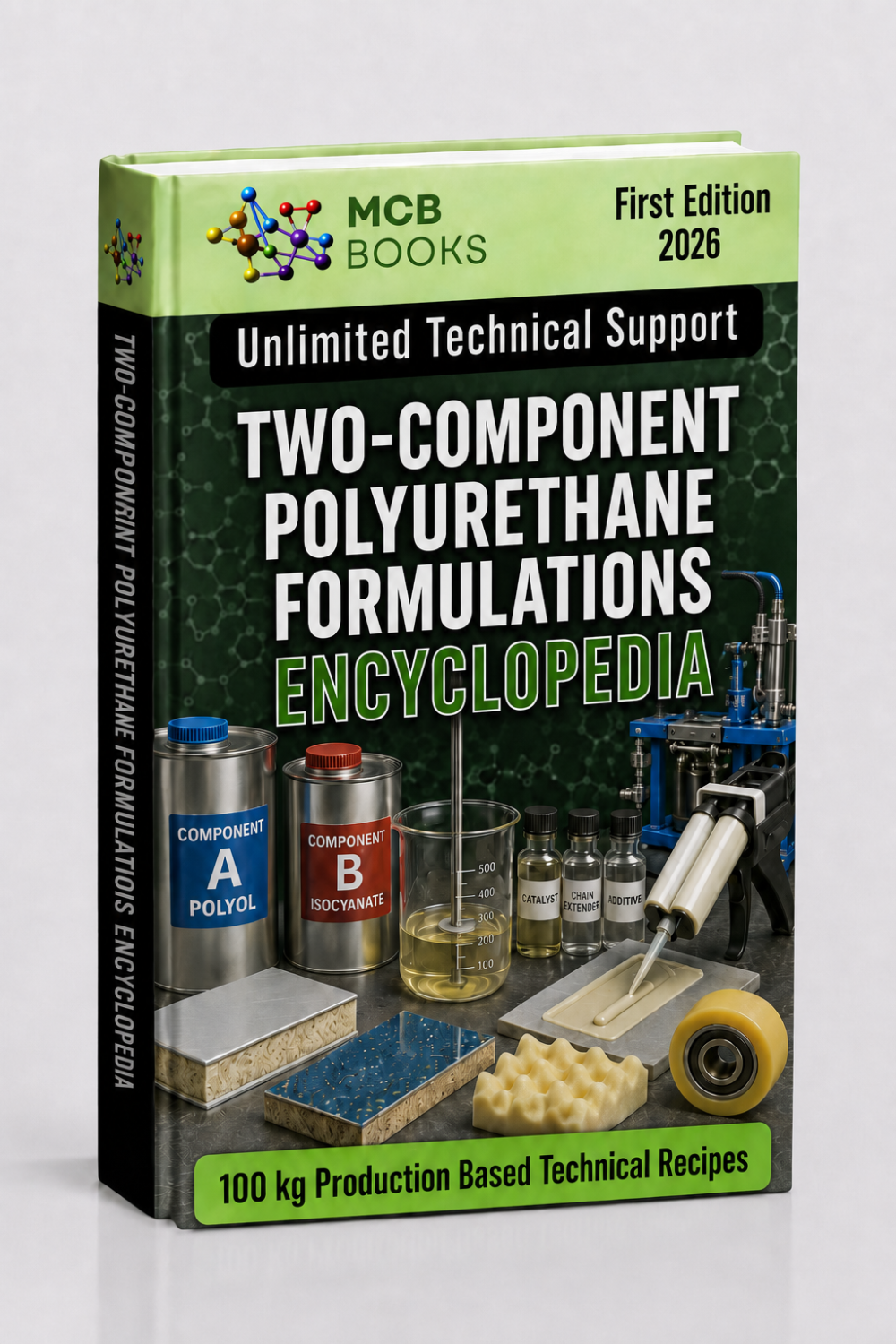
POLYURETHANE BINDER FORMULATIONS ENCYCLOPEDIA
Book details
- Editor
- MCB BOOKS
- ISBN
- 978-605-88350-7-2
- Number of Pages
- 360 Pages
- Publication Date
- 2026
- Copyright
- MCB BOOKS
- Format
- Hard Book & E book (PDF)
- Language
- English
About the Encyclopedia
The POLYURETHANE BINDER FORMULATIONS ENCYCLOPEDIA is a comprehensive technical reference for chemical manufacturers, polyurethane formulators, construction material producers, and industrial researchers. Published by MCB BOOKS, this 360-page encyclopedia covers polyurethane binder formulations and industrial production processes for a wide range of applications. The book explores one-component and two-component binders, moisture-curing systems, water-based and solvent-free technologies, and specialized binders for EPDM rubber granules, SBR rubber, playground surfaces, running tracks, sports flooring, decorative stone carpets, and industrial composites. It includes formulation alternatives, production procedures, technical specifications, and product characteristics to support polyurethane binder development and manufacturing.
Table of contents
01Page 1 Contents 220 formulations · 1–352
- 1General Purpose Polyurethane Binder Formulation and Industrial Production Process 1
- 3General Purpose Polyurethane Binder Formulation and Industrial Production Process 2
- 5General Purpose Polyurethane Binder Formulation and Industrial Production Process 3
- 7General Purpose Polyurethane Binder Special Specification
- 8General Purpose Polyurethane Binder Technical Properties and Usage
- 9One-Component Polyurethane Binder Formulation and Industrial Production Process 1
- 11One-Component Polyurethane Binder Formulation and Industrial Production Process 2
- 13One-Component Polyurethane Binder Formulation and Industrial Production Process 3
- 15One-Component Polyurethane Binder Special Specification
- 16One-Component Polyurethane Binder Technical Properties and Usage
- 17Two-Component Polyurethane Binder Formulation and Industrial Production Process 1
- 19Two-Component Polyurethane Binder Formulation and Industrial Production Process 2
- 21Two-Component Polyurethane Binder Formulation and Industrial Production Process 3
- 23Two-Component Polyurethane Binder Special Specification
- 24Two-Component Polyurethane Binder Technical Properties and Usage
- 25Moisture Curing Polyurethane Binder Formulation and Industrial Production Process 1
- 27Moisture Curing Polyurethane Binder Formulation and Industrial Production Process 2
- 29Moisture Curing Polyurethane Binder Formulation and Industrial Production Process 3
- 31Moisture Curing Polyurethane Binder Special Specification
- 32Moisture Curing Polyurethane Binder Technical Properties and Usage
- 33Solvent-Based Polyurethane Binder Formulation and Industrial Production Process 1
- 35Solvent-Based Polyurethane Binder Formulation and Industrial Production Process 2
- 37Solvent-Based Polyurethane Binder Formulation and Industrial Production Process 3
- 39Solvent-Based Polyurethane Binder Special Specification
- 40Solvent-Based Polyurethane Binder Technical Properties and Usage
- 41Solvent-Free Polyurethane Binder Formulation and Industrial Production Process 1
- 43Solvent-Free Polyurethane Binder Formulation and Industrial Production Process 2
- 45Solvent-Free Polyurethane Binder Formulation and Industrial Production Process 3
- 47Solvent-Free Polyurethane Binder Special Specification
- 48Solvent-Free Polyurethane Binder Technical Properties and Usage
- 49Water-Based Polyurethane Binder Formulation and Industrial Production Process 1
- 51Water-Based Polyurethane Binder Formulation and Industrial Production Process 2
- 53Water-Based Polyurethane Binder Formulation and Industrial Production Process 3
- 55Water-Based Polyurethane Binder Special Specification
- 56Water-Based Polyurethane Binder Technical Properties and Usage
- 57Low VOC Polyurethane Binder Formulation and Industrial Production Process 1
- 59Low VOC Polyurethane Binder Formulation and Industrial Production Process 2
- 61Low VOC Polyurethane Binder Formulation and Industrial Production Process 3
- 63Low VOC Polyurethane Binder Special Specification
- 64Low VOC Polyurethane Binder Technical Properties and Usage
- 65High Solids Polyurethane Binder Formulation and Industrial Production Process 1
- 67High Solids Polyurethane Binder Formulation and Industrial Production Process 2
- 69High Solids Polyurethane Binder Formulation and Industrial Production Process 3
- 71High Solids Polyurethane Binder Special Specification
- 72High Solids Polyurethane Binder Technical Properties and Usage
- 73Fast Curing Polyurethane Binder Formulation and Industrial Production Process 1
- 75Fast Curing Polyurethane Binder Formulation and Industrial Production Process 2
- 77Fast Curing Polyurethane Binder Formulation and Industrial Production Process 3
- 79Fast Curing Polyurethane Binder Special Specification
- 80Fast Curing Polyurethane Binder Technical Properties and Usage
- 81Flexible Polyurethane Binder Formulation and Industrial Production Process 1
- 83Flexible Polyurethane Binder Formulation and Industrial Production Process 2
- 85Flexible Polyurethane Binder Formulation and Industrial Production Process 3
- 87Flexible Polyurethane Binder Special Specification
- 88Flexible Polyurethane Binder Technical Properties and Usage
- 89High Strength Polyurethane Binder Formulation and Industrial Production Process 1
- 91High Strength Polyurethane Binder Formulation and Industrial Production Process 2
- 93High Strength Polyurethane Binder Formulation and Industrial Production Process 3
- 95High Strength Polyurethane Binder Special Specification
- 96High Strength Polyurethane Binder Technical Properties and Usage
- 97High Elasticity Polyurethane Binder Formulation and Industrial Production Process 1
- 99High Elasticity Polyurethane Binder Formulation and Industrial Production Process 2
- 101High Elasticity Polyurethane Binder Formulation and Industrial Production Process 3
- 103High Elasticity Polyurethane Binder Special Specification
- 104High Elasticity Polyurethane Binder Technical Properties and Usage
- 105UV Resistant Polyurethane Binder Formulation and Industrial Production Process 1
- 107UV Resistant Polyurethane Binder Formulation and Industrial Production Process 2
- 109UV Resistant Polyurethane Binder Formulation and Industrial Production Process 3
- 111UV Resistant Polyurethane Binder Special Specification
- 112UV Resistant Polyurethane Binder Technical Properties and Usage
- 113Weather Resistant Polyurethane Binder Formulation and Industrial Production Process 1
- 115Weather Resistant Polyurethane Binder Formulation and Industrial Production Process 2
- 117Weather Resistant Polyurethane Binder Formulation and Industrial Production Process 3
- 119Weather Resistant Polyurethane Binder Special Specification
- 120Weather Resistant Polyurethane Binder Technical Properties and Usage
- 121Chemical Resistant Polyurethane Binder Formulation and Industrial Production Process 1
- 123Chemical Resistant Polyurethane Binder Formulation and Industrial Production Process 2
- 125Chemical Resistant Polyurethane Binder Formulation and Industrial Production Process 3
- 127Chemical Resistant Polyurethane Binder Special Specification
- 128Chemical Resistant Polyurethane Binder Technical Properties and Usage
- 129Hydrolysis Resistant Polyurethane Binder Formulation and Industrial Production Process 1
- 131Hydrolysis Resistant Polyurethane Binder Formulation and Industrial Production Process 2
- 133Hydrolysis Resistant Polyurethane Binder Formulation and Industrial Production Process 3
- 135Hydrolysis Resistant Polyurethane Binder Special Specification
- 136Hydrolysis Resistant Polyurethane Binder Technical Properties and Usage
- 137Abrasion Resistant Polyurethane Binder Formulation and Industrial Production Process 1
- 139Abrasion Resistant Polyurethane Binder Formulation and Industrial Production Process 2
- 141Abrasion Resistant Polyurethane Binder Formulation and Industrial Production Process 3
- 143Abrasion Resistant Polyurethane Binder Special Specification
- 144Abrasion Resistant Polyurethane Binder Technical Properties and Usage
- 145Rubber Granule Polyurethane Binder Formulation and Industrial Production Process 1
- 147Rubber Granule Polyurethane Binder Formulation and Industrial Production Process 2
- 149Rubber Granule Polyurethane Binder Formulation and Industrial Production Process 3
- 151Rubber Granule Polyurethane Binder Special Specification
- 152Rubber Granule Polyurethane Binder Technical Properties and Usage
- 153EPDM Granule Polyurethane Binder Formulation and Industrial Production Process 1
- 155EPDM Granule Polyurethane Binder Formulation and Industrial Production Process 2
- 157EPDM Granule Polyurethane Binder Formulation and Industrial Production Process 3
- 159EPDM Granule Polyurethane Binder Special Specification
- 160EPDM Granule Polyurethane Binder Technical Properties and Usage
- 161SBR Rubber Binder Formulation and Industrial Production Process 1
- 163SBR Rubber Binder Formulation and Industrial Production Process 2
- 165SBR Rubber Binder Formulation and Industrial Production Process 3
- 167SBR Rubber Binder Special Specification
- 168SBR Rubber Binder Technical Properties and Usage
- 169Playground Surface Polyurethane Binder Formulation and Industrial Production Process 1
- 171Playground Surface Polyurethane Binder Formulation and Industrial Production Process 2
- 173Playground Surface Polyurethane Binder Formulation and Industrial Production Process 3
- 175Playground Surface Polyurethane Binder Special Specification
- 176Playground Surface Polyurethane Binder Technical Properties and Usage
- 177Running Track Polyurethane Binder Formulation and Industrial Production Process 1
- 179Running Track Polyurethane Binder Formulation and Industrial Production Process 2
- 181Running Track Polyurethane Binder Formulation and Industrial Production Process 3
- 183Running Track Polyurethane Binder Special Specification
- 184Running Track Polyurethane Binder Technical Properties and Usage
- 185Sports Flooring Polyurethane Binder Formulation and Industrial Production Process 1
- 187Sports Flooring Polyurethane Binder Formulation and Industrial Production Process 2
- 189Sports Flooring Polyurethane Binder Formulation and Industrial Production Process 3
- 191Sports Flooring Polyurethane Binder Special Specification
- 192Sports Flooring Polyurethane Binder Technical Properties and Usage
- 193Safety Surface Polyurethane Binder Formulation and Industrial Production Process 1
- 195Safety Surface Polyurethane Binder Formulation and Industrial Production Process 2
- 197Safety Surface Polyurethane Binder Formulation and Industrial Production Process 3
- 199Safety Surface Polyurethane Binder Special Specification
- 200Safety Surface Polyurethane Binder Technical Properties and Usage
- 201Decorative Stone Carpet Binder Formulation and Industrial Production Process 1
- 203Decorative Stone Carpet Binder Formulation and Industrial Production Process 2
- 205Decorative Stone Carpet Binder Formulation and Industrial Production Process 3
- 207Decorative Stone Carpet Binder Special Specification
- 208Decorative Stone Carpet Binder Technical Properties and Usage
- 209Gravel Binding Polyurethane Formulation and Industrial Production Process 1
- 211Gravel Binding Polyurethane Formulation and Industrial Production Process 2
- 213Gravel Binding Polyurethane Formulation and Industrial Production Process 3
- 215Gravel Binding Polyurethane Special Specification
- 216Gravel Binding Polyurethane Technical Properties and Usage
- 217Permeable Pavement Polyurethane Binder Formulation and Industrial Production Process 1
- 219Permeable Pavement Polyurethane Binder Formulation and Industrial Production Process 2
- 221Permeable Pavement Polyurethane Binder Formulation and Industrial Production Process 3
- 223Permeable Pavement Polyurethane Binder Special Specification
- 224Permeable Pavement Polyurethane Binder Technical Properties and Usage
- 225Wood Composite Polyurethane Binder Formulation and Industrial Production Process 1
- 227Wood Composite Polyurethane Binder Formulation and Industrial Production Process 2
- 229Wood Composite Polyurethane Binder Formulation and Industrial Production Process 3
- 231Wood Composite Polyurethane Binder Special Specification
- 232Wood Composite Polyurethane Binder Technical Properties and Usage
- 233Cork Binder Polyurethane Formulation and Industrial Production Process 1
- 235Cork Binder Polyurethane Formulation and Industrial Production Process 2
- 237Cork Binder Polyurethane Formulation and Industrial Production Process 3
- 239Cork Binder Polyurethane Special Specification
- 240Cork Binder Polyurethane Technical Properties and Usage
- 241Textile Fiber Polyurethane Binder Formulation and Industrial Production Process 1
- 243Textile Fiber Polyurethane Binder Formulation and Industrial Production Process 2
- 245Textile Fiber Polyurethane Binder Formulation and Industrial Production Process 3
- 247Textile Fiber Polyurethane Binder Special Specification
- 248Textile Fiber Polyurethane Binder Technical Properties and Usage
- 249Foam Particle Polyurethane Binder Formulation and Industrial Production Process 1
- 251Foam Particle Polyurethane Binder Formulation and Industrial Production Process 2
- 253Foam Particle Polyurethane Binder Formulation and Industrial Production Process 3
- 255Foam Particle Polyurethane Binder Special Specification
- 256Foam Particle Polyurethane Binder Technical Properties and Usage
- 257Industrial Polyurethane Binder Formulation and Industrial Production Process 1
- 259Industrial Polyurethane Binder Formulation and Industrial Production Process 2
- 261Industrial Polyurethane Binder Formulation and Industrial Production Process 3
- 263Industrial Polyurethane Binder Special Specification
- 264Industrial Polyurethane Binder Technical Properties and Usage
- 265Construction Polyurethane Binder Formulation and Industrial Production Process 1
- 267Construction Polyurethane Binder Formulation and Industrial Production Process 2
- 269Construction Polyurethane Binder Formulation and Industrial Production Process 3
- 271Construction Polyurethane Binder Special Specification
- 272Construction Polyurethane Binder Technical Properties and Usage
- 273Heavy-Duty Polyurethane Binder Formulation and Industrial Production Process 1
- 275Heavy-Duty Polyurethane Binder Formulation and Industrial Production Process 2
- 277Heavy-Duty Polyurethane Binder Formulation and Industrial Production Process 3
- 279Heavy-Duty Polyurethane Binder Special Specification
- 280Heavy-Duty Polyurethane Binder Technical Properties and Usage
- 281Professional Polyurethane Binder Formulation and Industrial Production Process 1
- 283Professional Polyurethane Binder Formulation and Industrial Production Process 2
- 285Professional Polyurethane Binder Formulation and Industrial Production Process 3
- 287Professional Polyurethane Binder Special Specification
- 288Professional Polyurethane Binder Technical Properties and Usage
- 289Premium Polyurethane Binder Formulation and Industrial Production Process 1
- 291Premium Polyurethane Binder Formulation and Industrial Production Process 2
- 293Premium Polyurethane Binder Formulation and Industrial Production Process 3
- 295Premium Polyurethane Binder Special Specification
- 296Premium Polyurethane Binder Technical Properties and Usage
- 297Multi-Purpose Polyurethane Binder Formulation and Industrial Production Process 1
- 299Multi-Purpose Polyurethane Binder Formulation and Industrial Production Process 2
- 301Multi-Purpose Polyurethane Binder Formulation and Industrial Production Process 3
- 303Multi-Purpose Polyurethane Binder Special Specification
- 304Multi-Purpose Polyurethane Binder Technical Properties and Usage
- 305High Performance Polyurethane Binder Formulation and Industrial Production Process 1
- 307High Performance Polyurethane Binder Formulation and Industrial Production Process 2
- 309High Performance Polyurethane Binder Formulation and Industrial Production Process 3
- 311High Performance Polyurethane Binder Special Specification
- 312High Performance Polyurethane Binder Technical Properties and Usage
- 313Long Service Life Polyurethane Binder Formulation and Industrial Production Process 1
- 315Long Service Life Polyurethane Binder Formulation and Industrial Production Process 2
- 317Long Service Life Polyurethane Binder Formulation and Industrial Production Process 3
- 319Long Service Life Polyurethane Binder Special Specification
- 320Long Service Life Polyurethane Binder Technical Properties and Usage
- 321Eco-Friendly Polyurethane Binder Formulation and Industrial Production Process 1
- 323Eco-Friendly Polyurethane Binder Formulation and Industrial Production Process 2
- 325Eco-Friendly Polyurethane Binder Formulation and Industrial Production Process 3
- 327Eco-Friendly Polyurethane Binder Special Specification
- 328Eco-Friendly Polyurethane Binder Technical Properties and Usage
- 329Bio-Based Polyurethane Binder Formulation and Industrial Production Process 1
- 331Bio-Based Polyurethane Binder Formulation and Industrial Production Process 2
- 333Bio-Based Polyurethane Binder Formulation and Industrial Production Process 3
- 335Bio-Based Polyurethane Binder Special Specification
- 336Bio-Based Polyurethane Binder Technical Properties and Usage
- 337OEM Polyurethane Binder Formulation and Industrial Production Process 1
- 339OEM Polyurethane Binder Formulation and Industrial Production Process 2
- 341OEM Polyurethane Binder Formulation and Industrial Production Process 3
- 343OEM Polyurethane Binder Special Specification
- 344OEM Polyurethane Binder Technical Properties and Usage
- 345Advanced Polyurethane Binder Technology Formulation and Industrial Production Process 1
- 347Advanced Polyurethane Binder Technology Formulation and Industrial Production Process 2
- 349Advanced Polyurethane Binder Technology Formulation and Industrial Production Process 3
- 351Advanced Polyurethane Binder Technology Special Specification
- 352Advanced Polyurethane Binder Technology Technical Properties and Usage
More about this book
What's Inside the Encyclopedia
This encyclopedia contains 220 technical content entries covering polyurethane binder formulations, manufacturing processes, special specifications, and product properties. Readers can explore flexible, high-strength, high-elasticity, fast-curing, UV-resistant, weather-resistant, and abrasion-resistant binder technologies. Application-specific sections cover rubber granule binding, EPDM surfaces, playground flooring, athletic tracks, stone carpets, gravel binding, permeable pavements, wood composites, cork, textile fibers, and foam particles. The book also includes industrial, construction, bio-based, and specialty polyurethane binder systems, with multiple formulation alternatives and related production information for each major product category.
Why This Encyclopedia
Polyurethane binder performance depends on resin chemistry, curing behavior, substrate compatibility, and the interaction between polymer components and bonded materials. Choosing the right binder is essential for achieving suitable adhesion, flexibility, mechanical strength, weather resistance, and long-term durability. This encyclopedia brings together a wide selection of polyurethane binder technologies in one practical reference. It helps manufacturers compare formulation approaches, evaluate raw materials, understand industrial production requirements, and investigate binder systems for rubber surfaces, sports facilities, decorative flooring, construction materials, and composite products.
About Formulations
General Purpose Polyurethane Binder Formulations, One-Component Polyurethane Binder Formulations, Two-Component Polyurethane Binder Formulations, Moisture Curing Polyurethane Binder Formulations, Solvent-Based Polyurethane Binder Formulations, Solvent-Free Polyurethane Binder Formulations, Water-Based Polyurethane Binder Formulations, Low VOC Polyurethane Binder Formulations, High Solids Polyurethane Binder Formulations, Fast Curing Polyurethane Binder Formulations, Flexible Polyurethane Binder Formulations, High Strength Polyurethane Binder Formulations, High Elasticity Polyurethane Binder Formulations, UV Resistant Polyurethane Binder Formulations, Weather Resistant Polyurethane Binder Formulations, Chemical Resistant Polyurethane Binder Formulations, Hydrolysis Resistant Polyurethane Binder Formulations, Abrasion Resistant Polyurethane Binder Formulations, Rubber Granule Polyurethane Binder Formulations, EPDM Granule Polyurethane Binder Formulations, SBR Rubber Binder Formulations, Playground Surface Polyurethane Binder Formulations, Running Track Polyurethane Binder Formulations, Sports Flooring Polyurethane Binder Formulations, Safety Surface Polyurethane Binder Formulations, Decorative Stone Carpet Binder Formulations, Gravel Binding Polyurethane Formulations, Permeable Pavement Polyurethane Binder Formulations, Wood Composite Polyurethane Binder Formulations, Cork Binder Polyurethane Formulations, Textile Fiber Polyurethane Binder Formulations, Foam Particle Polyurethane Binder Formulations, Industrial Polyurethane Binder Formulations, Construction Polyurethane Binder Formulations, Heavy-Duty Polyurethane Binder Formulations, Professional Polyurethane Binder Formulations, Premium Polyurethane Binder Formulations, Multi-Purpose Polyurethane Binder Formulations, High Performance Polyurethane Binder Formulations, Long Service Life Polyurethane Binder Formulations, Eco-Friendly Polyurethane Binder Formulations, Bio-Based Polyurethane Binder Formulations, OEM Polyurethane Binder Formulations, Advanced Polyurethane Binder Technology Formulations
Manufacturing Methods
Each formulation is presented in a clear and practical structure showing the raw materials, CAS numbers, functions of each ingredient, and exact quantities required for production.
All formulations are calculated on a 100 kg production basis, making them easy to understand, compare, scale, and adapt for laboratory or industrial R&D work.
The book uses straightforward technical language so that readers can follow the formulations without needing advanced engineering knowledge.
The Production Process section explains the manufacturing sequence step by step, including charging order, mixing, dissolution, dispersion, temperature control, viscosity adjustment, filtration, and final filling.
Special attention is given to what happens at each production stage, helping the reader understand not only what to add, but when, how, and why it is added.
The formulations are presented as practical starting formulations for laboratory, in-house, R&D, product-development, and commercial production studies, with final validation and regulatory testing required before market use.
In this way, the encyclopedia guides the reader through the complete manufacturing workflow in a form that can be followed by formulators, technicians, production staff, entrepreneurs, and manufacturers alike.
Troubleshooting
The encyclopedia helps readers understand and identify common problems that may occur during production and application.
Issues such as incorrect viscosity, poor adhesion, slow or incomplete curing, premature thickening, air bubbles, poor dispersion, and moisture-related instability can be evaluated through the formulation and production guidance.
The production processes explain critical factors such as mixing order, temperature, moisture control, dispersion, degassing, viscosity adjustment, filtration, and packaging conditions that can directly influence the final product.
Readers can also understand how substrate preparation, mixing accuracy, bond-line thickness, curing conditions, and application environment affect adhesive performance.
By comparing the expected product properties with actual production results, users can more easily determine where a problem may have originated in the manufacturing process.
This practical approach helps reduce unnecessary trial and error and provides a clearer direction for corrective formulation adjustments and process optimization.
Troubleshooting therefore becomes part of the overall formulation-development process rather than a separate, complicated engineering task.
Unlimited Technical Support
Every MCB BOOKS encyclopedia is available as a hard book and PDF, and all purchases include unlimited technical support. The PDF is delivered digitally, while printed-book availability and shipping arrangements can be confirmed before ordering. Our technical assistance helps readers understand formulation principles, raw material functions, manufacturing procedures, and polyurethane binder processing considerations. Whether you are developing EPDM rubber binders, investigating sports flooring systems, or evaluating industrial polyurethane bonding technologies, our team can assist with technical questions related to the encyclopedia. For ordering information and technical inquiries, contact us through our website or WhatsApp.
Featured Articles
1. POLYURETHANE BINDER FORMULATIONS: RAW MATERIALS AND INDUSTRIAL MANUFACTURING PROCESSES
Polyurethane binder formulations are widely used to bond rubber granules, mineral aggregates, wood particles, cork, textile fibers, and other industrial materials. These binders provide a polymer matrix that holds individual particles or components together while contributing to mechanical strength, flexibility, and structural stability.
Polyurethane binders are commonly developed using polyols and isocyanate-based components. Their chemical reactions form polymer structures whose properties can be adjusted according to the intended application.
Polyether polyols are frequently selected for flexible polyurethane binder technologies because of their mechanical characteristics and suitability for different reactive systems. Polyester polyols may also be incorporated where particular adhesion, strength, or chemical resistance properties are required.
Isocyanate components, including methylene diphenyl diisocyanate-based materials, are used in various polyurethane binder systems. Their selection influences reactivity, curing behavior, viscosity, and finished polymer characteristics.
One-component polyurethane binders often rely on moisture-reactive prepolymers that cure through exposure to atmospheric or substrate moisture. Two-component systems generally use separately packaged reactive materials that are mixed before application.
Industrial binder formulations may contain catalysts, stabilizers, adhesion promoters, fillers, and rheology modifiers. The appropriate combination depends on the required processing method and finished product performance.
Manufacturing conditions are particularly important for moisture-sensitive systems. Uncontrolled moisture exposure during production can cause premature chemical reactions, carbon dioxide formation, viscosity changes, and reduced storage stability.
Production procedures may include controlled raw material charging, mixing, temperature regulation, moisture management, filtration, and packaging under suitable conditions.
For applications involving rubber granules or mineral aggregates, binder viscosity and wetting behavior influence distribution over particle surfaces and the quality of the finished material.
Quality control commonly includes viscosity, density, curing behavior, adhesion, elasticity, and mechanical resistance testing.
Reactive isocyanates can cause respiratory sensitization, making appropriate industrial ventilation and exposure controls essential during manufacturing and application.
The POLYURETHANE BINDER FORMULATIONS ENCYCLOPEDIA provides technical formulation examples and industrial production information for different polyurethane binder technologies, supporting manufacturers interested in developing and evaluating specialized binder products.
TAGS: Polyurethane Binder Formulations, Polyurethane Binder Manufacturing, PU Binder Raw Materials, Industrial Polyurethane Binders, Polyurethane Production Processes
2. EPDM AND SBR RUBBER GRANULE POLYURETHANE BINDERS FOR PLAYGROUND SURFACES
Polyurethane binders are widely used in rubber granule surfacing systems for playgrounds, sports facilities, safety areas, and recreational spaces. Their main function is to hold individual rubber particles together while producing a cohesive, flexible surface.
EPDM rubber granules are commonly used in colored surface layers because they are available in different colors and grades. SBR rubber granules, frequently produced from recycled tire rubber, are often used in underlying resilient layers.
The binder must provide suitable adhesion between rubber particles while allowing the finished surface to retain the required flexibility and mechanical strength.
One-component moisture-curing polyurethane binders are frequently used in rubber granule surfacing applications. These products can be mixed with rubber particles before placement and cure as moisture becomes available.
The behavior of the binder depends on its polymer structure, isocyanate content, viscosity, and curing characteristics. Application temperature, humidity, rubber particle quality, and mixing uniformity also influence the finished surface.
Aliphatic polyurethane binder systems may be selected for applications requiring improved color stability during outdoor exposure. Aromatic systems can undergo discoloration under ultraviolet light, although their suitability depends on the intended surface construction.
Binder selection should consider the type of rubber granule, particle size distribution, surface contamination, and required mechanical performance.
Insufficient binder distribution may result in weak particle bonding or surface deterioration. Excessive binder application can alter permeability, texture, elasticity, and material consumption.
Proper mixing and installation procedures are therefore essential to achieving consistent results.
Safety surfacing applications require evaluation of impact attenuation, surface durability, accessibility, slip resistance, and other applicable performance criteria. Binder chemistry alone cannot establish whether a complete playground surface meets these requirements.
Durability testing may include tensile strength, elongation, resistance to weathering, and bond integrity after environmental exposure.
Manufacturers should also consider installation conditions, curing time, and compatibility with the selected base layer.
The encyclopedia covers EPDM granule polyurethane binders, SBR rubber binders, rubber granule binding technologies, and playground safety surface formulations, providing a technical reference for manufacturers of resilient flooring materials.
TAGS: EPDM Polyurethane Binder, SBR Rubber Binder, Rubber Granule Binder, Playground Surface Binder, Polyurethane Safety Flooring
3. POLYURETHANE BINDERS FOR RUNNING TRACKS, SPORTS FLOORING AND SAFETY SURFACES
Polyurethane binder technology plays an important role in manufacturing and installing resilient surfaces for running tracks, sports facilities, and recreational flooring systems.
These applications require a combination of particle adhesion, flexibility, surface integrity, and mechanical durability under repeated use.
Running track systems may incorporate polyurethane binders with rubber granules or other suitable components to produce resilient surface layers. The precise construction depends on the selected track design and performance specification.
Sports flooring applications can require different binder properties according to the intended activity, substrate conditions, and installation method.
One-component polyurethane binders are frequently considered for systems where moisture curing offers practical processing advantages. Two-component formulations may be selected when controlled curing characteristics or other performance requirements are important.
Polymer flexibility influences the ability of bonded surfaces to accommodate deformation without cracking or losing cohesion.
Elastic recovery is another consideration. A binder that is excessively rigid may restrict the movement of rubber particles, while an unsuitable low-strength system can contribute to premature wear or particle loss.
Binder viscosity must be appropriate for mixing, application, and surface formation. Consistent distribution helps promote uniform bonding between particles.
UV resistance and weathering performance are particularly important for outdoor facilities. The choice between aromatic and aliphatic polyurethane technologies can influence color stability and long-term appearance.
Moisture, temperature, surface preparation, and curing conditions must be controlled during installation to avoid defects and inconsistent performance.
Quality evaluation may include tensile properties, elongation, abrasion resistance, dimensional stability, and adhesion between system layers.
The finished sports surface should also be tested against applicable performance requirements, which may include shock absorption, vertical deformation, traction, and surface uniformity.
The polyurethane binder is only one part of the complete flooring system. Rubber granule characteristics, installation thickness, layer construction, and substrate preparation all affect final performance.
Manufacturers developing these products must balance binder performance, application efficiency, raw material compatibility, and surface durability.
The POLYURETHANE BINDER FORMULATIONS ENCYCLOPEDIA includes running track binders, sports flooring binders, and safety surface polyurethane binder technologies with corresponding formulation and manufacturing information.
TAGS: Running Track Polyurethane Binder, Sports Flooring Binder, Athletic Track Binder, Safety Surface Polyurethane, Rubber Sports Flooring Formulations
4. DECORATIVE STONE CARPET AND GRAVEL BINDING POLYURETHANE FORMULATIONS
Polyurethane binders are used in decorative stone carpet systems, gravel stabilization, permeable pavement products, and selected architectural surfacing applications.
These technologies combine mineral aggregates with suitable binder materials to form consolidated surfaces while retaining some of the visual or structural characteristics of the original particles.
Decorative stone carpets commonly use selected natural stone or mineral aggregates combined with a transparent or suitably formulated polyurethane binder.
The binder must provide appropriate adhesion to the aggregate and maintain the required surface appearance, mechanical stability, and resistance to environmental conditions.
Aggregate selection is an important part of formulation development. Particle size, surface moisture, mineral composition, dust content, and cleanliness can influence the interaction between binder and stone.
One-component moisture-curing polyurethane systems may be used in certain stone carpet applications. Other reactive technologies can also be selected according to performance and processing requirements.
Transparent binder formulations require careful consideration of color stability and yellowing resistance, especially for outdoor decorative surfaces.
Aliphatic polyurethane chemistry is often investigated where improved resistance to ultraviolet discoloration is needed.
Binder viscosity affects aggregate wetting, mixing consistency, and distribution throughout the stone mixture.
Poor wetting may lead to insufficient particle cohesion, while inappropriate binder loading may alter surface appearance, texture, or permeability.
Gravel binding polyurethane products are developed for stabilizing selected loose aggregates in landscaping and architectural applications.
Permeable pavement systems require additional attention to pore structure and drainage behavior. Excessive binder or unsuitable aggregate grading can reduce permeability.
The physical properties of the finished surface depend on the complete system rather than the binder alone.
Performance testing may include bond strength, abrasion resistance, water exposure, weathering behavior, and resistance to particle loss.
Manufacturers should evaluate substrate preparation, installation conditions, and curing requirements before selecting a binder formulation.
The encyclopedia includes decorative stone carpet binders, gravel binding polyurethane systems, and permeable pavement formulations, providing technical information for businesses developing aggregate-binding products.
TAGS: Stone Carpet Polyurethane Binder, Gravel Binding Polyurethane, Decorative Stone Binder, Permeable Pavement Binder, Polyurethane Aggregate Binder
5. POLYURETHANE BINDER QUALITY CONTROL, CURING BEHAVIOR AND INDUSTRIAL APPLICATIONS
Quality control is essential in polyurethane binder manufacturing because binder performance depends on chemical composition, reaction conditions, application methods, and compatibility with the materials being bonded.
One of the most important manufacturing parameters is viscosity. Suitable viscosity allows the binder to be mixed, distributed, and applied effectively without excessive material consumption or processing difficulties.
For rubber granule and aggregate applications, viscosity influences particle wetting and binder distribution.
A binder that is too viscous may be difficult to distribute uniformly, while an excessively low-viscosity system may migrate or behave differently from the intended application requirements.
Curing characteristics are another major consideration. Moisture-curing polyurethane binders depend on humidity, temperature, and the availability of water during the curing process.
Uncontrolled moisture exposure during production or storage may initiate premature reactions, reducing shelf life and affecting application performance.
Two-component polyurethane binders require correct proportioning and mixing of reactive components. Incorrect mixing ratios may contribute to incomplete curing or inconsistent mechanical properties.
Quality control procedures may include viscosity measurement, density determination, reactive group analysis where applicable, curing time evaluation, and storage stability testing.
Mechanical performance testing should reflect the intended binder application. Rubber surface binders may require tensile strength and elongation assessment, while aggregate-binding products may require evaluation of particle cohesion and abrasion resistance.
Weathering resistance is especially important for outdoor surfaces. UV exposure, moisture, temperature changes, and mechanical loading can influence long-term binder performance.
Common production or application problems include premature thickening, slow curing, poor particle adhesion, uneven binder distribution, and inadequate mechanical strength.
Premature thickening in reactive polyurethane systems may indicate moisture contamination, incorrect storage conditions, or unwanted chemical reactions.
Slow curing can be associated with environmental conditions, formulation chemistry, or unsuitable reactive component balance.
Poor adhesion may result from contaminated rubber granules, wet aggregates, insufficient binder distribution, or incompatibility with the material surface.
A systematic troubleshooting process should therefore include raw material inspection, manufacturing records, environmental conditions, and finished product testing.
Binder manufacturers should also consider packaging compatibility, shelf-life evaluation, and appropriate industrial safety procedures.
The POLYURETHANE BINDER FORMULATIONS ENCYCLOPEDIA provides formulation examples, manufacturing processes, product specifications, and technical characteristics that support polyurethane binder quality assessment and industrial product development.
TAGS: Polyurethane Binder Quality Control, Polyurethane Binder Troubleshooting, PU Binder Curing, Rubber Binder Performance, Industrial Binder Testing
Some Raw Materials Used
Polyether Polyols, Polyester Polyols, Polyurethane Prepolymers, Isocyanate-Terminated Prepolymers, Polymeric MDI, Methylene Diphenyl Diisocyanate (MDI), Modified MDI, Aliphatic Polyisocyanates, Isophorone Diisocyanate (IPDI), Hexamethylene Diisocyanate (HDI), Bio-Based Polyols, Castor Oil-Based Polyols, Polyurethane Dispersions, Polyurethane Catalysts, Tertiary Amine Catalysts, Bismuth Catalysts, Organotin Catalysts, Moisture Scavengers, Molecular Sieves, Silane Coupling Agents, Adhesion Promoters, Polyurethane-Compatible Plasticizers, Reactive Diluents, Calcium Carbonate, Talc, Silica, Fumed Silica, Barium Sulfate, Rheology Modifiers, Anti-Settling Agents, Defoamers, Wetting Agents, Dispersing Agents, UV Absorbers, Hindered Amine Light Stabilizers, Antioxidants, Compatible Organic Solvents
Why Choose This Encyclopedia
POLYURETHANE BINDER FORMULATIONS ENCYCLOPEDIA is prepared for manufacturers, formulators and R&D teams who want to produce commercially, not only to read about chemistry. Every product in the book follows the same structure: raw materials with their functions and quantities; the complete production process with charging order, mixing, temperature and control points; product specifications; and troubleshooting guidance that links common production problems to their causes.
The recipes are written as tested starting points: reproduce them at laboratory scale, confirm the specification, then scale up to pilot and full production. Readers planning a new line often combine this book with THINNER FORMULATIONS AND MANUFACTURING ENCYCLOPEDIA, and our free articles offer further technical background.
Every MCB Books encyclopedia is available as a hard book and PDF — the PDF is delivered instantly, the printed edition ships worldwide — and all purchases include unlimited technical support. Questions before ordering? Contact the MCB Books team or write to us on WhatsApp; we reply the same day.
Related books