POLYURETHANE SEALANT FORMULATIONS ENCYCLOPEDIA
Book details
- Editor
- MCB BOOKS
- ISBN
- 978-605-88350-7-2
- Number of Pages
- 350 Pages
- Publication Date
- 2026
- Copyright
- MCB BOOKS
- Format
- Hard Book & E book (PDF)
- Language
- English
About the Encyclopedia
The POLYURETHANE SEALANT FORMULATIONS ENCYCLOPEDIA is a 350-page technical reference covering polyurethane sealant formulations and industrial manufacturing processes. Published by MCB BOOKS, it includes one-component, two-component, moisture-curing, flexible, and high-performance sealant technologies. Applications include construction joints, concrete floors, expansion joints, roofing, windows, doors, waterproofing, and industrial sealing. The encyclopedia provides formulation examples, production procedures, technical specifications, and product characteristics for chemical manufacturers, formulation chemists, and construction material producers.
Table of contents
01Page 1 Contents 210 formulations · 1–336
- 1General Purpose Polyurethane Sealant Formulation and Industrial Production Process 1
- 3General Purpose Polyurethane Sealant Formulation and Industrial Production Process 2
- 5General Purpose Polyurethane Sealant Formulation and Industrial Production Process 3
- 7General Purpose Polyurethane Sealant Special Specification
- 8General Purpose Polyurethane Sealant Technical Properties and Usage
- 9One-Component Polyurethane Sealant Formulation and Industrial Production Process 1
- 11One-Component Polyurethane Sealant Formulation and Industrial Production Process 2
- 13One-Component Polyurethane Sealant Formulation and Industrial Production Process 3
- 15One-Component Polyurethane Sealant Special Specification
- 16One-Component Polyurethane Sealant Technical Properties and Usage
- 17Two-Component Polyurethane Sealant Formulation and Industrial Production Process 1
- 19Two-Component Polyurethane Sealant Formulation and Industrial Production Process 2
- 21Two-Component Polyurethane Sealant Formulation and Industrial Production Process 3
- 23Two-Component Polyurethane Sealant Special Specification
- 24Two-Component Polyurethane Sealant Technical Properties and Usage
- 25Moisture Curing Polyurethane Sealant Formulation and Industrial Production Process 1
- 27Moisture Curing Polyurethane Sealant Formulation and Industrial Production Process 2
- 29Moisture Curing Polyurethane Sealant Formulation and Industrial Production Process 3
- 31Moisture Curing Polyurethane Sealant Special Specification
- 32Moisture Curing Polyurethane Sealant Technical Properties and Usage
- 33Fast Curing Polyurethane Sealant Formulation and Industrial Production Process 1
- 35Fast Curing Polyurethane Sealant Formulation and Industrial Production Process 2
- 37Fast Curing Polyurethane Sealant Formulation and Industrial Production Process 3
- 39Fast Curing Polyurethane Sealant Special Specification
- 40Fast Curing Polyurethane Sealant Technical Properties and Usage
- 41Low Modulus Polyurethane Sealant Formulation and Industrial Production Process 1
- 43Low Modulus Polyurethane Sealant Formulation and Industrial Production Process 2
- 45Low Modulus Polyurethane Sealant Formulation and Industrial Production Process 3
- 47Low Modulus Polyurethane Sealant Special Specification
- 48Low Modulus Polyurethane Sealant Technical Properties and Usage
- 49High Modulus Polyurethane Sealant Formulation and Industrial Production Process 1
- 51High Modulus Polyurethane Sealant Formulation and Industrial Production Process 2
- 53High Modulus Polyurethane Sealant Formulation and Industrial Production Process 3
- 55High Modulus Polyurethane Sealant Special Specification
- 56High Modulus Polyurethane Sealant Technical Properties and Usage
- 57Self-Leveling Polyurethane Sealant Formulation and Industrial Production Process 1
- 59Self-Leveling Polyurethane Sealant Formulation and Industrial Production Process 2
- 61Self-Leveling Polyurethane Sealant Formulation and Industrial Production Process 3
- 63Self-Leveling Polyurethane Sealant Special Specification
- 64Self-Leveling Polyurethane Sealant Technical Properties and Usage
- 65Non-Sag Polyurethane Sealant Formulation and Industrial Production Process 1
- 67Non-Sag Polyurethane Sealant Formulation and Industrial Production Process 2
- 69Non-Sag Polyurethane Sealant Formulation and Industrial Production Process 3
- 71Non-Sag Polyurethane Sealant Special Specification
- 72Non-Sag Polyurethane Sealant Technical Properties and Usage
- 73Low VOC Polyurethane Sealant Formulation and Industrial Production Process 1
- 75Low VOC Polyurethane Sealant Formulation and Industrial Production Process 2
- 77Low VOC Polyurethane Sealant Formulation and Industrial Production Process 3
- 79Low VOC Polyurethane Sealant Special Specification
- 80Low VOC Polyurethane Sealant Technical Properties and Usage
- 81Solvent-Free Polyurethane Sealant Formulation and Industrial Production Process 1
- 83Solvent-Free Polyurethane Sealant Formulation and Industrial Production Process 2
- 85Solvent-Free Polyurethane Sealant Formulation and Industrial Production Process 3
- 87Solvent-Free Polyurethane Sealant Special Specification
- 88Solvent-Free Polyurethane Sealant Technical Properties and Usage
- 89High Solids Polyurethane Sealant Formulation and Industrial Production Process 1
- 91High Solids Polyurethane Sealant Formulation and Industrial Production Process 2
- 93High Solids Polyurethane Sealant Formulation and Industrial Production Process 3
- 95High Solids Polyurethane Sealant Special Specification
- 96High Solids Polyurethane Sealant Technical Properties and Usage
- 97Paintable Polyurethane Sealant Formulation and Industrial Production Process 1
- 99Paintable Polyurethane Sealant Formulation and Industrial Production Process 2
- 101Paintable Polyurethane Sealant Formulation and Industrial Production Process 3
- 103Paintable Polyurethane Sealant Special Specification
- 104Paintable Polyurethane Sealant Technical Properties and Usage
- 105UV Resistant Polyurethane Sealant Formulation and Industrial Production Process 1
- 107UV Resistant Polyurethane Sealant Formulation and Industrial Production Process 2
- 109UV Resistant Polyurethane Sealant Formulation and Industrial Production Process 3
- 111UV Resistant Polyurethane Sealant Special Specification
- 112UV Resistant Polyurethane Sealant Technical Properties and Usage
- 113Weather Resistant Polyurethane Sealant Formulation and Industrial Production Process 1
- 115Weather Resistant Polyurethane Sealant Formulation and Industrial Production Process 2
- 117Weather Resistant Polyurethane Sealant Formulation and Industrial Production Process 3
- 119Weather Resistant Polyurethane Sealant Special Specification
- 120Weather Resistant Polyurethane Sealant Technical Properties and Usage
- 121Waterproof Polyurethane Sealant Formulation and Industrial Production Process 1
- 123Waterproof Polyurethane Sealant Formulation and Industrial Production Process 2
- 125Waterproof Polyurethane Sealant Formulation and Industrial Production Process 3
- 127Waterproof Polyurethane Sealant Special Specification
- 128Waterproof Polyurethane Sealant Technical Properties and Usage
- 129Chemical Resistant Polyurethane Sealant Formulation and Industrial Production Process 1
- 131Chemical Resistant Polyurethane Sealant Formulation and Industrial Production Process 2
- 133Chemical Resistant Polyurethane Sealant Formulation and Industrial Production Process 3
- 135Chemical Resistant Polyurethane Sealant Special Specification
- 136Chemical Resistant Polyurethane Sealant Technical Properties and Usage
- 137Oil Resistant Polyurethane Sealant Formulation and Industrial Production Process 1
- 139Oil Resistant Polyurethane Sealant Formulation and Industrial Production Process 2
- 141Oil Resistant Polyurethane Sealant Formulation and Industrial Production Process 3
- 143Oil Resistant Polyurethane Sealant Special Specification
- 144Oil Resistant Polyurethane Sealant Technical Properties and Usage
- 145Fuel Resistant Polyurethane Sealant Formulation and Industrial Production Process 1
- 147Fuel Resistant Polyurethane Sealant Formulation and Industrial Production Process 2
- 149Fuel Resistant Polyurethane Sealant Formulation and Industrial Production Process 3
- 151Fuel Resistant Polyurethane Sealant Special Specification
- 152Fuel Resistant Polyurethane Sealant Technical Properties and Usage
- 153High Temperature Polyurethane Sealant Formulation and Industrial Production Process 1
- 155High Temperature Polyurethane Sealant Formulation and Industrial Production Process 2
- 157High Temperature Polyurethane Sealant Formulation and Industrial Production Process 3
- 159High Temperature Polyurethane Sealant Special Specification
- 160High Temperature Polyurethane Sealant Technical Properties and Usage
- 161Low Temperature Polyurethane Sealant Formulation and Industrial Production Process 1
- 163Low Temperature Polyurethane Sealant Formulation and Industrial Production Process 2
- 165Low Temperature Polyurethane Sealant Formulation and Industrial Production Process 3
- 167Low Temperature Polyurethane Sealant Special Specification
- 168Low Temperature Polyurethane Sealant Technical Properties and Usage
- 169Fire Resistant Polyurethane Sealant Formulation and Industrial Production Process 1
- 171Fire Resistant Polyurethane Sealant Formulation and Industrial Production Process 2
- 173Fire Resistant Polyurethane Sealant Formulation and Industrial Production Process 3
- 175Fire Resistant Polyurethane Sealant Special Specification
- 176Fire Resistant Polyurethane Sealant Technical Properties and Usage
- 177Acoustic Polyurethane Sealant Formulation and Industrial Production Process 1
- 179Acoustic Polyurethane Sealant Formulation and Industrial Production Process 2
- 181Acoustic Polyurethane Sealant Formulation and Industrial Production Process 3
- 183Acoustic Polyurethane Sealant Special Specification
- 184Acoustic Polyurethane Sealant Technical Properties and Usage
- 185Expansion Joint Polyurethane Sealant Formulation and Industrial Production Process 1
- 187Expansion Joint Polyurethane Sealant Formulation and Industrial Production Process 2
- 189Expansion Joint Polyurethane Sealant Formulation and Industrial Production Process 3
- 191Expansion Joint Polyurethane Sealant Special Specification
- 192Expansion Joint Polyurethane Sealant Technical Properties and Usage
- 193Construction Joint Polyurethane Sealant Formulation and Industrial Production Process 1
- 195Construction Joint Polyurethane Sealant Formulation and Industrial Production Process 2
- 197Construction Joint Polyurethane Sealant Formulation and Industrial Production Process 3
- 199Construction Joint Polyurethane Sealant Special Specification
- 200Construction Joint Polyurethane Sealant Technical Properties and Usage
- 201Concrete Joint Polyurethane Sealant Formulation and Industrial Production Process 1
- 203Concrete Joint Polyurethane Sealant Formulation and Industrial Production Process 2
- 205Concrete Joint Polyurethane Sealant Formulation and Industrial Production Process 3
- 207Concrete Joint Polyurethane Sealant Special Specification
- 208Concrete Joint Polyurethane Sealant Technical Properties and Usage
- 209Floor Joint Polyurethane Sealant Formulation and Industrial Production Process 1
- 211Floor Joint Polyurethane Sealant Formulation and Industrial Production Process 2
- 213Floor Joint Polyurethane Sealant Formulation and Industrial Production Process 3
- 215Floor Joint Polyurethane Sealant Special Specification
- 216Floor Joint Polyurethane Sealant Technical Properties and Usage
- 217Roof Joint Polyurethane Sealant Formulation and Industrial Production Process 1
- 219Roof Joint Polyurethane Sealant Formulation and Industrial Production Process 2
- 221Roof Joint Polyurethane Sealant Formulation and Industrial Production Process 3
- 223Roof Joint Polyurethane Sealant Special Specification
- 224Roof Joint Polyurethane Sealant Technical Properties and Usage
- 225Window and Door Polyurethane Sealant Formulation and Industrial Production Process 1
- 227Window and Door Polyurethane Sealant Formulation and Industrial Production Process 2
- 229Window and Door Polyurethane Sealant Formulation and Industrial Production Process 3
- 231Window and Door Polyurethane Sealant Special Specification
- 232Window and Door Polyurethane Sealant Technical Properties and Usage
- 233Curtain Wall Polyurethane Sealant Formulation and Industrial Production Process 1
- 235Curtain Wall Polyurethane Sealant Formulation and Industrial Production Process 2
- 237Curtain Wall Polyurethane Sealant Formulation and Industrial Production Process 3
- 239Curtain Wall Polyurethane Sealant Special Specification
- 240Curtain Wall Polyurethane Sealant Technical Properties and Usage
- 241Glass Bonding Polyurethane Sealant Formulation and Industrial Production Process 1
- 243Glass Bonding Polyurethane Sealant Formulation and Industrial Production Process 2
- 245Glass Bonding Polyurethane Sealant Formulation and Industrial Production Process 3
- 247Glass Bonding Polyurethane Sealant Special Specification
- 248Glass Bonding Polyurethane Sealant Technical Properties and Usage
- 249Metal Bonding Polyurethane Sealant Formulation and Industrial Production Process 1
- 251Metal Bonding Polyurethane Sealant Formulation and Industrial Production Process 2
- 253Metal Bonding Polyurethane Sealant Formulation and Industrial Production Process 3
- 255Metal Bonding Polyurethane Sealant Special Specification
- 256Metal Bonding Polyurethane Sealant Technical Properties and Usage
- 257Wood Bonding Polyurethane Sealant Formulation and Industrial Production Process 1
- 259Wood Bonding Polyurethane Sealant Formulation and Industrial Production Process 2
- 261Wood Bonding Polyurethane Sealant Formulation and Industrial Production Process 3
- 263Wood Bonding Polyurethane Sealant Special Specification
- 264Wood Bonding Polyurethane Sealant Technical Properties and Usage
- 265Stone Bonding Polyurethane Sealant Formulation and Industrial Production Process 1
- 267Stone Bonding Polyurethane Sealant Formulation and Industrial Production Process 2
- 269Stone Bonding Polyurethane Sealant Formulation and Industrial Production Process 3
- 271Stone Bonding Polyurethane Sealant Special Specification
- 272Stone Bonding Polyurethane Sealant Technical Properties and Usage
- 273Marine Grade Polyurethane Sealant Formulation and Industrial Production Process 1
- 275Marine Grade Polyurethane Sealant Formulation and Industrial Production Process 2
- 277Marine Grade Polyurethane Sealant Formulation and Industrial Production Process 3
- 279Marine Grade Polyurethane Sealant Special Specification
- 280Marine Grade Polyurethane Sealant Technical Properties and Usage
- 281Automotive Body Polyurethane Sealant Formulation and Industrial Production Process 1
- 283Automotive Body Polyurethane Sealant Formulation and Industrial Production Process 2
- 285Automotive Body Polyurethane Sealant Formulation and Industrial Production Process 3
- 287Automotive Body Polyurethane Sealant Special Specification
- 288Automotive Body Polyurethane Sealant Technical Properties and Usage
- 289Windshield Polyurethane Sealant Formulation and Industrial Production Process 1
- 291Windshield Polyurethane Sealant Formulation and Industrial Production Process 2
- 293Windshield Polyurethane Sealant Formulation and Industrial Production Process 3
- 295Windshield Polyurethane Sealant Special Specification
- 296Windshield Polyurethane Sealant Technical Properties and Usage
- 297Railway Polyurethane Sealant Formulation and Industrial Production Process 1
- 299Railway Polyurethane Sealant Formulation and Industrial Production Process 2
- 301Railway Polyurethane Sealant Formulation and Industrial Production Process 3
- 303Railway Polyurethane Sealant Special Specification
- 304Railway Polyurethane Sealant Technical Properties and Usage
- 305Bridge Joint Polyurethane Sealant Formulation and Industrial Production Process 1
- 307Bridge Joint Polyurethane Sealant Formulation and Industrial Production Process 2
- 309Bridge Joint Polyurethane Sealant Formulation and Industrial Production Process 3
- 311Bridge Joint Polyurethane Sealant Special Specification
- 312Bridge Joint Polyurethane Sealant Technical Properties and Usage
- 313Tunnel Joint Polyurethane Sealant Formulation and Industrial Production Process 1
- 315Tunnel Joint Polyurethane Sealant Formulation and Industrial Production Process 2
- 317Tunnel Joint Polyurethane Sealant Formulation and Industrial Production Process 3
- 319Tunnel Joint Polyurethane Sealant Special Specification
- 320Tunnel Joint Polyurethane Sealant Technical Properties and Usage
- 321Industrial Polyurethane Sealant Formulation and Industrial Production Process 1
- 323Industrial Polyurethane Sealant Formulation and Industrial Production Process 2
- 325Industrial Polyurethane Sealant Formulation and Industrial Production Process 3
- 327Industrial Polyurethane Sealant Special Specification
- 328Industrial Polyurethane Sealant Technical Properties and Usage
- 329Heavy-Duty Polyurethane Sealant Formulation and Industrial Production Process 1
- 331Heavy-Duty Polyurethane Sealant Formulation and Industrial Production Process 2
- 333Heavy-Duty Polyurethane Sealant Formulation and Industrial Production Process 3
- 335Heavy-Duty Polyurethane Sealant Special Specification
- 336Heavy-Duty Polyurethane Sealant Technical Properties and Usage
More about this book
What's Inside the Encyclopedia
This encyclopedia contains 210 technical content entries covering polyurethane sealant formulations, manufacturing processes, product specifications, and technical properties. Readers can explore moisture-curing systems, low-modulus and high-modulus sealants, self-leveling and non-sag technologies, paintable sealants, and solvent-free formulations. Application-specific sections cover concrete joints, expansion joints, flooring, roofing, curtain walls, windows, doors, glass, and metal sealing. Additional content addresses UV-resistant, weather-resistant, waterproof, chemical-resistant, acoustic, and specialty industrial sealants, with multiple formulation alternatives and related production information.
Why This Encyclopedia
Polyurethane sealant manufacturing requires careful control of polymer chemistry, curing behavior, adhesion, viscosity, and joint movement capability. Different construction and industrial applications demand specific combinations of flexibility, mechanical strength, weather resistance, and long-term sealing performance. This encyclopedia brings together numerous polyurethane sealant technologies in one practical reference, helping manufacturers compare raw materials, investigate formulation alternatives, understand production methods, and evaluate sealants for different substrates and operating conditions.
About Formulations
General Purpose Polyurethane Sealant Formulations, One-Component Polyurethane Sealant Formulations, Two-Component Polyurethane Sealant Formulations, Moisture-Curing Polyurethane Sealants, Fast-Curing Polyurethane Sealants, Low-Modulus Polyurethane Sealants, High-Modulus Polyurethane Sealants, Self-Leveling Polyurethane Sealants, Non-Sag Polyurethane Sealants, Solvent-Free Polyurethane Sealants, Low-VOC Polyurethane Sealants, Paintable Polyurethane Sealants, UV-Resistant Polyurethane Sealants, Waterproof Polyurethane Sealants, Chemical-Resistant Polyurethane Sealants, Expansion Joint Polyurethane Sealants, Concrete Joint Polyurethane Sealants, Floor Joint Polyurethane Sealants, Roof Joint Polyurethane Sealants, Window and Door Polyurethane Sealants
Manufacturing Methods
Each formulation is presented in a clear and practical structure showing the raw materials, CAS numbers, functions of each ingredient, and exact quantities required for production.
All formulations are calculated on a 100 kg production basis, making them easy to understand, compare, scale, and adapt for laboratory or industrial R&D work.
The book uses straightforward technical language so that readers can follow the formulations without needing advanced engineering knowledge.
The Production Process section explains the manufacturing sequence step by step, including charging order, mixing, dissolution, dispersion, temperature control, viscosity adjustment, filtration, and final filling.
Special attention is given to what happens at each production stage, helping the reader understand not only what to add, but when, how, and why it is added.
The formulations are presented as practical starting formulations for laboratory, in-house, R&D, product-development, and commercial production studies, with final validation and regulatory testing required before market use.
In this way, the encyclopedia guides the reader through the complete manufacturing workflow in a form that can be followed by formulators, technicians, production staff, entrepreneurs, and manufacturers alike.
Troubleshooting
The encyclopedia helps readers understand and identify common problems that may occur during production and application.
Issues such as incorrect viscosity, poor adhesion, slow or incomplete curing, premature thickening, air bubbles, poor dispersion, and moisture-related instability can be evaluated through the formulation and production guidance.
The production processes explain critical factors such as mixing order, temperature, moisture control, dispersion, degassing, viscosity adjustment, filtration, and packaging conditions that can directly influence the final product.
Readers can also understand how substrate preparation, mixing accuracy, bond-line thickness, curing conditions, and application environment affect adhesive performance.
By comparing the expected product properties with actual production results, users can more easily determine where a problem may have originated in the manufacturing process.
This practical approach helps reduce unnecessary trial and error and provides a clearer direction for corrective formulation adjustments and process optimization.
Troubleshooting therefore becomes part of the overall formulation-development process rather than a separate, complicated engineering task.
Unlimited Technical Support
Every MCB BOOKS encyclopedia is available in hard book and PDF formats, with unlimited technical support included for customers. PDF purchases are delivered digitally, while printed-book availability and shipping arrangements can be confirmed before ordering. Our technical assistance helps readers understand polyurethane sealant chemistry, raw material functions, manufacturing procedures, curing conditions, and product performance. Whether you are developing construction joint sealants, moisture-curing systems, or industrial sealing materials, our team can assist with technical questions related to the encyclopedia. For product information, purchasing details, and technical inquiries, contact us through our website or WhatsApp.
Featured Articles
1. POLYURETHANE SEALANT FORMULATIONS AND INDUSTRIAL MANUFACTURING PROCESSES
Polyurethane sealant formulations are widely used in construction, infrastructure maintenance, automotive manufacturing, and industrial sealing applications. These materials are designed to fill joints and gaps while accommodating movement, maintaining adhesion, and protecting assemblies against environmental exposure.
Polyurethane sealants are commonly manufactured using reactive polyurethane prepolymers, polyols, isocyanate components, fillers, plasticizers, catalysts, and specialized additives. The choice of materials influences flexibility, curing behavior, adhesion, mechanical strength, and long-term durability.
One-component polyurethane sealants frequently contain moisture-reactive prepolymers. These products cure through reactions with environmental moisture, gradually forming an elastomeric polymer network.
Two-component polyurethane sealants typically involve separately packaged reactive components that are mixed before application. Their curing process can be adjusted through the choice of reactive materials, catalysts, and component ratios.
Polyether polyols are important raw materials in many polyurethane sealant technologies because they can provide suitable flexibility and hydrolysis resistance. Polyester polyols may also be used where particular mechanical or adhesion properties are required.
Fillers such as calcium carbonate can influence viscosity, extrusion behavior, mechanical properties, and formulation cost. Their moisture content and compatibility must be carefully controlled in moisture-reactive systems.
Plasticizers and rheology modifiers help adjust application consistency and the ability of a sealant to remain in place after dispensing.
Industrial production commonly involves controlled raw material charging, filler dispersion, vacuum mixing, temperature management, degassing, and moisture-resistant packaging.
Quality control may include viscosity, extrusion rate, skin formation time, curing depth, hardness, tensile properties, elongation, and adhesion testing.
Reactive isocyanates require appropriate industrial exposure controls, ventilation, and protective equipment during production.
The POLYURETHANE SEALANT FORMULATIONS ENCYCLOPEDIA provides formulation examples and manufacturing information covering different polyurethane sealant technologies for construction chemical manufacturers and industrial product developers.
TAGS: Polyurethane Sealant Formulations, Polyurethane Sealant Manufacturing, PU Sealant Raw Materials, Industrial Sealant Production, Polyurethane Sealant Technology
2. ONE-COMPONENT AND TWO-COMPONENT POLYURETHANE SEALANT TECHNOLOGIES
One-component and two-component polyurethane sealants are widely used in construction and industrial applications requiring reliable sealing and long-term joint performance.
Although both technologies use polyurethane chemistry, they differ in their curing mechanisms, component handling, and manufacturing requirements.
One-component polyurethane sealants are supplied as ready-to-apply products. Many formulations contain isocyanate-terminated polyurethane prepolymers that react with atmospheric moisture.
This reaction gradually creates a crosslinked polymer structure responsible for the sealant's mechanical properties.
One-component products are commonly used in construction joints, floor joints, roofing applications, and other sealing operations where simplified application is advantageous.
Their curing performance depends on temperature, humidity, application thickness, and substrate conditions.
Moisture-reactive systems also require careful storage and packaging because uncontrolled contact with water can cause premature thickening or curing.
Two-component polyurethane sealants generally contain a resin component and a separate curing component. They are mixed at a specified ratio immediately before application.
The curing reaction proceeds through the interaction of compatible reactive groups, providing controlled polymer development under suitable conditions.
Two-component systems can be useful for applications involving larger joint dimensions, controlled curing requirements, or specialized industrial processing.
Important manufacturing parameters include component viscosity, mixing accuracy, pot life, reaction rate, and finished mechanical properties.
Incorrect mixing proportions may lead to incomplete curing, reduced adhesion, or inconsistent sealant performance.
Both technologies can be developed in different hardness and modulus ranges.
Low-modulus polyurethane sealants are generally designed to accommodate substantial movement with relatively low stress on the bonded surfaces.
Higher-modulus systems may be selected where greater stiffness or resistance to deformation is required.
The appropriate formulation depends on joint design, substrate characteristics, expected movement, and environmental exposure.
Manufacturers should evaluate adhesion, elongation, elastic recovery, curing behavior, and durability before selecting a sealant for a particular application.
The encyclopedia includes one-component, two-component, moisture-curing, fast-curing, low-modulus, and high-modulus polyurethane sealant formulations with related production information.
TAGS: One-Component Polyurethane Sealant, Two-Component Polyurethane Sealant, Moisture-Curing Polyurethane, 1K PU Sealant, 2K Polyurethane Sealant
3. POLYURETHANE JOINT SEALANTS FOR CONCRETE, FLOORING AND EXPANSION JOINTS
Polyurethane joint sealants are important materials in construction systems where joints must remain sealed while accommodating movement caused by temperature changes, loading, shrinkage, or structural behavior.
Concrete joints are commonly found in industrial floors, parking facilities, pavements, warehouses, and commercial buildings.
The selection of a polyurethane joint sealant depends on the joint dimensions, expected movement, mechanical exposure, and compatibility with the surrounding concrete.
Low-modulus polyurethane sealants may be considered where substantial joint movement is expected. Higher-modulus materials can be suitable for applications requiring greater resistance to deformation.
Self-leveling polyurethane sealants are designed to flow into horizontal joints and develop a relatively uniform surface without extensive tooling.
These products require controlled viscosity and flow characteristics to achieve suitable application behavior.
Non-sag polyurethane sealants are developed for vertical joints and other applications where the material must remain in position without excessive movement after application.
Rheology modifiers, fillers, and formulation components influence these application properties.
Joint surface preparation is essential for reliable adhesion. Concrete surfaces should be evaluated for moisture, dust, contamination, and overall condition.
Depending on the substrate and application requirements, suitable primers may be necessary.
Joint design is another important factor. Sealant depth, width, backing materials, and the avoidance of undesirable three-sided adhesion can strongly influence movement performance.
A polyurethane sealant cannot compensate for an improperly designed joint or unsuitable substrate conditions.
Industrial floor sealants may also require resistance to cleaning chemicals, abrasion, and selected mechanical loads.
Performance evaluation can include tensile properties, elastic recovery, adhesion under extension, hardness, and durability after exposure to relevant environmental conditions.
Manufacturers should select appropriate test standards and technical requirements for the intended construction application.
The POLYURETHANE SEALANT FORMULATIONS ENCYCLOPEDIA includes expansion joint, construction joint, concrete joint, and floor joint polyurethane sealant technologies, supporting formulation development for different construction environments.
TAGS: Polyurethane Joint Sealant, Concrete Joint Sealant, Expansion Joint Polyurethane, Self-Leveling Polyurethane Sealant, Industrial Floor Joint Sealant
4. WATERPROOF, WEATHER-RESISTANT AND LOW-VOC POLYURETHANE SEALANT FORMULATIONS
Polyurethane sealants are widely used to protect joints and interfaces against water penetration, air leakage, and environmental exposure.
Waterproof polyurethane sealants are developed for applications where reliable adhesion and resistance to moisture are important.
These products may be used in roofing, building joints, exterior construction details, and selected industrial assemblies.
The ability of a sealant to prevent water penetration depends on its formulation, adhesion, curing quality, joint design, and installation conditions.
Weather-resistant polyurethane sealants must withstand environmental factors such as temperature variation, moisture, sunlight, and repeated joint movement.
Ultraviolet exposure is an important consideration because some aromatic polyurethane systems can discolor or experience changes in properties during prolonged outdoor service.
Aliphatic polyurethane technologies may provide improved resistance to ultraviolet discoloration in appropriate formulations.
UV stabilizers and antioxidants can also be considered as part of the complete formulation design.
Low-VOC polyurethane sealants aim to reduce volatile organic compound content while maintaining suitable extrusion, curing, adhesion, and mechanical characteristics.
Solvent-free polyurethane sealants represent another formulation approach. These systems may use reactive polymers, fillers, plasticizers, catalysts, and other compatible ingredients without intentionally added volatile solvents.
High-solids formulations focus on increasing the proportion of nonvolatile materials while maintaining practical manufacturing and application properties.
Low-VOC, solvent-free, and high-solids descriptions refer to different formulation characteristics and should not be treated as identical claims.
Manufacturers must evaluate the complete product composition and applicable requirements before making environmental or compliance statements.
For waterproofing applications, quality control may include water exposure tests, adhesion testing, curing evaluation, and mechanical performance measurements.
Roofing and exterior joint applications may also require accelerated weathering and movement capability testing.
The encyclopedia covers waterproof, UV-resistant, weather-resistant, solvent-free, low-VOC, and high-solids polyurethane sealant technologies for industrial and construction applications.
TAGS: Waterproof Polyurethane Sealant, Weather Resistant PU Sealant, UV Resistant Polyurethane Sealant, Low VOC Polyurethane Sealant, Solvent-Free Polyurethane Sealant
5. POLYURETHANE SEALANT QUALITY CONTROL, ADHESION AND TROUBLESHOOTING
Quality control is essential in polyurethane sealant manufacturing because product performance depends on raw material quality, processing consistency, curing behavior, and application conditions.
Viscosity and extrusion characteristics are important parameters for evaluating polyurethane sealant products.
The material must be sufficiently workable for application while maintaining the required shape after dispensing.
Non-sag sealants require suitable resistance to flow on vertical surfaces, while self-leveling systems must exhibit controlled movement in horizontal joints.
Rheology modifiers, fillers, plasticizers, and polyurethane polymer structure all influence these characteristics.
Skin formation time is another important property, particularly for moisture-curing polyurethane sealants.
It describes the time required for the exposed surface to develop a skin under specified testing conditions.
Curing depth and full cure behavior are influenced by formulation chemistry, temperature, humidity, and joint dimensions.
Mechanical testing commonly includes tensile strength, elongation at break, hardness, and elastic recovery.
Adhesion testing is particularly important because a sealant must remain bonded to its intended substrates while accommodating movement.
Concrete, metal, glass, and other materials may require different surface preparation or primer systems.
Common manufacturing problems include premature thickening, air entrapment, inconsistent viscosity, filler settling, and poor storage stability.
Moisture contamination is a major concern in isocyanate-terminated polyurethane systems because unintended reactions can alter the product before application.
Application defects may include bubbling, poor adhesion, incomplete curing, cracking, and sealant failure during joint movement.
Bubbles may result from trapped air, moisture reactions, or unsuitable application conditions.
Poor adhesion can be associated with surface contamination, incompatible substrates, inadequate preparation, or incorrect primer selection.
Troubleshooting should involve systematic assessment of raw materials, processing records, packaging conditions, application methods, and the service environment.
Additional durability tests may be required to evaluate weathering, chemical exposure, and movement under repeated loading.
The POLYURETHANE SEALANT FORMULATIONS ENCYCLOPEDIA provides formulation information, manufacturing procedures, product specifications, and technical properties that support polyurethane sealant quality assessment and product development.
TAGS: Polyurethane Sealant Quality Control, Polyurethane Sealant Troubleshooting, Sealant Adhesion Testing, Polyurethane Sealant Specifications, Joint Sealant Performance
Some Raw Materials Used
Polyether Polyols, Polyester Polyols, Polyurethane Prepolymers, Isocyanate-Terminated Prepolymers, Polymeric MDI, Methylene Diphenyl Diisocyanate (MDI), Modified MDI, Isophorone Diisocyanate (IPDI), Aliphatic Polyisocyanates, Polyurethane Catalysts, Bismuth Catalysts, Organotin Catalysts, Tertiary Amine Catalysts, Calcium Carbonate, Talc, Fumed Silica, Precipitated Silica, Barium Sulfate, Polyurethane-Compatible Plasticizers, Reactive Diluents, Moisture Scavengers, Molecular Sieves, Silane Adhesion Promoters, Rheology Modifiers, Thixotropic Agents, UV Absorbers, Hindered Amine Light Stabilizers, Antioxidants, Pigments, Titanium Dioxide, Carbon Black, Defoamers, Anti-Settling Agents
Why Choose This Encyclopedia
POLYURETHANE SEALANT FORMULATIONS ENCYCLOPEDIA is prepared for manufacturers, formulators and R&D teams who want to produce commercially, not only to read about chemistry. Every product in the book follows the same structure: raw materials with their functions and quantities; the complete production process with charging order, mixing, temperature and control points; product specifications; and troubleshooting guidance that links common production problems to their causes.
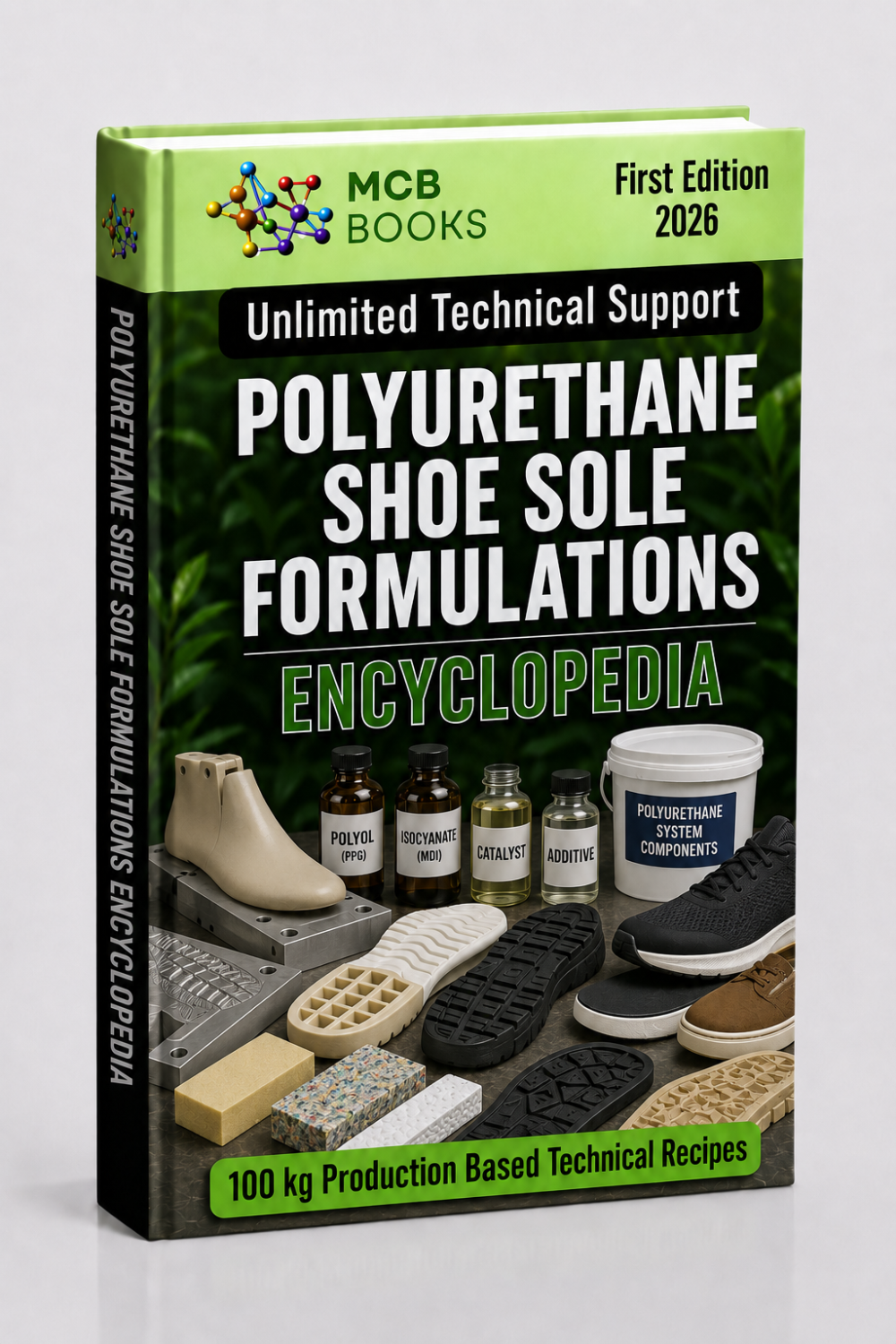
The recipes are written as tested starting points: reproduce them at laboratory scale, confirm the specification, then scale up to pilot and full production. Readers planning a new line often combine this book with POLYURETHANE SHOE SOLE FORMULATIONS ENCYCLOPEDIA, and our free articles offer further technical background.
Every MCB Books encyclopedia is available as a hard book and PDF — the PDF is delivered instantly, the printed edition ships worldwide — and all purchases include unlimited technical support. Questions before ordering? Contact the MCB Books team or write to us on WhatsApp; we reply the same day.
Related books