SILICONE TEXTILE SOFTENERS FORMULATIONS & MANUFACTURING ENCYCLOPEDIA
Book details
- Editor
- MCB BOOKS
- ISBN
- 978-6259-6032-9-2
- Number of Pages
- 420 Pages
- Publication Date
- 2026
- Copyright
- MCB BOOKS
- Format
- Hard Book & E book (PDF)
- Language
- English
About the Encyclopedia
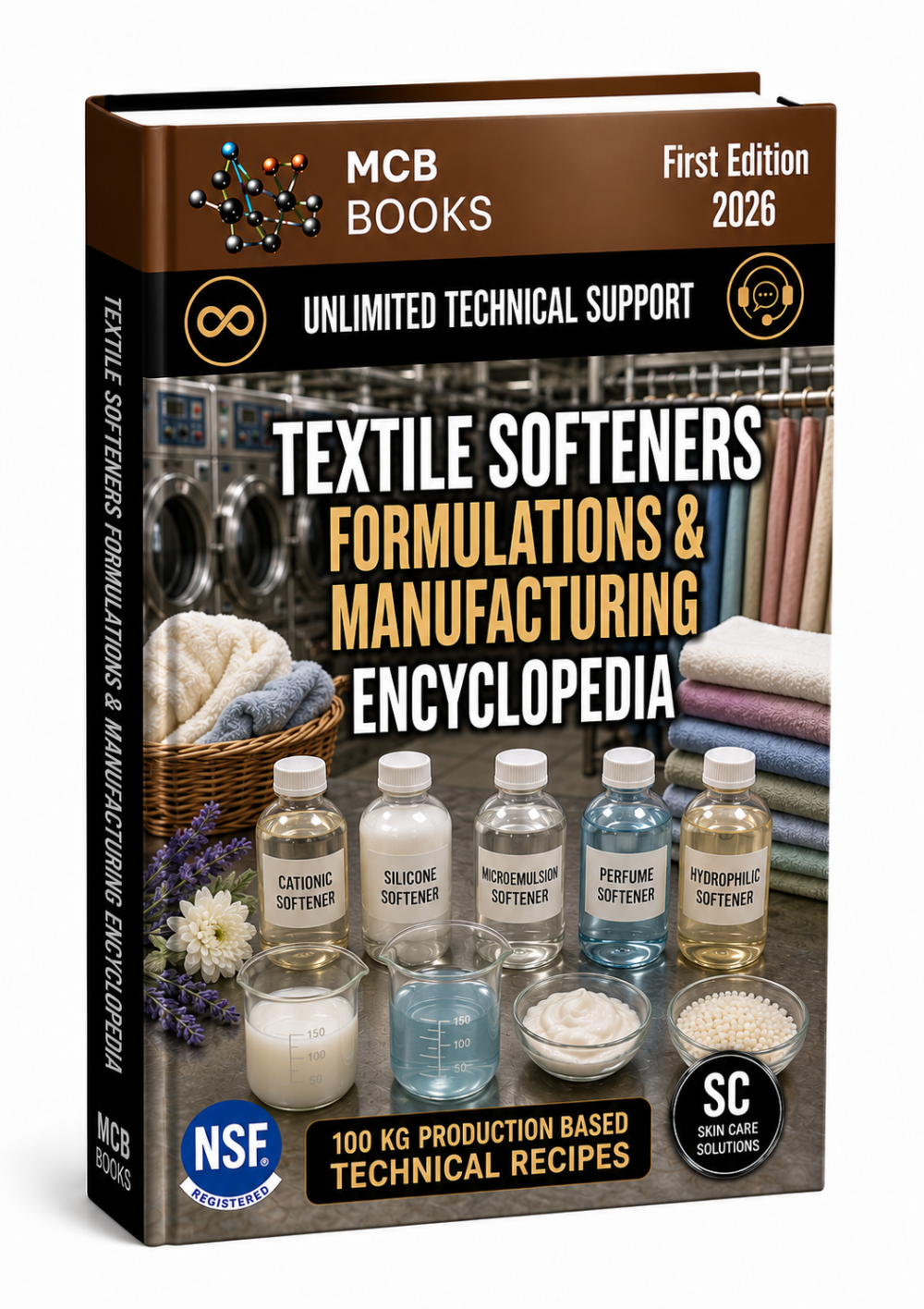
The Silicone Textile Softeners Formulations & Manufacturing Encyclopedia is a practical technical reference for manufacturers developing silicone-based softening and finishing chemicals for textiles.
It brings together silicone textile softener formulations, manufacturing methods and product-development information for amino silicone, hydrophilic silicone, microemulsion, macroemulsion and other textile silicone technologies.
The book focuses on products designed to improve fabric softness, smoothness, handle and surface feel.
It is especially useful for manufacturers who want to build a specialized silicone softener range rather than compete only with conventional textile softeners.
Table of contents
01Page 1 Contents 250 formulations · 1–400
- 1Amino Silicone Textile Softener Formulation and Industrial Production Process 1
- 3Amino Silicone Textile Softener Formulation and Industrial Production Process 2
- 5Amino Silicone Textile Softener Formulation and Industrial Production Process 3
- 7Amino Silicone Textile Softener Special Specification
- 8Amino Silicone Textile Softener Technical Properties and Usage
- 9Micro Silicone Textile Softener Formulation and Industrial Production Process 1
- 11Micro Silicone Textile Softener Formulation and Industrial Production Process 2
- 13Micro Silicone Textile Softener Formulation and Industrial Production Process 3
- 15Micro Silicone Textile Softener Special Specification
- 16Micro Silicone Textile Softener Technical Properties and Usage
- 17Macro Silicone Textile Softener Formulation and Industrial Production Process 1
- 19Macro Silicone Textile Softener Formulation and Industrial Production Process 2
- 21Macro Silicone Textile Softener Formulation and Industrial Production Process 3
- 23Macro Silicone Textile Softener Special Specification
- 24Macro Silicone Textile Softener Technical Properties and Usage
- 25Block Silicone Textile Softener Formulation and Industrial Production Process 1
- 27Block Silicone Textile Softener Formulation and Industrial Production Process 2
- 29Block Silicone Textile Softener Formulation and Industrial Production Process 3
- 31Block Silicone Textile Softener Special Specification
- 32Block Silicone Textile Softener Technical Properties and Usage
- 33Reactive Silicone Textile Softener Formulation and Industrial Production Process 1
- 35Reactive Silicone Textile Softener Formulation and Industrial Production Process 2
- 37Reactive Silicone Textile Softener Formulation and Industrial Production Process 3
- 39Reactive Silicone Textile Softener Special Specification
- 40Reactive Silicone Textile Softener Technical Properties and Usage
- 41Hydrophilic Silicone Textile Softener Formulation and Industrial Production Process 1
- 43Hydrophilic Silicone Textile Softener Formulation and Industrial Production Process 2
- 45Hydrophilic Silicone Textile Softener Formulation and Industrial Production Process 3
- 47Hydrophilic Silicone Textile Softener Special Specification
- 48Hydrophilic Silicone Textile Softener Technical Properties and Usage
- 49Nano Silicone Textile Softener Formulation and Industrial Production Process 1
- 51Nano Silicone Textile Softener Formulation and Industrial Production Process 2
- 53Nano Silicone Textile Softener Formulation and Industrial Production Process 3
- 55Nano Silicone Textile Softener Special Specification
- 56Nano Silicone Textile Softener Technical Properties and Usage
- 57Silicone Elastomer Textile Softener Formulation and Industrial Production Process 1
- 59Silicone Elastomer Textile Softener Formulation and Industrial Production Process 2
- 61Silicone Elastomer Textile Softener Formulation and Industrial Production Process 3
- 63Silicone Elastomer Textile Softener Special Specification
- 64Silicone Elastomer Textile Softener Technical Properties and Usage
- 65Silicone Microemulsion Softener Formulation and Industrial Production Process 1
- 67Silicone Microemulsion Softener Formulation and Industrial Production Process 2
- 69Silicone Microemulsion Softener Formulation and Industrial Production Process 3
- 71Silicone Microemulsion Softener Special Specification
- 72Silicone Microemulsion Softener Technical Properties and Usage
- 73Silicone Macroemulsion Softener Formulation and Industrial Production Process 1
- 75Silicone Macroemulsion Softener Formulation and Industrial Production Process 2
- 77Silicone Macroemulsion Softener Formulation and Industrial Production Process 3
- 79Silicone Macroemulsion Softener Special Specification
- 80Silicone Macroemulsion Softener Technical Properties and Usage
- 81High Concentration Silicone Softener Formulation and Industrial Production Process 1
- 83High Concentration Silicone Softener Formulation and Industrial Production Process 2
- 85High Concentration Silicone Softener Formulation and Industrial Production Process 3
- 87High Concentration Silicone Softener Special Specification
- 88High Concentration Silicone Softener Technical Properties and Usage
- 89Low Yellowing Silicone Softener Formulation and Industrial Production Process 1
- 91Low Yellowing Silicone Softener Formulation and Industrial Production Process 2
- 93Low Yellowing Silicone Softener Formulation and Industrial Production Process 3
- 95Low Yellowing Silicone Softener Special Specification
- 96Low Yellowing Silicone Softener Technical Properties and Usage
- 97High Slip Silicone Softener Formulation and Industrial Production Process 1
- 99High Slip Silicone Softener Formulation and Industrial Production Process 2
- 101High Slip Silicone Softener Formulation and Industrial Production Process 3
- 103High Slip Silicone Softener Special Specification
- 104High Slip Silicone Softener Technical Properties and Usage
- 105Super Soft Silicone Softener Formulation and Industrial Production Process 1
- 107Super Soft Silicone Softener Formulation and Industrial Production Process 2
- 109Super Soft Silicone Softener Formulation and Industrial Production Process 3
- 111Super Soft Silicone Softener Special Specification
- 112Super Soft Silicone Softener Technical Properties and Usage
- 113Cotton Silicone Softener Formulation and Industrial Production Process 1
- 115Cotton Silicone Softener Formulation and Industrial Production Process 2
- 117Cotton Silicone Softener Formulation and Industrial Production Process 3
- 119Cotton Silicone Softener Special Specification
- 120Cotton Silicone Softener Technical Properties and Usage
- 121Polyester Silicone Softener Formulation and Industrial Production Process 1
- 123Polyester Silicone Softener Formulation and Industrial Production Process 2
- 125Polyester Silicone Softener Formulation and Industrial Production Process 3
- 127Polyester Silicone Softener Special Specification
- 128Polyester Silicone Softener Technical Properties and Usage
- 129Polyester/Cotton Blend Silicone Softener Formulation and Industrial Production Process 1
- 131Polyester/Cotton Blend Silicone Softener Formulation and Industrial Production Process 2
- 133Polyester/Cotton Blend Silicone Softener Formulation and Industrial Production Process 3
- 135Polyester/Cotton Blend Silicone Softener Special Specification
- 136Polyester/Cotton Blend Silicone Softener Technical Properties and Usage
- 137Denim Silicone Softener Formulation and Industrial Production Process 1
- 139Denim Silicone Softener Formulation and Industrial Production Process 2
- 141Denim Silicone Softener Formulation and Industrial Production Process 3
- 143Denim Silicone Softener Special Specification
- 144Denim Silicone Softener Technical Properties and Usage
- 145Terry Towel Silicone Softener Formulation and Industrial Production Process 1
- 147Terry Towel Silicone Softener Formulation and Industrial Production Process 2
- 149Terry Towel Silicone Softener Formulation and Industrial Production Process 3
- 151Terry Towel Silicone Softener Special Specification
- 152Terry Towel Silicone Softener Technical Properties and Usage
- 153Knit Fabric Silicone Softener Formulation and Industrial Production Process 1
- 155Knit Fabric Silicone Softener Formulation and Industrial Production Process 2
- 157Knit Fabric Silicone Softener Formulation and Industrial Production Process 3
- 159Knit Fabric Silicone Softener Special Specification
- 160Knit Fabric Silicone Softener Technical Properties and Usage
- 161Woven Fabric Silicone Softener Formulation and Industrial Production Process 1
- 163Woven Fabric Silicone Softener Formulation and Industrial Production Process 2
- 165Woven Fabric Silicone Softener Formulation and Industrial Production Process 3
- 167Woven Fabric Silicone Softener Special Specification
- 168Woven Fabric Silicone Softener Technical Properties and Usage
- 169Garment Wash Silicone Softener Formulation and Industrial Production Process 1
- 171Garment Wash Silicone Softener Formulation and Industrial Production Process 2
- 173Garment Wash Silicone Softener Formulation and Industrial Production Process 3
- 175Garment Wash Silicone Softener Special Specification
- 176Garment Wash Silicone Softener Technical Properties and Usage
- 177Garment Finishing Silicone Softener Formulation and Industrial Production Process 1
- 179Garment Finishing Silicone Softener Formulation and Industrial Production Process 2
- 181Garment Finishing Silicone Softener Formulation and Industrial Production Process 3
- 183Garment Finishing Silicone Softener Special Specification
- 184Garment Finishing Silicone Softener Technical Properties and Usage
- 185Exhaust Process Silicone Softener Formulation and Industrial Production Process 1
- 187Exhaust Process Silicone Softener Formulation and Industrial Production Process 2
- 189Exhaust Process Silicone Softener Formulation and Industrial Production Process 3
- 191Exhaust Process Silicone Softener Special Specification
- 192Exhaust Process Silicone Softener Technical Properties and Usage
- 193Pad Application Silicone Softener Formulation and Industrial Production Process 1
- 195Pad Application Silicone Softener Formulation and Industrial Production Process 2
- 197Pad Application Silicone Softener Formulation and Industrial Production Process 3
- 199Pad Application Silicone Softener Special Specification
- 200Pad Application Silicone Softener Technical Properties and Usage
- 201Cold Process Silicone Softener Formulation and Industrial Production Process 1
- 203Cold Process Silicone Softener Formulation and Industrial Production Process 2
- 205Cold Process Silicone Softener Formulation and Industrial Production Process 3
- 207Cold Process Silicone Softener Special Specification
- 208Cold Process Silicone Softener Technical Properties and Usage
- 209High Temperature Silicone Softener Formulation and Industrial Production Process 1
- 211High Temperature Silicone Softener Formulation and Industrial Production Process 2
- 213High Temperature Silicone Softener Formulation and Industrial Production Process 3
- 215High Temperature Silicone Softener Special Specification
- 216High Temperature Silicone Softener Technical Properties and Usage
- 217Low Foam Silicone Softener Formulation and Industrial Production Process 1
- 219Low Foam Silicone Softener Formulation and Industrial Production Process 2
- 221Low Foam Silicone Softener Formulation and Industrial Production Process 3
- 223Low Foam Silicone Softener Special Specification
- 224Low Foam Silicone Softener Technical Properties and Usage
- 225Eco-Friendly Silicone Softener Formulation and Industrial Production Process 1
- 227Eco-Friendly Silicone Softener Formulation and Industrial Production Process 2
- 229Eco-Friendly Silicone Softener Formulation and Industrial Production Process 3
- 231Eco-Friendly Silicone Softener Special Specification
- 232Eco-Friendly Silicone Softener Technical Properties and Usage
- 233Biodegradable Silicone Softener Formulation and Industrial Production Process 1
- 235Biodegradable Silicone Softener Formulation and Industrial Production Process 2
- 237Biodegradable Silicone Softener Formulation and Industrial Production Process 3
- 239Biodegradable Silicone Softener Special Specification
- 240Biodegradable Silicone Softener Technical Properties and Usage
- 241Silicone Softener Emulsion Formulation and Industrial Production Process 1
- 243Silicone Softener Emulsion Formulation and Industrial Production Process 2
- 245Silicone Softener Emulsion Formulation and Industrial Production Process 3
- 247Silicone Softener Emulsion Special Specification
- 248Silicone Softener Emulsion Technical Properties and Usage
- 249Silicone Softener Microdispersion Formulation and Industrial Production Process 1
- 251Silicone Softener Microdispersion Formulation and Industrial Production Process 2
- 253Silicone Softener Microdispersion Formulation and Industrial Production Process 3
- 255Silicone Softener Microdispersion Special Specification
- 256Silicone Softener Microdispersion Technical Properties and Usage
- 257Silicone Softener for Cotton Knitwear Formulation and Industrial Production Process 1
- 259Silicone Softener for Cotton Knitwear Formulation and Industrial Production Process 2
- 261Silicone Softener for Cotton Knitwear Formulation and Industrial Production Process 3
- 263Silicone Softener for Cotton Knitwear Special Specification
- 264Silicone Softener for Cotton Knitwear Technical Properties and Usage
- 265Silicone Softener for Home Textiles Formulation and Industrial Production Process 1
- 267Silicone Softener for Home Textiles Formulation and Industrial Production Process 2
- 269Silicone Softener for Home Textiles Formulation and Industrial Production Process 3
- 271Silicone Softener for Home Textiles Special Specification
- 272Silicone Softener for Home Textiles Technical Properties and Usage
- 273Silicone Softener for Apparel Formulation and Industrial Production Process 1
- 275Silicone Softener for Apparel Formulation and Industrial Production Process 2
- 277Silicone Softener for Apparel Formulation and Industrial Production Process 3
- 279Silicone Softener for Apparel Special Specification
- 280Silicone Softener for Apparel Technical Properties and Usage
- 281Silicone Softener for Technical Textiles Formulation and Industrial Production Process 1
- 283Silicone Softener for Technical Textiles Formulation and Industrial Production Process 2
- 285Silicone Softener for Technical Textiles Formulation and Industrial Production Process 3
- 287Silicone Softener for Technical Textiles Special Specification
- 288Silicone Softener for Technical Textiles Technical Properties and Usage
- 289Silicone Softener with Water Repellency Formulation and Industrial Production Process 1
- 291Silicone Softener with Water Repellency Formulation and Industrial Production Process 2
- 293Silicone Softener with Water Repellency Formulation and Industrial Production Process 3
- 295Silicone Softener with Water Repellency Special Specification
- 296Silicone Softener with Water Repellency Technical Properties and Usage
- 297Hydrophilic Silicone Finish Formulation and Industrial Production Process 1
- 299Hydrophilic Silicone Finish Formulation and Industrial Production Process 2
- 301Hydrophilic Silicone Finish Formulation and Industrial Production Process 3
- 303Hydrophilic Silicone Finish Special Specification
- 304Hydrophilic Silicone Finish Technical Properties and Usage
- 305Silicone Anti-Crease Finish Formulation and Industrial Production Process 1
- 307Silicone Anti-Crease Finish Formulation and Industrial Production Process 2
- 309Silicone Anti-Crease Finish Formulation and Industrial Production Process 3
- 311Silicone Anti-Crease Finish Special Specification
- 312Silicone Anti-Crease Finish Technical Properties and Usage
- 313Premium Silicone Textile Finish Formulation and Industrial Production Process 1
- 315Premium Silicone Textile Finish Formulation and Industrial Production Process 2
- 317Premium Silicone Textile Finish Formulation and Industrial Production Process 3
- 319Premium Silicone Textile Finish Special Specification
- 320Premium Silicone Textile Finish Technical Properties and Usage
- 321Industrial Silicone Softener Formulation and Industrial Production Process 1
- 323Industrial Silicone Softener Formulation and Industrial Production Process 2
- 325Industrial Silicone Softener Formulation and Industrial Production Process 3
- 327Industrial Silicone Softener Special Specification
- 328Industrial Silicone Softener Technical Properties and Usage
- 329Multi-Purpose Silicone Softener Formulation and Industrial Production Process 1
- 331Multi-Purpose Silicone Softener Formulation and Industrial Production Process 2
- 333Multi-Purpose Silicone Softener Formulation and Industrial Production Process 3
- 335Multi-Purpose Silicone Softener Special Specification
- 336Multi-Purpose Silicone Softener Technical Properties and Usage
- 337Professional Silicone Finishing Agent Formulation and Industrial Production Process 1
- 339Professional Silicone Finishing Agent Formulation and Industrial Production Process 2
- 341Professional Silicone Finishing Agent Formulation and Industrial Production Process 3
- 343Professional Silicone Finishing Agent Special Specification
- 344Professional Silicone Finishing Agent Technical Properties and Usage
- 345High Durability Silicone Finish Formulation and Industrial Production Process 1
- 347High Durability Silicone Finish Formulation and Industrial Production Process 2
- 349High Durability Silicone Finish Formulation and Industrial Production Process 3
- 351High Durability Silicone Finish Special Specification
- 352High Durability Silicone Finish Technical Properties and Usage
- 353Ultra Smooth Silicone Finish Formulation and Industrial Production Process 1
- 355Ultra Smooth Silicone Finish Formulation and Industrial Production Process 2
- 357Ultra Smooth Silicone Finish Formulation and Industrial Production Process 3
- 359Ultra Smooth Silicone Finish Special Specification
- 360Ultra Smooth Silicone Finish Technical Properties and Usage
- 361Complete Silicone Softener System Formulation and Industrial Production Process 1
- 363Complete Silicone Softener System Formulation and Industrial Production Process 2
- 365Complete Silicone Softener System Formulation and Industrial Production Process 3
- 367Complete Silicone Softener System Special Specification
- 368Complete Silicone Softener System Technical Properties and Usage
- 369Complete Textile Silicone Finishing System Formulation and Industrial Production Process 1
- 371Complete Textile Silicone Finishing System Formulation and Industrial Production Process 2
- 373Complete Textile Silicone Finishing System Formulation and Industrial Production Process 3
- 375Complete Textile Silicone Finishing System Special Specification
- 376Complete Textile Silicone Finishing System Technical Properties and Usage
- 377Professional Silicone Textile Chemical Package Formulation and Industrial Production Process 1
- 379Professional Silicone Textile Chemical Package Formulation and Industrial Production Process 2
- 381Professional Silicone Textile Chemical Package Formulation and Industrial Production Process 3
- 383Professional Silicone Textile Chemical Package Special Specification
- 384Professional Silicone Textile Chemical Package Technical Properties and Usage
- 385Industrial Silicone Textile Finishing Collection Formulation and Industrial Production Process 1
- 387Industrial Silicone Textile Finishing Collection Formulation and Industrial Production Process 2
- 389Industrial Silicone Textile Finishing Collection Formulation and Industrial Production Process 3
- 391Industrial Silicone Textile Finishing Collection Special Specification
- 392Industrial Silicone Textile Finishing Collection Technical Properties and Usage
- 393Complete Silicone Textile Softeners Collection Formulation and Industrial Production Process 1
- 395Complete Silicone Textile Softeners Collection Formulation and Industrial Production Process 2
- 397Complete Silicone Textile Softeners Collection Formulation and Industrial Production Process 3
- 399Complete Silicone Textile Softeners Collection Special Specification
- 400Complete Silicone Textile Softeners Collection Technical Properties and Usage
More about this book
What's Inside the Encyclopedia
The encyclopedia covers a broad range of silicone technologies used in textile finishing.
Readers can study amino silicone softeners, cationic and nonionic silicone systems, silicone microemulsions, macroemulsions and hydrophilic silicone products.
Different formulations can be developed around softness, smoothness, elasticity, lubricity, hydrophilicity and fabric handle.
The content also addresses low-yellowing and performance-oriented silicone softeners for different textile fibers and finishing requirements.
Manufacturers can use these technologies to create standard, professional and premium silicone finishing products for textile mills and finishing plants.
Why This Encyclopedia
Silicone softeners are not simply another version of conventional textile softener.
Silicone chemistry can create a very different fabric feel.
Amino-functional silicones are widely used where strong softness and smoothness are required.
Hydrophilic silicone systems are developed when softness needs to be combined with better water affinity.
Microemulsion and macroemulsion technologies also create different particle sizes, appearance and application characteristics.
The Silicone Textile Softeners Formulations & Manufacturing Encyclopedia helps manufacturers turn these differences into clearly defined commercial products instead of selling one generic silicone emulsion.
About Formulations
Silicone Textile Softener Formulations, Amino Silicone Softener, Amino Silicone Microemulsion, Silicone Macroemulsion, Hydrophilic Silicone Softener, Cationic Silicone Softener, Nonionic Silicone Softener, Low Yellowing Silicone Softener, High Softness Silicone Finish, Smooth Handle Silicone Softener, Elastic Handle Silicone Softener, Silicone Lubricating Softener, Silicone Finish for Cotton, Silicone Finish for Polyester, Silicone Finish for Cotton Blends, Concentrated Silicone Softener, Premium Silicone Textile Finish, Professional Silicone Softener
Manufacturing Methods
Each formulation is presented in a clear and practical structure showing the raw materials, CAS numbers, functions of each ingredient, and exact quantities required for production.
All formulations are calculated on a 100 kg production basis, making them easy to understand, compare, scale, and adapt for laboratory or industrial R&D work.
The book uses straightforward technical language so that readers can follow the formulations without needing advanced engineering knowledge.
The Production Process section explains the manufacturing sequence step by step, including charging order, mixing, dissolution, dispersion, temperature control, viscosity adjustment, filtration, and final filling.
Special attention is given to what happens at each production stage, helping the reader understand not only what to add, but when, how, and why it is added.
The formulations are presented as practical starting formulations for laboratory, in-house, R&D, product-development, and commercial production studies, with final validation and regulatory testing required before market use.
In this way, the encyclopedia guides the reader through the complete manufacturing workflow in a form that can be followed by formulators, technicians, production staff, entrepreneurs, and manufacturers alike.
Troubleshooting
The encyclopedia helps readers understand and identify common problems that may occur during production and application.
Issues such as incorrect viscosity, poor adhesion, slow or incomplete curing, premature thickening, air bubbles, poor dispersion, and moisture-related instability can be evaluated through the formulation and production guidance.
The production processes explain critical factors such as mixing order, temperature, moisture control, dispersion, degassing, viscosity adjustment, filtration, and packaging conditions that can directly influence the final product.
Readers can also understand how substrate preparation, mixing accuracy, bond-line thickness, curing conditions, and application environment affect adhesive performance.
By comparing the expected product properties with actual production results, users can more easily determine where a problem may have originated in the manufacturing process.
This practical approach helps reduce unnecessary trial and error and provides a clearer direction for corrective formulation adjustments and process optimization.
Troubleshooting therefore becomes part of the overall formulation-development process rather than a separate, complicated engineering task.
Unlimited Technical Support
Customers purchasing the Silicone Textile Softeners Formulations & Manufacturing Encyclopedia receive technical support from MCB BOOKS for questions related to the formulations and manufacturing information included in the book.
If you need help understanding an amino silicone formulation, microemulsion, macroemulsion, hydrophilic silicone system, emulsifier package or production step, you can contact our technical team.
Technical support helps manufacturers use the formulation information more confidently during laboratory development, pilot production and commercial scale-up.
Featured Articles
1 – Silicone Textile Softener Formulations for Commercial Manufacturing
Professional silicone textile softener formulations can be developed for different fabric types and finishing targets.
One customer may want an extremely soft hand, while another may prioritize smoothness, elasticity or water absorbency.
Silicone chemistry gives manufacturers several routes for creating these different effects.
Amino silicone, hydrophilic silicone and emulsion technologies can each be developed into separate commercial grades.
For manufacturers, this creates a higher-value product family compared with relying only on conventional softening agents.
TAGS: silicone textile softener formulations, silicone textile softener, textile silicone, silicone softener manufacturing, textile finishing silicone
2 – Amino Silicone Softener for Soft and Smooth Fabric Handle
Amino silicone softener is one of the most important silicone technologies used in textile finishing.
Amino-functional groups help the silicone interact effectively with textile surfaces and can provide a soft, smooth and pleasant handle.
The exact amino content and silicone structure influence the final fabric feel.
Emulsification also matters because the silicone needs to remain stable during storage, dilution and application.
For manufacturers, amino silicone softeners can be developed into several grades for cotton, blends and synthetic fabrics.
TAGS: amino silicone softener, amino silicone textile finish, textile silicone softener, silicone textile softener formulations, soft handle silicone
3 – Silicone Microemulsion and Macroemulsion Technologies
Silicone microemulsion and silicone macroemulsion are two important routes for textile softener manufacturing.
Microemulsions contain very fine dispersed silicone particles and can provide excellent penetration and smooth fabric feel.
Macroemulsions use larger dispersed particles and may create a different surface effect and softness profile.
Neither technology should automatically be treated as better for every application.
Manufacturers can offer both systems according to textile type, finishing process and required handle.
TAGS: silicone microemulsion, silicone macroemulsion, textile silicone emulsion, amino silicone emulsion, silicone softener formulations
4 – Hydrophilic Silicone Softener for Textile Finishing
A hydrophilic silicone softener is developed for applications where softness needs to be combined with improved water affinity.
Conventional silicone softening can sometimes reduce fabric absorbency.
Hydrophilic modification provides another route for manufacturers who need to maintain a softer hand while supporting moisture-related fabric performance.
These products are especially useful when the end textile needs both comfort and practical absorbency.
For manufacturers, hydrophilic silicone creates a clear premium category within the textile softener market.
TAGS: hydrophilic silicone softener, hydrophilic textile silicone, silicone textile finishing, textile softener manufacturing, silicone textile softener formulations
5 – Low Yellowing Silicone Softener for Textile Applications
Color stability is important when silicone softeners are used on white, pale or sensitive fabrics.
A low yellowing silicone softener is developed to reduce unwanted color change during drying, curing and use.
Silicone structure, amino functionality and process temperature all influence the result.
Manufacturers need to evaluate the product on the actual fabric and under realistic finishing conditions.
For commercial suppliers, low-yellowing grades create a useful premium option for customers working with light-colored textiles and higher-quality finishing programs.
TAGS: low yellowing silicone softener, non yellowing silicone softener, amino silicone textile finish, silicone softener manufacturing, textile silicone
Some Raw Materials Used
Amino Silicone Fluids, Amino Functional Polysiloxanes, Polydimethylsiloxane, Modified Silicone Fluids, Hydrophilic Silicone Polymers, Silicone Oils, Nonionic Emulsifiers, Cationic Emulsifiers, Fatty Alcohol Ethoxylates, Polyether Modified Silicones, Silicone Polyethers, Acetic Acid, Organic Acids, pH Adjusters, Stabilizers, Preservatives, Glycols, Vegetable Oil Derivatives, Waxes, Deionized Water
Why Choose This Encyclopedia
The Silicone Textile Softeners Formulations & Manufacturing Encyclopedia is designed for manufacturers who want to specialize in higher-value silicone finishing products for textile processing.
It combines amino silicone, microemulsion, macroemulsion, hydrophilic silicone, low-yellowing and different performance-oriented softener technologies in one technical reference.
The commercial advantage is specialization.
Manufacturers can offer standard silicone softeners, premium amino silicone systems, hydrophilic grades and low-yellowing products for different fabrics and customer requirements.
This creates opportunities with textile finishing plants, dyehouses, textile chemical distributors and private-label customers.
The formulations should first be evaluated at laboratory scale, followed by pilot production and textile application trials according to fiber type, finishing method, dilution level, drying temperature and required fabric handle.
Every MCB Books encyclopedia is available as a hard book and PDF — the PDF is delivered instantly, the printed edition ships worldwide — and all purchases include unlimited technical support. Questions before ordering? Contact the MCB Books team or write to us on WhatsApp; we reply the same day.
Related books