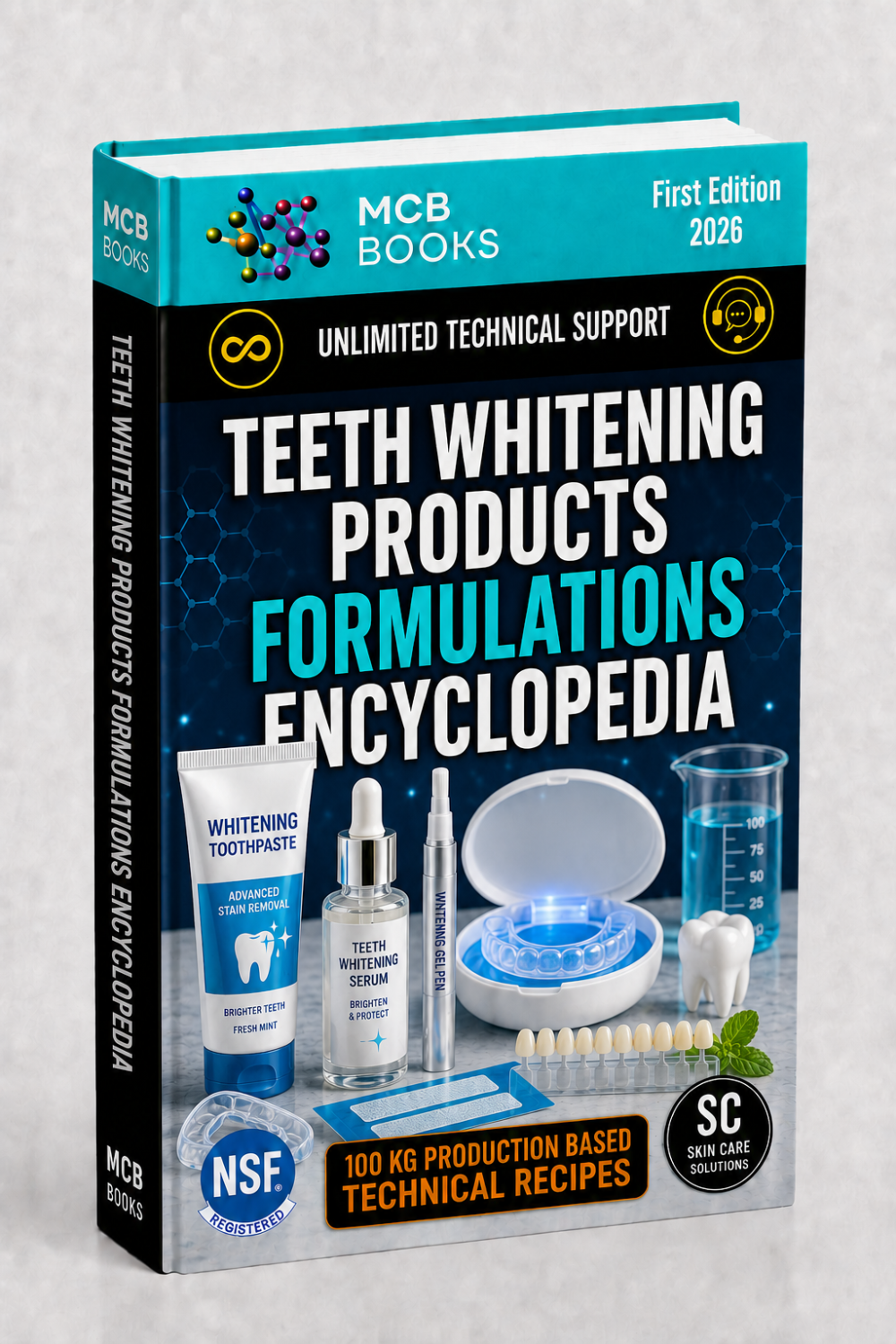
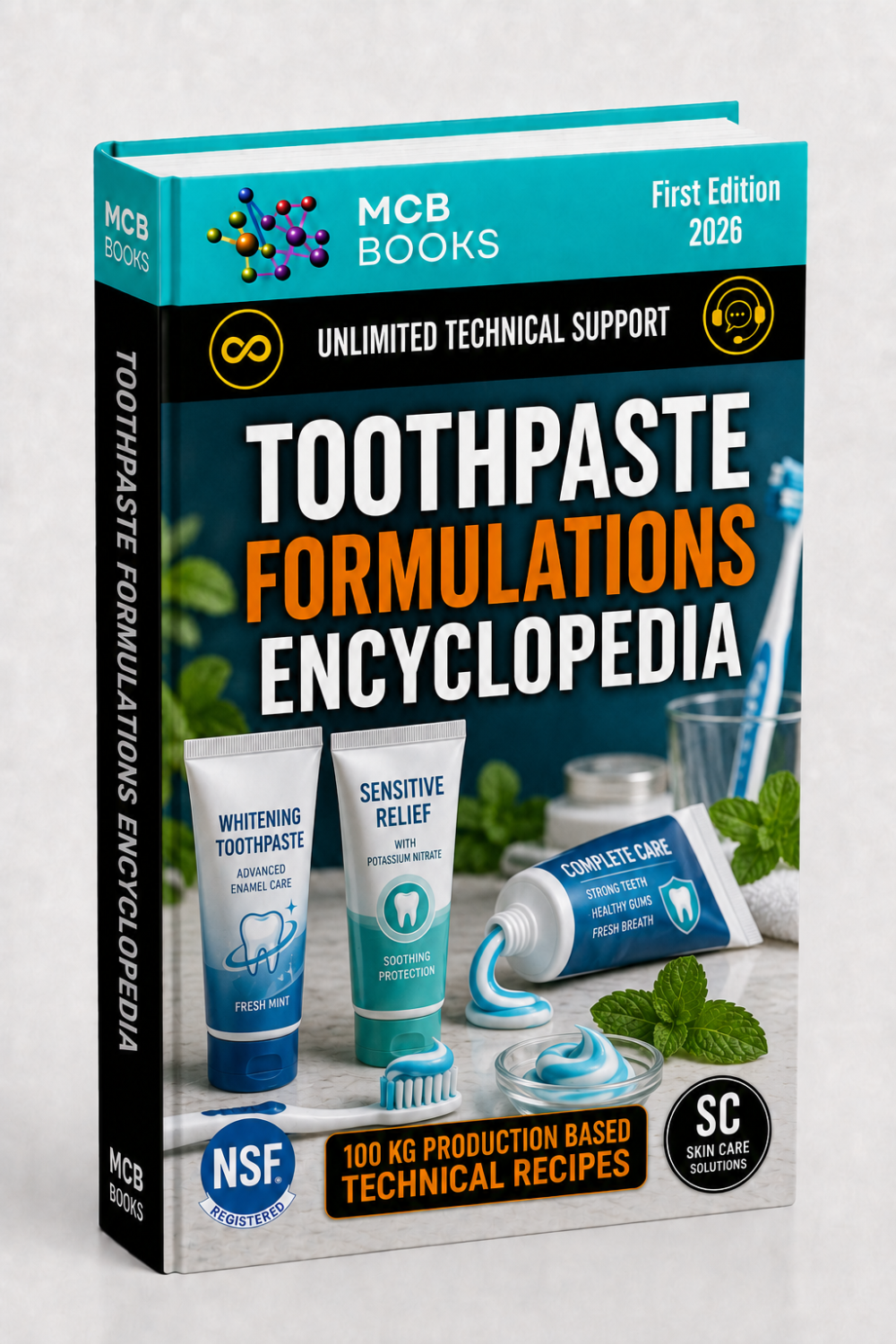
WHITENING TOOTHPASTE FORMULATIONS ENCYCLOPEDIA
Book details
- Editor
- MCB BOOKS
- ISBN
- 978-625-95879-1-2
- Number of Pages
- 350 Pages
- Publication Date
- 2026
- Copyright
- MCB BOOKS
- Format
- Hard Book & E book (PDF)
- Language
- English
About the Encyclopedia
Making a whitening toothpaste involves more than adding a polishing ingredient to a regular toothpaste formula. Manufacturers need to think about cleaning performance, abrasivity, ingredient compatibility and how the product will behave during everyday brushing. A toothpaste should also have a pleasant taste, the right consistency and enough stability to maintain its quality throughout its shelf life.
The Whitening Toothpaste Formulations Encyclopedia is developed for manufacturers who want to produce their own whitening toothpaste products. It covers different whitening technologies, including silica-based polishing systems, activated charcoal, baking soda, enzyme-based formulations, peroxide ingredients and PAP whitening concepts.
With 350 pages, 42 product types and 126 whitening toothpaste formulations, the encyclopedia offers a wide selection of manufacturing approaches for companies developing new products or expanding an existing toothpaste range.
Not all whitening toothpastes work in the same way. Some primarily help remove external stains through cleaning and polishing, while others are developed around chemical whitening ingredients. These differences influence the choice of raw materials, processing conditions and the testing needed before a product can be sold.
The book also covers low-abrasive whitening toothpaste, fluoride and fluoride-free products, sensitive whitening toothpaste, herbal and natural formulations, and specialized products for different consumer preferences.
Whether you're developing a daily whitening toothpaste, exploring a premium formulation or preparing products for private-label customers, this encyclopedia provides technical information to help you compare ingredient systems and manufacturing methods.
It is intended for toothpaste manufacturers, formulation chemists, chemical engineers, private-label producers and oral care companies interested in whitening toothpaste production.
Table of contents
01Page 1 Contents 210 formulations · 1–336
- 1General Purpose Whitening Toothpaste Formulation and Industrial Production Process 1
- 3General Purpose Whitening Toothpaste Formulation and Industrial Production Process 2
- 5General Purpose Whitening Toothpaste Formulation and Industrial Production Process 3
- 7General Purpose Whitening Toothpaste Special Specification
- 8General Purpose Whitening Toothpaste Technical Properties and Usage
- 9Hydrogen Peroxide Whitening Toothpaste Formulation and Industrial Production Process 1
- 11Hydrogen Peroxide Whitening Toothpaste Formulation and Industrial Production Process 2
- 13Hydrogen Peroxide Whitening Toothpaste Formulation and Industrial Production Process 3
- 15Hydrogen Peroxide Whitening Toothpaste Special Specification
- 16Hydrogen Peroxide Whitening Toothpaste Technical Properties and Usage
- 17Carbamide Peroxide Whitening Toothpaste Formulation and Industrial Production Process 1
- 19Carbamide Peroxide Whitening Toothpaste Formulation and Industrial Production Process 2
- 21Carbamide Peroxide Whitening Toothpaste Formulation and Industrial Production Process 3
- 23Carbamide Peroxide Whitening Toothpaste Special Specification
- 24Carbamide Peroxide Whitening Toothpaste Technical Properties and Usage
- 25PAP Whitening Toothpaste Formulation and Industrial Production Process 1
- 27PAP Whitening Toothpaste Formulation and Industrial Production Process 2
- 29PAP Whitening Toothpaste Formulation and Industrial Production Process 3
- 31PAP Whitening Toothpaste Special Specification
- 32PAP Whitening Toothpaste Technical Properties and Usage
- 33Activated Charcoal Whitening Toothpaste Formulation and Industrial Production Process 1
- 35Activated Charcoal Whitening Toothpaste Formulation and Industrial Production Process 2
- 37Activated Charcoal Whitening Toothpaste Formulation and Industrial Production Process 3
- 39Activated Charcoal Whitening Toothpaste Special Specification
- 40Activated Charcoal Whitening Toothpaste Technical Properties and Usage
- 41Baking Soda Whitening Toothpaste Formulation and Industrial Production Process 1
- 43Baking Soda Whitening Toothpaste Formulation and Industrial Production Process 2
- 45Baking Soda Whitening Toothpaste Formulation and Industrial Production Process 3
- 47Baking Soda Whitening Toothpaste Special Specification
- 48Baking Soda Whitening Toothpaste Technical Properties and Usage
- 49Silica Whitening Toothpaste Formulation and Industrial Production Process 1
- 51Silica Whitening Toothpaste Formulation and Industrial Production Process 2
- 53Silica Whitening Toothpaste Formulation and Industrial Production Process 3
- 55Silica Whitening Toothpaste Special Specification
- 56Silica Whitening Toothpaste Technical Properties and Usage
- 57Enzyme-Based Whitening Toothpaste Formulation and Industrial Production Process 1
- 59Enzyme-Based Whitening Toothpaste Formulation and Industrial Production Process 2
- 61Enzyme-Based Whitening Toothpaste Formulation and Industrial Production Process 3
- 63Enzyme-Based Whitening Toothpaste Special Specification
- 64Enzyme-Based Whitening Toothpaste Technical Properties and Usage
- 65Fluoride Whitening Toothpaste Formulation and Industrial Production Process 1
- 67Fluoride Whitening Toothpaste Formulation and Industrial Production Process 2
- 69Fluoride Whitening Toothpaste Formulation and Industrial Production Process 3
- 71Fluoride Whitening Toothpaste Special Specification
- 72Fluoride Whitening Toothpaste Technical Properties and Usage
- 73Fluoride-Free Whitening Toothpaste Formulation and Industrial Production Process 1
- 75Fluoride-Free Whitening Toothpaste Formulation and Industrial Production Process 2
- 77Fluoride-Free Whitening Toothpaste Formulation and Industrial Production Process 3
- 79Fluoride-Free Whitening Toothpaste Special Specification
- 80Fluoride-Free Whitening Toothpaste Technical Properties and Usage
- 81Herbal Whitening Toothpaste Formulation and Industrial Production Process 1
- 83Herbal Whitening Toothpaste Formulation and Industrial Production Process 2
- 85Herbal Whitening Toothpaste Formulation and Industrial Production Process 3
- 87Herbal Whitening Toothpaste Special Specification
- 88Herbal Whitening Toothpaste Technical Properties and Usage
- 89Natural Whitening Toothpaste Formulation and Industrial Production Process 1
- 91Natural Whitening Toothpaste Formulation and Industrial Production Process 2
- 93Natural Whitening Toothpaste Formulation and Industrial Production Process 3
- 95Natural Whitening Toothpaste Special Specification
- 96Natural Whitening Toothpaste Technical Properties and Usage
- 97Organic Whitening Toothpaste Formulation and Industrial Production Process 1
- 99Organic Whitening Toothpaste Formulation and Industrial Production Process 2
- 101Organic Whitening Toothpaste Formulation and Industrial Production Process 3
- 103Organic Whitening Toothpaste Special Specification
- 104Organic Whitening Toothpaste Technical Properties and Usage
- 105Aloe Vera Whitening Toothpaste Formulation and Industrial Production Process 1
- 107Aloe Vera Whitening Toothpaste Formulation and Industrial Production Process 2
- 109Aloe Vera Whitening Toothpaste Formulation and Industrial Production Process 3
- 111Aloe Vera Whitening Toothpaste Special Specification
- 112Aloe Vera Whitening Toothpaste Technical Properties and Usage
- 113Coconut Oil Whitening Toothpaste Formulation and Industrial Production Process 1
- 115Coconut Oil Whitening Toothpaste Formulation and Industrial Production Process 2
- 117Coconut Oil Whitening Toothpaste Formulation and Industrial Production Process 3
- 119Coconut Oil Whitening Toothpaste Special Specification
- 120Coconut Oil Whitening Toothpaste Technical Properties and Usage
- 121Neem Whitening Toothpaste Formulation and Industrial Production Process 1
- 123Neem Whitening Toothpaste Formulation and Industrial Production Process 2
- 125Neem Whitening Toothpaste Formulation and Industrial Production Process 3
- 127Neem Whitening Toothpaste Special Specification
- 128Neem Whitening Toothpaste Technical Properties and Usage
- 129Tea Tree Whitening Toothpaste Formulation and Industrial Production Process 1
- 131Tea Tree Whitening Toothpaste Formulation and Industrial Production Process 2
- 133Tea Tree Whitening Toothpaste Formulation and Industrial Production Process 3
- 135Tea Tree Whitening Toothpaste Special Specification
- 136Tea Tree Whitening Toothpaste Technical Properties and Usage
- 137Clove Whitening Toothpaste Formulation and Industrial Production Process 1
- 139Clove Whitening Toothpaste Formulation and Industrial Production Process 2
- 141Clove Whitening Toothpaste Formulation and Industrial Production Process 3
- 143Clove Whitening Toothpaste Special Specification
- 144Clove Whitening Toothpaste Technical Properties and Usage
- 145Sensitive Whitening Toothpaste Formulation and Industrial Production Process 1
- 147Sensitive Whitening Toothpaste Formulation and Industrial Production Process 2
- 149Sensitive Whitening Toothpaste Formulation and Industrial Production Process 3
- 151Sensitive Whitening Toothpaste Special Specification
- 152Sensitive Whitening Toothpaste Technical Properties and Usage
- 153Enamel Protection Whitening Toothpaste Formulation and Industrial Production Process 1
- 155Enamel Protection Whitening Toothpaste Formulation and Industrial Production Process 2
- 157Enamel Protection Whitening Toothpaste Formulation and Industrial Production Process 3
- 159Enamel Protection Whitening Toothpaste Special Specification
- 160Enamel Protection Whitening Toothpaste Technical Properties and Usage
- 161Anti-Cavity Whitening Toothpaste Formulation and Industrial Production Process 1
- 163Anti-Cavity Whitening Toothpaste Formulation and Industrial Production Process 2
- 165Anti-Cavity Whitening Toothpaste Formulation and Industrial Production Process 3
- 167Anti-Cavity Whitening Toothpaste Special Specification
- 168Anti-Cavity Whitening Toothpaste Technical Properties and Usage
- 169Anti-Plaque Whitening Toothpaste Formulation and Industrial Production Process 1
- 171Anti-Plaque Whitening Toothpaste Formulation and Industrial Production Process 2
- 173Anti-Plaque Whitening Toothpaste Formulation and Industrial Production Process 3
- 175Anti-Plaque Whitening Toothpaste Special Specification
- 176Anti-Plaque Whitening Toothpaste Technical Properties and Usage
- 177Tartar Control Whitening Toothpaste Formulation and Industrial Production Process 1
- 179Tartar Control Whitening Toothpaste Formulation and Industrial Production Process 2
- 181Tartar Control Whitening Toothpaste Formulation and Industrial Production Process 3
- 183Tartar Control Whitening Toothpaste Special Specification
- 184Tartar Control Whitening Toothpaste Technical Properties and Usage
- 185Fresh Mint Whitening Toothpaste Formulation and Industrial Production Process 1
- 187Fresh Mint Whitening Toothpaste Formulation and Industrial Production Process 2
- 189Fresh Mint Whitening Toothpaste Formulation and Industrial Production Process 3
- 191Fresh Mint Whitening Toothpaste Special Specification
- 192Fresh Mint Whitening Toothpaste Technical Properties and Usage
- 193Breath Freshening Whitening Toothpaste Formulation and Industrial Production Process 1
- 195Breath Freshening Whitening Toothpaste Formulation and Industrial Production Process 2
- 197Breath Freshening Whitening Toothpaste Formulation and Industrial Production Process 3
- 199Breath Freshening Whitening Toothpaste Special Specification
- 200Breath Freshening Whitening Toothpaste Technical Properties and Usage
- 201Low Abrasive Whitening Toothpaste Formulation and Industrial Production Process 1
- 203Low Abrasive Whitening Toothpaste Formulation and Industrial Production Process 2
- 205Low Abrasive Whitening Toothpaste Formulation and Industrial Production Process 3
- 207Low Abrasive Whitening Toothpaste Special Specification
- 208Low Abrasive Whitening Toothpaste Technical Properties and Usage
- 209Daily Care Whitening Toothpaste Formulation and Industrial Production Process 1
- 211Daily Care Whitening Toothpaste Formulation and Industrial Production Process 2
- 213Daily Care Whitening Toothpaste Formulation and Industrial Production Process 3
- 215Daily Care Whitening Toothpaste Special Specification
- 216Daily Care Whitening Toothpaste Technical Properties and Usage
- 217High Performance Whitening Toothpaste Formulation and Industrial Production Process 1
- 219High Performance Whitening Toothpaste Formulation and Industrial Production Process 2
- 221High Performance Whitening Toothpaste Formulation and Industrial Production Process 3
- 223High Performance Whitening Toothpaste Special Specification
- 224High Performance Whitening Toothpaste Technical Properties and Usage
- 225Professional Whitening Toothpaste Formulation and Industrial Production Process 1
- 227Professional Whitening Toothpaste Formulation and Industrial Production Process 2
- 229Professional Whitening Toothpaste Formulation and Industrial Production Process 3
- 231Professional Whitening Toothpaste Special Specification
- 232Professional Whitening Toothpaste Technical Properties and Usage
- 233Premium Whitening Toothpaste Formulation and Industrial Production Process 1
- 235Premium Whitening Toothpaste Formulation and Industrial Production Process 2
- 237Premium Whitening Toothpaste Formulation and Industrial Production Process 3
- 239Premium Whitening Toothpaste Special Specification
- 240Premium Whitening Toothpaste Technical Properties and Usage
- 241OEM Whitening Toothpaste Formulation and Industrial Production Process 1
- 243OEM Whitening Toothpaste Formulation and Industrial Production Process 2
- 245OEM Whitening Toothpaste Formulation and Industrial Production Process 3
- 247OEM Whitening Toothpaste Special Specification
- 248OEM Whitening Toothpaste Technical Properties and Usage
- 249Vegan Whitening Toothpaste Formulation and Industrial Production Process 1
- 251Vegan Whitening Toothpaste Formulation and Industrial Production Process 2
- 253Vegan Whitening Toothpaste Formulation and Industrial Production Process 3
- 255Vegan Whitening Toothpaste Special Specification
- 256Vegan Whitening Toothpaste Technical Properties and Usage
- 257SLS-Free Whitening Toothpaste Formulation and Industrial Production Process 1
- 259SLS-Free Whitening Toothpaste Formulation and Industrial Production Process 2
- 261SLS-Free Whitening Toothpaste Formulation and Industrial Production Process 3
- 263SLS-Free Whitening Toothpaste Special Specification
- 264SLS-Free Whitening Toothpaste Technical Properties and Usage
- 265Paraben-Free Whitening Toothpaste Formulation and Industrial Production Process 1
- 267Paraben-Free Whitening Toothpaste Formulation and Industrial Production Process 2
- 269Paraben-Free Whitening Toothpaste Formulation and Industrial Production Process 3
- 271Paraben-Free Whitening Toothpaste Special Specification
- 272Paraben-Free Whitening Toothpaste Technical Properties and Usage
- 273Sulfate-Free Whitening Toothpaste Formulation and Industrial Production Process 1
- 275Sulfate-Free Whitening Toothpaste Formulation and Industrial Production Process 2
- 277Sulfate-Free Whitening Toothpaste Formulation and Industrial Production Process 3
- 279Sulfate-Free Whitening Toothpaste Special Specification
- 280Sulfate-Free Whitening Toothpaste Technical Properties and Usage
- 281Gel Whitening Toothpaste Formulation and Industrial Production Process 1
- 283Gel Whitening Toothpaste Formulation and Industrial Production Process 2
- 285Gel Whitening Toothpaste Formulation and Industrial Production Process 3
- 287Gel Whitening Toothpaste Special Specification
- 288Gel Whitening Toothpaste Technical Properties and Usage
- 289Transparent Gel Whitening Toothpaste Formulation and Industrial Production Process 1
- 291Transparent Gel Whitening Toothpaste Formulation and Industrial Production Process 2
- 293Transparent Gel Whitening Toothpaste Formulation and Industrial Production Process 3
- 295Transparent Gel Whitening Toothpaste Special Specification
- 296Transparent Gel Whitening Toothpaste Technical Properties and Usage
- 297Dentist Recommended Whitening Toothpaste Formulation and Industrial Production Process 1
- 299Dentist Recommended Whitening Toothpaste Formulation and Industrial Production Process 2
- 301Dentist Recommended Whitening Toothpaste Formulation and Industrial Production Process 3
- 303Dentist Recommended Whitening Toothpaste Special Specification
- 304Dentist Recommended Whitening Toothpaste Technical Properties and Usage
- 305Eco-Friendly Whitening Toothpaste Formulation and Industrial Production Process 1
- 307Eco-Friendly Whitening Toothpaste Formulation and Industrial Production Process 2
- 309Eco-Friendly Whitening Toothpaste Formulation and Industrial Production Process 3
- 311Eco-Friendly Whitening Toothpaste Special Specification
- 312Eco-Friendly Whitening Toothpaste Technical Properties and Usage
- 313Sustainable Whitening Toothpaste Formulation and Industrial Production Process 1
- 315Sustainable Whitening Toothpaste Formulation and Industrial Production Process 2
- 317Sustainable Whitening Toothpaste Formulation and Industrial Production Process 3
- 319Sustainable Whitening Toothpaste Special Specification
- 320Sustainable Whitening Toothpaste Technical Properties and Usage
- 321Children's Whitening Toothpaste Formulation and Industrial Production Process 1
- 323Children's Whitening Toothpaste Formulation and Industrial Production Process 2
- 325Children's Whitening Toothpaste Formulation and Industrial Production Process 3
- 327Children's Whitening Toothpaste Special Specification
- 328Children's Whitening Toothpaste Technical Properties and Usage
- 329Advanced Whitening Toothpaste Technology Formulation and Industrial Production Process 1
- 331Advanced Whitening Toothpaste Technology Formulation and Industrial Production Process 2
- 333Advanced Whitening Toothpaste Technology Formulation and Industrial Production Process 3
- 335Advanced Whitening Toothpaste Technology Special Specification
- 336Advanced Whitening Toothpaste Technology Technical Properties and Usage
More about this book
What's Inside the Encyclopedia
The Whitening Toothpaste Formulations Encyclopedia contains 42 different product groups, each with three formulations and industrial production processes. Every product group also includes special specifications and technical properties, giving manufacturers 126 formulation approaches across 210 technical entries.
The collection begins with general whitening toothpaste and continues with formulations featuring hydrogen peroxide, carbamide peroxide and PAP (phthalimidoperoxycaproic acid). These product groups introduce different chemical whitening concepts, each requiring careful attention to ingredient stability, oral safety and the regulations of the intended market.
Manufacturers can also explore activated charcoal whitening toothpaste, baking soda whitening toothpaste, silica whitening toothpaste and enzyme-based whitening toothpaste. These products offer different approaches to surface stain removal, cleaning and product development.
The encyclopedia includes fluoride and fluoride-free whitening toothpaste, along with herbal, natural and organic whitening toothpaste formulations. Other product groups feature aloe vera, coconut oil, neem, tea tree and clove ingredients for manufacturers investigating different botanical product concepts.
There are also formulations combining whitening with other oral care characteristics, including sensitive whitening toothpaste, enamel protection, anti-cavity, anti-plaque and tartar control toothpaste.
For daily consumer products, the collection covers fresh mint, breath freshening, low-abrasive and daily-care whitening toothpaste. Further sections include gel whitening toothpaste, transparent gel whitening toothpaste, SLS-free, sulfate-free, paraben-free and vegan formulations.
Manufacturers interested in commercial product development will also find professional, high-performance, premium and OEM whitening toothpaste concepts, together with eco-friendly, sustainable and advanced whitening toothpaste technologies.
This variety allows manufacturers to study different whitening toothpaste formulas without limiting development to one type of abrasive, one ingredient system or one product format.
Why This Encyclopedia
Whitening toothpaste is a competitive product category, and manufacturers need formulas that make sense both technically and commercially.
A silica-based toothpaste may require a different abrasive and thickening system from a peroxide-containing formulation. Charcoal can affect color, texture and dispersion, while enzymes introduce additional questions about ingredient stability and manufacturing conditions.
These are not small differences. They influence how a product is formulated, produced, tested and packaged.
The Whitening Toothpaste Formulations Encyclopedia brings together 126 formulations across 42 product types, giving manufacturers an opportunity to compare different ingredient combinations and production methods.
It also helps businesses explore whitening toothpaste developed for different customer preferences, from fluoride-free and natural formulations to low-abrasive, sensitive, premium and private-label products.
For a manufacturer already producing conventional toothpaste, the encyclopedia provides technical starting points for expanding into whitening products. For a business planning a new brand, it offers different approaches to investigate before choosing a formulation for laboratory development.
Rather than covering every oral care product, this book concentrates on whitening toothpaste manufacturing, making it a more focused reference for companies interested in this particular market.
About Formulations
Whitening Toothpaste Formulations, Whitening Toothpaste Manufacturing, Silica Whitening Toothpaste, Hydrogen Peroxide Whitening Toothpaste, Carbamide Peroxide Toothpaste, PAP Whitening Toothpaste, Activated Charcoal Whitening Toothpaste, Baking Soda Whitening Toothpaste, Enzyme-Based Whitening Toothpaste, Low-Abrasive Whitening Toothpaste, Fluoride Whitening Toothpaste, Fluoride-Free Whitening Toothpaste, Sensitive Whitening Toothpaste, Enamel Protection Whitening Toothpaste, Natural Whitening Toothpaste, Organic Whitening Toothpaste, Gel Whitening Toothpaste, Transparent Whitening Toothpaste Gel, SLS-Free Whitening Toothpaste, Premium Whitening Toothpaste, Private Label Whitening Toothpaste, Whitening Toothpaste Raw Materials
Manufacturing Methods
Each formulation is presented in a clear and practical structure showing the raw materials, CAS numbers, functions of each ingredient, and exact quantities required for production.
All formulations are calculated on a 100 kg production basis, making them easy to understand, compare, scale, and adapt for laboratory or industrial R&D work.
The book uses straightforward technical language so that readers can follow the formulations without needing advanced engineering knowledge.
The Production Process section explains the manufacturing sequence step by step, including charging order, mixing, dissolution, dispersion, temperature control, viscosity adjustment, filtration, and final filling.
Special attention is given to what happens at each production stage, helping the reader understand not only what to add, but when, how, and why it is added.
The formulations are presented as practical starting formulations for laboratory, in-house, R&D, product-development, and commercial production studies, with final validation and regulatory testing required before market use.
In this way, the encyclopedia guides the reader through the complete manufacturing workflow in a form that can be followed by formulators, technicians, production staff, entrepreneurs, and manufacturers alike.
Troubleshooting
The encyclopedia helps readers understand and identify common problems that may occur during production and application.
Issues such as incorrect viscosity, poor adhesion, slow or incomplete curing, premature thickening, air bubbles, poor dispersion, and moisture-related instability can be evaluated through the formulation and production guidance.
The production processes explain critical factors such as mixing order, temperature, moisture control, dispersion, degassing, viscosity adjustment, filtration, and packaging conditions that can directly influence the final product.
Readers can also understand how substrate preparation, mixing accuracy, bond-line thickness, curing conditions, and application environment affect adhesive performance.
By comparing the expected product properties with actual production results, users can more easily determine where a problem may have originated in the manufacturing process.
This practical approach helps reduce unnecessary trial and error and provides a clearer direction for corrective formulation adjustments and process optimization.
Troubleshooting therefore becomes part of the overall formulation-development process rather than a separate, complicated engineering task.
Unlimited Technical Support
When you purchase the Whitening Toothpaste Formulations Encyclopedia, you can contact our technical team with questions about the formulations, raw materials and manufacturing procedures covered in the book.
If you're comparing different polishing agents, looking for suitable ingredient alternatives or reviewing a production step, our team is available to help you understand the technical information.
Whether you're working with silica-based toothpaste, activated charcoal, peroxide-related formulations or a low-abrasive whitening product, you can discuss formulation-related questions directly with us.
The encyclopedia is available in PDF e-book and hard book formats.
For sample pages, purchasing information or technical assistance, contact us through WhatsApp.
Featured Articles
1. HOW TO MAKE WHITENING TOOTHPASTE FORMULATIONS FOR COMMERCIAL PRODUCTION
Whitening toothpaste is one of the product categories that many oral care manufacturers consider when developing a new range. Customers want products that help maintain a clean appearance, remove everyday stains and fit comfortably into their normal brushing routine. For manufacturers, the challenge is creating a toothpaste that delivers the intended cleaning performance without compromising other important product characteristics.
Developing whitening toothpaste formulations begins with choosing the whitening approach. Some products use carefully selected polishing materials to help remove surface stains. Others incorporate chemical whitening ingredients, which introduce different safety, stability and regulatory considerations.
Silica is widely used in toothpaste as a cleaning and polishing ingredient. However, different silica grades have different particle properties, thickening behavior and abrasive characteristics. Manufacturers need to select the appropriate material for the intended formulation.
Other whitening toothpaste concepts may contain baking soda, activated charcoal, enzymes or selected chemical whitening agents. These materials cannot simply be substituted for one another because they behave differently during production and use.
The toothpaste base also matters. Humectants such as glycerin and sorbitol help establish the desired consistency, while binders keep the product uniform. Suitable surfactants, flavors and sweeteners contribute to the brushing experience.
During manufacturing, the base is prepared first, followed by controlled incorporation of thickeners, polishing agents and other compatible ingredients. Proper mixing helps prevent lumps, air pockets and inconsistent texture.
Abrasivity should be evaluated in the finished toothpaste. A product that removes stains aggressively is not necessarily appropriate for everyday use, particularly if it causes excessive wear.
Quality control should consider viscosity, appearance, chemical stability, packaging compatibility and the evidence supporting whitening claims.
The Whitening Toothpaste Formulations Encyclopedia contains 126 formulations across 42 product groups, covering several approaches to whitening toothpaste production.
For manufacturers planning to introduce a whitening toothpaste, the book offers technical starting points for comparing ingredients, understanding production requirements and developing products for different market needs.
TAGS: whitening toothpaste formulations, how to make whitening toothpaste, whitening toothpaste manufacturing process, commercial whitening toothpaste production
2. SILICA, BAKING SODA AND ACTIVATED CHARCOAL WHITENING TOOTHPASTE FORMULATIONS
Not every whitening toothpaste relies on peroxide or another chemical whitening agent. Many products are developed around ingredients that help clean the tooth surface and remove external stains. Silica, baking soda and activated charcoal are three ingredients manufacturers may consider, although their properties and supporting evidence differ.
Silica whitening toothpaste formulations use selected silica grades to provide cleaning and polishing characteristics. The choice of silica influences the paste's texture, abrasive behavior and interaction with the thickening system.
Two silica ingredients with similar names may perform differently because of their particle size, structure and manufacturing grade. For this reason, selecting an abrasive should involve more than comparing ingredient prices.
Baking soda whitening toothpaste is another product direction. Sodium bicarbonate can contribute to cleaning properties and influence the formulation's pH. Manufacturers need to consider its compatibility with the other ingredients, particularly when developing products containing specific functional actives.
Activated charcoal is also found in some whitening toothpaste concepts. Its dark appearance can create a distinctive product, but charcoal formulations present challenges involving dispersion, texture, potential abrasivity and the strength of the evidence behind particular whitening claims.
The presence of charcoal does not, by itself, demonstrate superior whitening performance or long-term safety. The finished product needs appropriate evaluation.
These ingredients also behave differently during manufacturing. Silica powders require controlled incorporation to produce a uniform paste. Baking soda affects the formulation environment, while charcoal can create additional concerns involving dust handling and even distribution.
Humectants, thickeners and suitable cleansing ingredients need to be selected around the chosen polishing system. Flavor is important as well, since an unpleasant taste or chalky mouthfeel can affect consumer acceptance.
Whitening effectiveness and toothpaste abrasivity should be considered together. The aim is not simply to produce the strongest possible polishing action, but to develop a product suitable for its intended use.
The Whitening Toothpaste Formulations Encyclopedia includes separate product groups for silica, baking soda and activated charcoal whitening toothpaste, each with three formulation and manufacturing approaches.
These sections give manufacturers different options to investigate when developing surface-stain-removal toothpaste for commercial production.
TAGS: silica whitening toothpaste formulations, baking soda whitening toothpaste manufacturing, activated charcoal whitening toothpaste, whitening toothpaste polishing agents
3. HYDROGEN PEROXIDE, CARBAMIDE PEROXIDE AND PAP WHITENING TOOTHPASTE FORMULATIONS
Chemical whitening ingredients introduce a different set of challenges from conventional polishing agents. For manufacturers, developing a toothpaste with hydrogen peroxide, carbamide peroxide or PAP requires careful attention to the intended whitening mechanism, ingredient compatibility and the conditions under which the finished product will be used.
Hydrogen peroxide whitening toothpaste formulations involve an oxidizing ingredient whose stability can be affected by other raw materials, contamination, temperature, pH and packaging.
That makes the supporting formulation especially important. A base suitable for ordinary toothpaste cannot automatically be used for a peroxide product without additional compatibility and stability work.
Carbamide peroxide whitening toothpaste formulations are another product concept. Carbamide peroxide is associated with peroxide-releasing whitening systems, and its behavior depends on the formulation environment and storage conditions.
Manufacturers need to consider how the ingredient behaves in the finished paste, whether it remains stable during the intended shelf life and how its use fits the regulations of the target market.
PAP, or phthalimidoperoxycaproic acid, is also included in certain whitening product technologies. PAP whitening toothpaste formulations require assessment of their chemical stability, ingredient compatibility, safety and substantiated whitening performance.
None of these ingredients should be treated as interchangeable. The surrounding formulation, manufacturing conditions and supporting testing requirements can be significantly different.
Production planning should also account for the sensitivity of oxidizing ingredients. Appropriate raw material specifications, controlled processing and compatible packaging are essential parts of development.
Regulatory restrictions are particularly important for peroxide-containing oral care products. Permitted concentrations and sale conditions vary by market, and some products may be restricted to professional dental channels. A published formulation does not establish that a particular commercial product is legally permitted.
Manufacturers must also distinguish between surface stain removal and changes in intrinsic tooth color when evaluating whitening claims.
The Whitening Toothpaste Formulations Encyclopedia includes hydrogen peroxide, carbamide peroxide and PAP whitening toothpaste as separate product groups.
For companies researching chemical whitening toothpaste, these sections provide technical subjects to investigate alongside the necessary laboratory testing, safety assessment and market-specific regulatory review.
TAGS: hydrogen peroxide whitening toothpaste, carbamide peroxide toothpaste formulations, PAP whitening toothpaste manufacturing, chemical whitening toothpaste ingredients
4. LOW-ABRASIVE AND SENSITIVE WHITENING TOOTHPASTE FORMULATIONS
Whitening toothpaste does not have to be developed around an aggressive polishing system. Many manufacturers are interested in products that combine everyday stain removal with a more carefully controlled abrasive profile.
This is particularly relevant when developing toothpaste intended for consumers who also pay attention to enamel care or tooth sensitivity.
Low-abrasive whitening toothpaste formulations require a suitable selection of cleaning and polishing ingredients. The type, grade and concentration of abrasive materials can influence the finished product's performance.
Hydrated silica is one ingredient that may be considered, but different grades provide different cleaning and abrasive characteristics. Manufacturers should not assume that all silica-based toothpastes perform in the same way.
The full formulation must be evaluated using appropriate methods for determining toothpaste abrasivity. A claim of low abrasivity should be supported by relevant testing rather than the ingredient list alone.
Sensitive whitening toothpaste formulations introduce additional considerations. Some products aim to combine surface stain removal with ingredients or formulation characteristics associated with the management of tooth sensitivity.
However, whitening performance and sensitivity relief are separate claims. A toothpaste must have appropriate evidence for each benefit it intends to communicate.
Manufacturing generally begins with preparing the toothpaste base, followed by the incorporation of thickeners, abrasives and other compatible ingredients. Mixing should produce a consistent texture without unwanted particles or separation.
Flavor and foam characteristics also affect the finished product. Some manufacturers prefer a mild mint profile and suitable alternative surfactants when developing products for particular consumer preferences.
The toothpaste should remain stable during storage and dispense consistently from its packaging. Changes in viscosity or flavor can influence the customer's experience even when the cleaning ingredients remain present.
The Whitening Toothpaste Formulations Encyclopedia includes low-abrasive, sensitive, enamel protection and daily-care whitening toothpaste product groups.
These formulations offer manufacturers several product development directions within the whitening toothpaste category.
For businesses planning a broader whitening toothpaste range, they provide opportunities to study products designed around different cleaning characteristics, ingredient combinations and customer needs.
TAGS: low abrasive whitening toothpaste formulations, sensitive whitening toothpaste manufacturing, enamel care whitening toothpaste, gentle whitening toothpaste production
5. PRIVATE LABEL WHITENING TOOTHPASTE MANUFACTURING AND PRODUCT DEVELOPMENT
Whitening toothpaste is a product category that can be developed in several directions. A brand may want a simple mint toothpaste designed for surface stain removal, while another customer may request a charcoal formula, a transparent gel or a specialized ingredient system.
For private-label manufacturers, these differences create opportunities to offer products with distinct characteristics rather than supplying the same toothpaste under different labels.
The first step is choosing the intended product. Whitening toothpaste formulations can use different polishing systems, flavor profiles, binders and functional ingredients, and those choices determine much of the manufacturing process.
A silica-based toothpaste may require different powder incorporation and viscosity control from a clear gel product. Formulations containing chemically reactive whitening ingredients need additional compatibility and stability evaluation.
Manufacturers also need to think about the customer experience. A whitening toothpaste should have a suitable texture, taste and consistency, and its packaging should make it easy to use.
Private label whitening toothpaste manufacturing requires repeatable production conditions. Raw material specifications, mixing procedures, filling operations and quality checks should be documented so that different batches meet the established requirements.
Packaging can also influence the product's stability. Certain whitening ingredients require careful container selection, and a formula that performs well in a laboratory vessel may behave differently after filling.
Claims are another important part of development. Whitening, enamel protection, sensitivity relief and other performance statements should be supported by evidence relevant to the finished product.
Brands planning to make natural, organic, vegan or environmentally focused claims need appropriate documentation for those descriptions as well.
The Whitening Toothpaste Formulations Encyclopedia covers 42 product groups and 126 formulation approaches, including premium, professional, OEM, high-performance, gel and specialized whitening toothpaste products.
For companies already manufacturing toothpaste, the encyclopedia can support research into additional product types. New businesses can use it to study different formulation systems before deciding which products fit their production plans.
Its main value for private-label manufacturers is the variety of technical approaches available within one specialized toothpaste category.
TAGS: private label whitening toothpaste, OEM whitening toothpaste formulations, whitening toothpaste manufacturing business, commercial whitening toothpaste development
Some Raw Materials Used
Purified Water, Deionized Water, Glycerin, Sorbitol, Hydrated Silica, Precipitated Silica, Sodium Bicarbonate, Activated Charcoal, Hydrogen Peroxide, Carbamide Peroxide, Phthalimidoperoxycaproic Acid (PAP), Suitable Enzyme Ingredients, Sodium Fluoride, Sodium Monofluorophosphate, Calcium Carbonate, Xylitol, Cellulose Gum, Xanthan Gum, Carrageenan, Hydroxyethyl Cellulose, Sodium Lauroyl Sarcosinate, Sodium Lauryl Sulfate, Cocamidopropyl Betaine, Sodium Saccharin, Sucralose, Sodium Citrate, Citric Acid, Aloe Vera Extract, Coconut Oil, Neem Extract, Clove Extract, Peppermint Flavor, Spearmint Flavor, Compatible Toothpaste Binders, Oral-Use Flavoring Agents, pH Adjusting Agents, Whitening Toothpaste Polishing Agents, Suitable Preservation Systems.
These are representative ingredients and ingredient classes associated with the formulation technologies covered by the book. They are not a verified ingredient list for every recipe. Some materials require specialized formulation systems and may be restricted or unsuitable for certain oral care applications or markets.
Why Choose This Encyclopedia
If you're planning to manufacture whitening toothpaste, the Whitening Toothpaste Formulations Encyclopedia gives you a broad selection of approaches to study within one specialized technical reference.
Inside, you'll find 126 whitening toothpaste formulations across 42 different product groups, with industrial production processes, special specifications and technical properties.
The book includes silica-based whitening toothpaste, baking soda toothpaste, activated charcoal formulations, enzyme-based products, peroxide and PAP whitening concepts, along with sensitive, low-abrasive, gel, natural, organic and premium toothpaste formulations.
This range allows manufacturers to compare different raw materials, product characteristics and manufacturing methods before deciding which formulations to develop further.
It is particularly useful for toothpaste manufacturers, formulation chemists, chemical engineers, private-label producers and businesses developing their own whitening toothpaste brand.
Rather than concentrating on one whitening ingredient, the encyclopedia provides different technical directions for product research and manufacturing planning.
With 350 pages of technical content, it can serve as a reference for developing new whitening toothpaste products and exploring additional opportunities within an existing oral care range.
Available as a PDF e-book or hard book, the encyclopedia is suitable for manufacturers and product development teams.
For sample pages, purchasing information or technical assistance, contact our team directly through WhatsApp.
Related books