Amino acid organic fertilizers are widely used in modern agriculture to support plant growth, nutrient uptake, root development, flowering, fruit formation, and crop quality. For professional fertilizer manufacturers, standardized 100 kg amino acid organic fertilizer formulas provide a practical basis for developing consistent commercial products. These formulations can be designed as liquid fertilizers, foliar sprays, fertigation products, root stimulants, and multifunctional plant nutrition solutions for different crops and growing conditions.
A typical 100 kg amino acid organic fertilizer formula may contain free amino acids, protein hydrolysates, peptides, organic nitrogen sources, seaweed extracts, humic acid, fulvic acid, potassium compounds, micronutrients, organic acids, stabilizers, preservatives, and water. The exact quantities and ingredient combinations depend on the intended application, desired nutrient analysis, target crop, and final product characteristics. Each raw material should have a defined technical function and should be compatible with the other components in the formulation.
The use of standardized 100 kg fertilizer formulas provides several advantages for professional and industrial production. Manufacturers can calculate raw material requirements accurately, maintain consistent batch quality, and simplify production planning. Once a formulation has been validated, the same ingredient ratios may be adapted for larger production batches such as 500 kg or 1,000 kg, while considering mixing equipment, processing conditions, and quality-control requirements.
Production generally begins with the addition of a calculated quantity of water to a suitable mixing vessel. Amino acid concentrates or protein hydrolysates are introduced gradually under continuous agitation. Additional nutrients, organic substances, micronutrients, and functional additives are then incorporated according to the production formula. Mixing order is important because improper addition can result in precipitation, sediment formation, excessive viscosity, or poor product stability.
pH, temperature, mixing speed, processing time, density, viscosity, and solubility should be monitored during manufacturing. After the ingredients are completely incorporated, the product may be homogenized and filtered before final weight adjustment and packaging. Finished products should also undergo quality-control testing for appearance, pH, density, amino acid content, total nitrogen, sediment formation, and storage stability.
Different 100 kg amino acid organic fertilizer formulations can be developed for specific agricultural purposes, including root development, vegetative growth, flowering, fruit enlargement, nutrient uptake, transplant recovery, and plant stress management. Amino acids can also be combined with seaweed extracts, micronutrients, potassium, and humic substances to create specialized commercial fertilizer products.
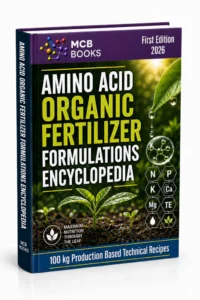
The AMINO ACID ORGANIC FERTILIZER FORMULATIONS ENCYCLOPEDIA provides practical information about 100 kg amino acid fertilizer formulas, raw materials, manufacturing procedures, production methods, and quality control. It is a valuable technical reference for fertilizer manufacturers, formulators, agricultural companies, and entrepreneurs interested in professional and industrial amino acid organic fertilizer production.