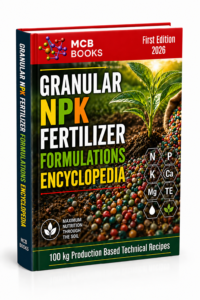
EDTA-chelated micronutrient fertilizers are widely manufactured for professional agriculture because they provide essential trace elements in soluble, stable, and plant-available forms. Iron, zinc, manganese, and copper are required in small quantities, but deficiencies can significantly reduce plant growth, chlorophyll formation, enzyme activity, flowering, fruit development, crop quality, and yield. Standardized 100 kg EDTA-chelated micronutrient fertilizer formulas help manufacturers control ingredient quantities, calculate production costs, maintain batch consistency, and scale products for industrial manufacturing.

The EDTA CHELATED MICRONUTRIENTS FORMULATIONS ENCYCLOPEDIA provides practical production concepts for single-element chelates and combined micronutrient fertilizer products. These may include Fe-EDTA, Zn-EDTA, Mn-EDTA, Cu-EDTA, liquid micronutrient concentrates, water-soluble powders, foliar fertilizers, fertigation products, hydroponic nutrients, and multi-element chelated fertilizer blends.
A 100 kg fertilizer formula provides a useful production standard because the total amount of all raw materials is calculated to equal exactly 100 kg. This structure simplifies raw-material purchasing, inventory management, batch documentation, quality control, and production planning. For example, a validated 100 kg formula may generally be converted into a 1,000 kg industrial batch by multiplying every ingredient quantity by ten. However, production time, agitation efficiency, heating capacity, cooling requirements, filtration rate, and order of addition must be reassessed during scale-up.
The main raw materials used in EDTA-chelated micronutrient fertilizer manufacturing include EDTA acid, disodium EDTA, tetrasodium EDTA, suitable alkaline agents, purified water, and selected metal sources. Iron sulfate, zinc sulfate, manganese sulfate, and copper sulfate are commonly evaluated as micronutrient sources. Depending on the production process, manufacturers may also use metal oxides, carbonates, chlorides, nitrates, or other technically suitable compounds.
The EDTA source must be selected according to the desired product pH, solubility, nutrient concentration, reaction conditions, and final physical form. EDTA acid normally requires controlled neutralization to improve its solubility in water. Disodium or tetrasodium EDTA may dissolve more easily, but they can influence the sodium level and final pH of the product. The relationship between the EDTA source and the metallic micronutrient must be calculated accurately to achieve effective chelation.
Production generally begins by adding a portion of clean water to a corrosion-resistant reaction vessel. Agitation is started, and the EDTA source is introduced gradually. When required, a compatible alkaline agent is added carefully to dissolve the EDTA and establish suitable reaction conditions. The selected metal compound is then added slowly while temperature, pH, color, and solution clarity are monitored.
Each micronutrient behaves differently during the chelation process. Fe-EDTA products normally have a characteristic dark color and are commonly manufactured to support chlorophyll formation and correct iron chlorosis. Zn-EDTA fertilizers are used to support enzyme activity, hormone production, shoot development, flowering, and reproductive growth. Mn-EDTA contributes to photosynthesis and metabolic processes, while Cu-EDTA supports lignin formation, protein metabolism, and plant defense mechanisms.
The reaction should continue until the metal source is sufficiently dissolved and complexed. Incomplete chelation may leave excessive free-metal ions in the product, increasing the risk of precipitation, sedimentation, poor dilution performance, or phytotoxicity. Excessive EDTA may unnecessarily raise production costs and alter the declared composition. Laboratory calculations and pilot-scale production trials are therefore essential before industrial manufacturing.
Water quality is another critical production factor. Water containing excessive hardness, calcium, magnesium, carbonate, bicarbonate, phosphate, or suspended impurities may interfere with chelation and reduce finished-product stability. Purified, softened, demineralized, or low-mineral water is generally preferred for professional liquid fertilizer production.
After chelation is completed, compatible additives may be incorporated according to the product type. These can include pH regulators, stabilizers, preservatives, surfactants, humectants, antifoaming agents, or other permitted fertilizer ingredients. Every additive must be tested for compatibility with the chelated metal system.
Liquid EDTA fertilizer products should be filtered before packaging to remove insoluble material and protect spraying, fertigation, hydroponic, and drip-irrigation equipment. Powder products may require concentration, crystallization, drying, grinding, and sieving. The finished powder should remain free-flowing, have controlled moisture content, and dissolve within the specified time.
Multi-element EDTA-chelated fertilizer formulas require particularly careful design. Iron, zinc, manganese, and copper concentrations must be balanced according to the target crop and application method. The manufacturer must also evaluate interactions between different chelated metals and any additional macronutrients. Concentrated calcium, phosphate, carbonate, or strongly alkaline materials may create stability problems and should not be included without laboratory compatibility testing.
The EDTA CHELATED MICRONUTRIENTS FORMULATIONS ENCYCLOPEDIA can support fertilizer producers by providing a structured approach to ingredient selection, 100 kg batch calculations, reaction procedures, manufacturing controls, and finished-product specifications. Standardized formulations make it easier to compare production batches and identify possible variations in raw-material quality or processing conditions.
Quality-control testing for each 100 kg batch should include appearance, color, odor, pH, density, total micronutrient content, chelated micronutrient percentage, free-metal concentration, solubility, insoluble matter, dilution stability, sediment formation, crystallization resistance, and storage stability. Powder products should also be tested for moisture content, particle size, flowability, and dissolution performance.
Finished products should be evaluated at low, ambient, and elevated temperatures. Retained samples from each batch should be stored for traceability and future comparison. Production records should include raw-material lot numbers, ingredient weights, processing temperature, reaction time, pH adjustments, filtration details, test results, filling quantities, and batch codes.
The EDTA CHELATED MICRONUTRIENTS FORMULATIONS ENCYCLOPEDIA offers a practical foundation for manufacturers developing commercial chelated fertilizers for foliar application, fertigation, drip irrigation, greenhouse cultivation, hydroponic systems, orchards, vegetables, field crops, and ornamental plants. By combining accurate 100 kg formulas, suitable raw materials, controlled chelation reactions, reliable quality testing, and industrial production discipline, manufacturers can produce stable and commercially valuable EDTA-chelated micronutrient fertilizers.