Plant tissue culture growth regulators are essential for controlling the developmental responses of plant cells and tissues under in vitro conditions. They are widely used in commercial micropropagation laboratories, plant biotechnology, nursery production, research centers and crop improvement programs. Properly designed 100 kg plant tissue culture growth regulator formulas can be developed for specific purposes such as shoot induction, root development, callus formation, multiplication and complete plant regeneration.
The development of a 100 kg formulation begins with selecting the appropriate plant growth regulator or combination of regulators according to the desired tissue culture response. Auxins such as Indole-3-Acetic Acid (IAA), Indole-3-Butyric Acid (IBA), 1-Naphthaleneacetic Acid (NAA) and 2,4-Dichlorophenoxyacetic Acid (2,4-D) are commonly associated with rooting, callus induction and cell differentiation. Cytokinins such as 6-Benzylaminopurine (6-BA/BAP) and kinetin are frequently used for shoot initiation, shoot multiplication and cell division. Gibberellins may also be included in specialized products intended to support shoot elongation or other developmental processes.
In commercial 100 kg production systems, the active growth regulators are combined with carefully selected carriers and formulation auxiliaries. These may include purified or deionized water, suitable solvents or co-solvents, buffering agents, pH-adjusting materials and stabilizers. Because plant growth regulators differ considerably in their solubility characteristics, the formulation system must be designed to maintain complete dissolution, chemical stability and uniform active ingredient distribution.
Shoot induction formulations generally focus on cytokinin-based systems or carefully balanced cytokinin and auxin combinations. These products are intended to encourage the formation and multiplication of shoots from explants. Root development formulations, on the other hand, normally rely more heavily on auxins such as IBA or NAA to stimulate root initiation and establishment before regenerated plants are transferred to ex vitro conditions.
Callus formation is another major tissue culture application. Auxin-rich formulations, particularly those containing suitable concentrations of 2,4-D or other auxins, may be used to promote the formation of undifferentiated plant tissue. The callus can later be transferred to different media containing modified growth regulator ratios to encourage organogenesis, shoot formation or complete plant regeneration.
Micropropagation requires precise control over every stage of the culture cycle. A growth regulator formulation suitable for multiplication may not be appropriate for rooting or regeneration. Manufacturers therefore commonly develop different formulations for establishment, multiplication, shoot induction, rooting and regeneration stages. Accurate concentration control is particularly important because relatively small changes in hormone balance can substantially alter tissue response.
Quality control of commercial 100 kg batches may include verification of active ingredient content, pH, appearance, clarity, density, homogeneity and storage stability. Products intended for laboratory use should also be manufactured using suitable contamination-control procedures and packaged in containers that protect formulation integrity during storage.
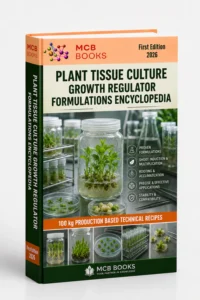
The PLANT TISSUE CULTURE GROWTH REGULATOR FORMULATIONS ENCYCLOPEDIA provides practical technical information on 100 kg formulation concepts, raw material functions, production methods and tissue culture applications. It is a useful reference for professionals developing specialized growth regulator products for shoot induction, root development, callus formation, micropropagation and complete plant regeneration.