INTRODUCTION
Teat disinfectants, also known as cow udder disinfectants, play a critical role in dairy farm hygiene and milk quality management. These products are used before and after milking to eliminate harmful microorganisms, prevent mastitis, and improve overall herd health. With increasing demand for high-quality milk production, the use of scientifically formulated teat dips and udder disinfectants has become essential in modern dairy operations.
Properly formulated disinfectants not only provide antimicrobial protection but also help maintain skin condition and prevent irritation in dairy animals.
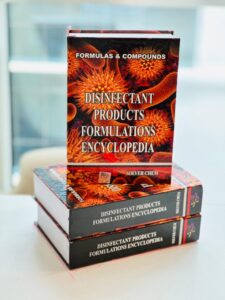
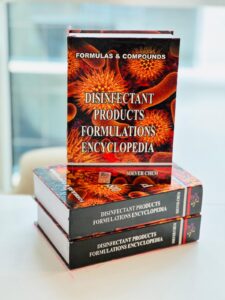
This formulation is part of the Disinfectant Products Formulations Encyclopedia, developed by a chemical engineer with over 40 years of experience, containing professional industrial production methods.
WHAT IS TEAT DISINFECTANT?
Teat disinfectants are antimicrobial solutions specifically designed for cleaning and sanitizing cow udders. These products are typically applied as dips or sprays and are categorized into two main groups:
- Pre-milking disinfectants
- Post-milking disinfectants
Their primary function is to reduce bacterial contamination and prevent infections such as mastitis, which is one of the most significant economic losses in dairy farming.
KEY INGREDIENTS IN TEAT DISINFECTANT FORMULATIONS
High-quality teat disinfectants are formulated using carefully selected active ingredients and stabilizers.
1. Iodine-Based Compounds
- Povidone iodine
- Iodine complexes
✔ Strong antimicrobial activity
✔ Widely used in dairy farms
For detailed iodine-based formulations, you can read our full guide on Povidone Iodine Teat Disinfectant | Formulation, Ingredients and Production Process:
👉 https://makingchembooks.com/povidone-iodine-based-disinfectants-for-cow-udder-formulations-and-production-process/
2. Chlorhexidine
- Broad-spectrum disinfectant
- Effective against bacteria and fungi
✔ Long-lasting effect
✔ Gentle on skin
3. Lactic Acid
- Organic acid disinfectant
- Helps maintain skin condition
✔ Eco-friendly
✔ Mild but effective
4. Quaternary Ammonium Compounds (QAC)
- Benzalkonium chloride
✔ Strong disinfectant
✔ Used in combination systems
5. Skin Conditioning Agents
- Glycerin
- Aloe vera extract
✔ Prevent dryness
✔ Improve teat health
TYPES OF TEAT DISINFECTANTS
Pre-Milking Disinfectants
- Reduce initial bacterial load
- Applied before milking
Post-Milking Disinfectants
- Protect open teat canal
- Prevent infection after milking
PRODUCTION PROCESS OF TEAT DISINFECTANT
The manufacturing process must ensure stability, safety, and effectiveness.
First, clean water is added into a stainless steel mixing tank equipped with an agitator. The selected active ingredient, such as iodine or chlorhexidine, is slowly introduced into the system under continuous stirring. Solubilizers and surfactants are added to ensure proper dispersion of the active components.
After that, stabilizers and buffering agents are incorporated to maintain pH balance and product stability. Skin conditioning agents such as glycerin are added to improve the final product quality.
The mixture is then homogenized until a uniform solution is obtained. The final product is filtered to remove impurities and transferred into storage tanks before filling into appropriate packaging such as bottles or dipping cups.
QUALITY AND SAFETY CONSIDERATIONS
- Maintain correct pH (typically 4–6)
- Ensure microbiological stability
- Avoid skin irritation
- Use food-safe ingredients
Proper formulation ensures both effectiveness and animal safety.
APPLICATION METHODS
- Dip cups
- Spray systems
- Automatic milking systems
Correct application improves efficiency and reduces contamination risks.
SUMMARY
Teat disinfectants are essential products in modern dairy farming, ensuring hygiene, preventing infections, and improving milk quality. By using well-formulated disinfectants containing effective antimicrobial agents and skin conditioners, dairy producers can achieve higher productivity and better animal health.
Professional formulation and production techniques play a key role in delivering high-performance disinfectant products suitable for industrial use.
RELATED ARTICLES
👉 Alcohol-Based Disinfectant Formulations
👉 Benzalkonium Chloride Disinfectant Formulation
👉 Hydrogen Peroxide Disinfectant Production
👉 Surface Disinfectant Formulations
👉 Hospital Disinfectant Production Process