INTRODUCTION
Hydrogen peroxide disinfectants are widely used in industrial, medical, and household applications due to their strong oxidizing properties and broad-spectrum antimicrobial activity. These formulations are highly effective against bacteria, viruses, fungi, and spores, making them essential in modern disinfection systems.
Hydrogen peroxide-based disinfectants are particularly valued for their environmentally friendly decomposition into water and oxygen, leaving no harmful residues. Understanding formulation techniques and production processes is essential for manufacturers aiming to develop high-performance disinfectant products.
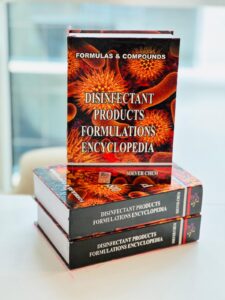
This formulation is part of the Disinfectant Products Formulations Encyclopedia, which includes advanced industrial formulations and detailed production techniques for commercial manufacturing.
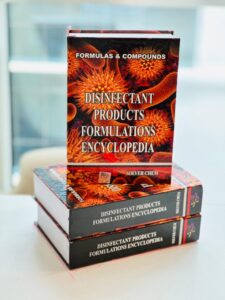
Discover advanced hydrogen peroxide disinfectant formulations and scalable industrial production techniques in the Disinfectant Products Formulations Encyclopedia.
👉 https://makingchembooks.com/product/disinfectant-products-formulations-encyclopedia/
WHAT IS HYDROGEN PEROXIDE?
Hydrogen peroxide (H₂O₂) is a powerful oxidizing agent used in disinfectant formulations. It works by generating free radicals that attack essential cell components of microorganisms, leading to rapid microbial destruction.
PROPERTIES OF HYDROGEN PEROXIDE
- Strong oxidizing and antimicrobial action
- Effective against bacteria, viruses, fungi, and spores
- Decomposes into water and oxygen (environmentally friendly)
- Non-toxic residue profile
- Suitable for medical and food industry applications
RAW MATERIALS AND INGREDIENTS
Typical formulation components include:
- Hydrogen Peroxide (active ingredient)
- Distilled Water (carrier)
- Stabilizers (to prevent decomposition)
- Surfactants (for improved wetting and cleaning)
- Chelating Agents (for formulation stability)
HYDROGEN PEROXIDE DISINFECTANT FORMULATION (EXAMPLE)
A standard formulation:
- Hydrogen Peroxide → 3–6%
- Nonionic Surfactant → 1–2%
- EDTA → 0.05–0.1%
- Stabilizer → 0.1–0.3%
- Distilled Water → balance
For more advanced and commercially optimized formulations, refer to the Disinfectant Products Formulations Encyclopedia, which provides multiple industrial recipes and scalable production methods.
👉 https://makingchembooks.com/product/disinfectant-products-formulations-encyclopedia/
PRODUCTION PROCESS
- Prepare distilled water in a mixing tank.
- Add stabilizers and mix thoroughly.
- Introduce hydrogen peroxide under controlled conditions.
- Add surfactants and chelating agents.
- Mix until a homogeneous solution is obtained.
- Avoid excessive agitation to prevent decomposition.
- Filter and fill into appropriate packaging.
Industrial manufacturers can access optimized processing techniques and large-scale production methods in the Disinfectant Products Formulations Encyclopedia.
👉 https://makingchembooks.com/product/disinfectant-products-formulations-encyclopedia/
APPLICATIONS OF HYDROGEN PEROXIDE DISINFECTANTS
- Healthcare and hospital disinfection
- Surface cleaning and sanitation
- Food processing hygiene
- Industrial cleaning applications
SPECIALIZED APPLICATIONS (DAIRY & INDUSTRIAL CLEANING)
Hydrogen peroxide disinfectants are widely used in dairy farms and industrial environments for equipment sanitation and microbial control. These formulations provide effective cleaning while minimizing chemical residues.
COMPARISON WITH OTHER DISINFECTANTS
- Hydrogen Peroxide → eco-friendly and residue-free
- Alcohol → fast evaporation
- Benzalkonium Chloride → longer-lasting effect
👉 Learn more:
Alcohol-Based Disinfectant | Formula, Ingredients & Production Process
👉 Also see:
Benzalkonium Chloride Disinfectant | Formula, Ingredients & Production Process
SUMMARY
Hydrogen peroxide disinfectants offer a powerful, environmentally friendly solution for modern disinfection needs. Their strong antimicrobial activity and clean decomposition profile make them ideal for a wide range of industrial and healthcare applications.
For complete formulation systems, production variations, and industrial-scale manufacturing techniques, explore the Disinfectant Products Formulations Encyclopedia.
👉 https://makingchembooks.com/product/disinfectant-products-formulations-encyclopedia/
RELATED ARTICLES
- How to Make Hand Sanitizer | Formula, Ingredients & Production Process
- Alcohol-Based Disinfectant
- Benzalkonium Chloride Disinfectant
- Surface Disinfectant Formulation
- Hospital Disinfectant Formulation