Natural and herbal baby wet wipes have become increasingly popular among parents looking for gentle, practical, and plant-inspired baby care products. These wipes are commonly used during diaper changes, feeding, travel, and everyday cleansing. However, developing an effective natural baby wet wipes formulation requires much more than adding a botanical extract to purified water. Manufacturers must carefully balance cleansing performance, skin comfort, microbiological protection, formulation stability, nonwoven fabric quality, and packaging efficiency.
Purified water normally forms the largest part of a baby wet wipes lotion. The water must meet suitable microbiological and chemical quality standards because high-water formulations are especially vulnerable to bacterial, yeast, and mold contamination. Reverse-osmosis-treated, deionized, or purified water is therefore widely used in professional wet wipes manufacturing.
Natural and herbal baby wet wipes formulations may contain botanical ingredients such as aloe vera, chamomile, calendula, cucumber, green tea, oat extract, lavender water, or witch hazel. These materials are generally selected to support moisturizing, soothing, refreshing, or skin-conditioning product concepts. Their inclusion levels must be carefully controlled because natural extracts can affect color, odor, pH, clarity, preservation, and long-term product stability.
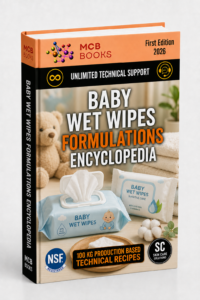
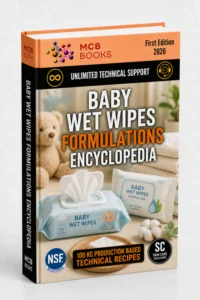
The BABY WET WIPES FORMULATIONS ENCYCLOPEDIA provides practical formulation concepts for producers who want to develop baby wipes containing plant-derived and skin-friendly ingredients. It can help manufacturers understand how herbal extracts, humectants, mild surfactants, preservatives, emollients, and pH regulators can be combined in professional wet wipes lotion systems.
Mild cleansing agents are necessary because water and herbal extracts alone may not remove oily impurities effectively. Low concentrations of gentle surfactants can improve cleansing without creating excessive foam or leaving an uncomfortable residue on the skin. Humectants such as glycerin may also be added to help maintain moisture and reduce the drying effect of repeated cleansing.
Manufacturers should remember that the word “natural” does not automatically mean preservative-free. Baby wet wipes contain large amounts of water and are frequently exposed to air and handling after opening. A reliable preservative system is essential for protecting the finished product throughout its shelf life. The selected system must be compatible with the herbal extracts, final pH, packaging material, and nonwoven fabric.
Fragrance is another important consideration. Some natural baby wipes use botanical fragrances or essential oils to create a recognizable product identity. However, fragrance-free products are often preferred for newborns and babies with sensitive skin. Essential oils must be used with particular caution because some may cause sensitivity when used at unsuitable concentrations. A simple, carefully balanced formula is often more appropriate for delicate baby skin.
The pH of the lotion should be adjusted to a skin-compatible range and checked during every production batch. Quality control tests may include appearance, odor, pH, viscosity, density, microbiological quality, preservative efficacy, and stability under different storage conditions. Manufacturers should also evaluate whether botanical ingredients cause discoloration, sedimentation, separation, or odor changes over time.
Nonwoven fabric selection directly affects product performance. The material should be soft, absorbent, strong when wet, and capable of distributing the lotion evenly. Cotton-based, viscose-based, and biodegradable materials are frequently considered for natural or environmentally focused product ranges.
The BABY WET WIPES FORMULATIONS ENCYCLOPEDIA can support the development of aloe vera baby wipes, chamomile wipes, calendula wipes, oat-based wipes, fragrance-free herbal wipes, moisturizing baby wipes, and biodegradable product concepts. It also provides guidance related to production methods, raw material functions, quality control, and commercial manufacturing requirements.
Successful natural baby wet wipes production depends on the correct interaction between plant extracts, cleansing agents, moisturizers, preservation systems, fabric, and packaging. The BABY WET WIPES FORMULATIONS ENCYCLOPEDIA offers a valuable technical starting point for manufacturers, private-label producers, entrepreneurs, and formulation specialists seeking to create stable, gentle, and commercially competitive natural and herbal baby wet wipes.