Baby wet wipes are used several times a day for diaper changes, hand cleaning, face cleansing, and general baby hygiene. Because these products come into direct and repeated contact with delicate skin, many consumers prefer formulations developed without alcohol and parabens. Alcohol-free and paraben-free baby wet wipes production has therefore become an important area for manufacturers, private-label brands, formulation specialists, and investors in the baby care market.
An alcohol-free baby wet wipes formulation is generally designed without drying alcohols such as ethanol or isopropyl alcohol. These ingredients may provide cleansing or antimicrobial benefits in certain products, but they can also contribute to dryness or discomfort when used frequently on sensitive baby skin. Alcohol-free baby wipes are therefore commonly positioned as gentle, moisturizing, newborn-friendly, or suitable for sensitive skin.
Purified water is usually the main ingredient in the wet wipes lotion. Water quality must be carefully controlled because baby wipes contain a high percentage of water and can be vulnerable to microbiological contamination. Reverse-osmosis-treated, deionized, or otherwise purified water is commonly used in professional baby wet wipes manufacturing.
Mild cleansing agents are added in low concentrations to help remove impurities without causing excessive skin dryness. The selected surfactants should be compatible with the other ingredients and suitable for leave-on baby care products. Humectants such as glycerin can help maintain moisture, while emollients and skin-conditioning ingredients can improve softness and reduce the tight feeling sometimes associated with repeated cleansing.
Paraben-free baby wet wipes are produced without preservatives from the paraben family. This product claim is mainly driven by consumer preference and market positioning. However, removing parabens does not eliminate the need for preservation. Baby wet wipes remain water-rich products and therefore require an effective preservative system that protects against bacteria, yeast, and mold during production, storage, and consumer use.
Alternative preservative systems must be selected according to the formulation pH, packaging type, raw material composition, expected shelf life, and applicable regulatory requirements. The preservative should remain effective in the final product and should not lose performance after the lotion is absorbed into the nonwoven fabric. Preservative efficacy testing is essential because a system that performs well in a liquid sample may behave differently in the finished wet wipe.
The pH of alcohol-free and paraben-free baby wipes should also be carefully adjusted. A mildly acidic and skin-compatible pH may support product comfort, preservative performance, and formulation stability. The final pH should be checked after production and monitored during stability testing.
Soothing ingredients such as panthenol, allantoin, aloe vera, chamomile extract, calendula extract, or oat-derived materials may be added to support a gentle product concept. Fragrance-free versions are often preferred for newborns and babies with highly sensitive skin. When fragrance is included, it should be used at a suitable concentration and evaluated for compatibility with the formula.
The choice of nonwoven fabric is another important production factor. The material should be soft, absorbent, strong when wet, and capable of distributing the lotion evenly. Viscose, polyester, cotton-based, and biodegradable nonwoven materials may be selected according to cost, performance, and sustainability objectives.
During production, the lotion is prepared in sanitized stainless-steel mixing equipment. Raw materials are added in the correct sequence under controlled agitation. After mixing, the solution is tested for appearance, odor, pH, viscosity, density, stability, and microbiological quality. It is then transferred to the wet wipes production line, where the nonwoven fabric is folded, cut, impregnated, and packaged.
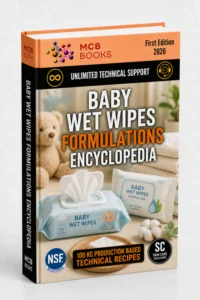
The Baby Wet Wipes Formulations Encyclopedia provides practical information about professional baby wipes formulations, raw material functions, manufacturing procedures, quality control, and product development. It can support producers seeking to manufacture alcohol-free, paraben-free, fragrance-free, moisturizing, hypoallergenic, or botanical baby wet wipes.
Successful alcohol-free and paraben-free baby wet wipes production requires more than attractive label claims. Manufacturers must combine mild cleansing performance, reliable preservation, skin-compatible pH, soft fabric, hygienic production, and protective packaging. With a professionally balanced formulation and controlled manufacturing process, producers can develop gentle, stable, and commercially competitive baby wet wipes.