Commercial baby wet wipes production is a growing manufacturing field that requires reliable formulations, suitable equipment, hygienic processing, quality raw materials, and effective product-development planning. Although baby wet wipes may appear to be simple cleansing products, successful industrial production depends on achieving the correct balance between mild cleansing, skin comfort, microbiological protection, lotion stability, fabric softness, packaging performance, and production cost.
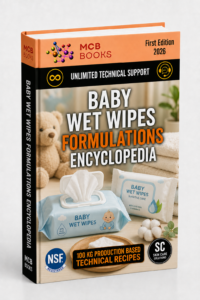
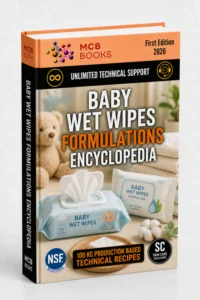
The BABY WET WIPES FORMULATIONS ENCYCLOPEDIA is designed for manufacturers, entrepreneurs, formulation specialists, private-label producers, chemical suppliers, and investors seeking practical technical information about baby wet wipes production. It provides structured formulation concepts and manufacturing guidance for developing different types of commercial baby wipes for newborns, infants, and sensitive skin applications.
The first stage of commercial wet wipes production is the preparation of the wet wipes lotion. Purified water usually represents the largest part of the formulation and acts as the carrier for the other ingredients. Depending on the desired product, the lotion may contain mild surfactants, humectants, emollients, skin-conditioning agents, botanical extracts, preservatives, chelating agents, pH regulators, solubilizers, and optional fragrance ingredients.
Raw material selection is especially important in baby care products. The cleansing system should remove impurities without causing excessive dryness or discomfort. Humectants such as glycerin may help maintain moisture, while ingredients such as panthenol, allantoin, aloe vera, chamomile, calendula, or oat extracts may support soothing and moisturizing product concepts.
Commercial manufacturers may produce several product categories, including fragrance-free baby wipes, hypoallergenic wipes, alcohol-free products, paraben-free wipes, natural and herbal wipes, moisturizing wipes, biodegradable wipes, and extra-sensitive newborn wipes. Each product type requires a different formulation strategy, raw material balance, marketing position, and quality-control program.
The BABY WET WIPES FORMULATIONS ENCYCLOPEDIA helps producers understand how different ingredients function within a professional wet wipes lotion. It also supports the preparation of production formulas on a practical industrial basis, allowing manufacturers to organize raw material quantities, production sequences, and batch calculations more efficiently.
During production, purified water is transferred into a sanitized stainless-steel mixing tank. Water-soluble ingredients are added under controlled agitation, followed by cleansing agents, moisturizers, preservatives, and other functional materials. Oil-soluble ingredients may require a compatible solubilizer or emulsifier. The formulation should be mixed until a uniform and stable solution is obtained.
Before the lotion is applied to the nonwoven fabric, it should be tested for appearance, odor, pH, viscosity, density, clarity, stability, and microbiological quality. Preservative efficacy testing is essential because baby wet wipes contain a high percentage of water and may be repeatedly exposed to air and handling after opening.
The choice of nonwoven material has a direct effect on product quality. The fabric should be soft, absorbent, strong when wet, and capable of holding and releasing the lotion evenly. Viscose, polyester, cotton-based fibers, and biodegradable materials may be selected according to performance requirements, product price, and sustainability goals.
The prepared lotion is transferred to the wet wipes production line, where the nonwoven fabric is unwound, folded, cut, impregnated, and packaged. Accurate lotion dosing is important because insufficient liquid can cause dry wipes, while excessive loading may result in leakage, increased costs, and packaging problems.
Packaging must prevent moisture loss, protect the wipes from contamination, and provide convenient consumer use. Flow packs, soft packs, canisters, refill packs, resealable labels, and plastic lids are widely used in commercial wet wipes production.
Hygienic manufacturing conditions are essential throughout the process. Mixing tanks, pipelines, pumps, filling systems, and product-contact surfaces must be cleaned and sanitized regularly. Water quality, employee hygiene, raw material storage, environmental control, traceability, and finished-product testing are also critical.
The BABY WET WIPES FORMULATIONS ENCYCLOPEDIA offers a valuable technical foundation for companies planning to enter or expand within the baby wipes market. By combining professional formulations, controlled production methods, suitable equipment, soft nonwoven fabrics, reliable preservation, and protective packaging, manufacturers can develop stable, gentle, and commercially competitive baby wet wipes for private-label, domestic, and international markets.