Newborn skin is thinner, more delicate, and more vulnerable to dryness and irritation than adult skin. Products used during diaper changes and daily cleansing must therefore be developed with carefully selected ingredients and controlled manufacturing methods. A fragrance-free and extra-sensitive wet wipes formula for newborns should provide gentle cleansing, adequate moisturization, reliable microbiological protection, and a soft skin feel without unnecessary perfume or harsh cleansing agents.
Purified water is usually the main ingredient in a newborn wet wipes lotion. Because the formulation contains a high percentage of water, its chemical and microbiological quality is extremely important. Manufacturers commonly use deionized, reverse-osmosis-treated, or purified water to reduce mineral content and contamination risks. Water storage tanks, pipelines, mixing equipment, and transfer systems should also be regularly cleaned and sanitized.
The cleansing system should be designed with low concentrations of mild surfactants. These ingredients help remove urine residues, impurities, and light oily materials from the skin. Strong detergents and aggressive surfactants are generally unsuitable for extra-sensitive newborn wipes because they may contribute to dryness, redness, or discomfort. The objective is to achieve effective but very gentle cleansing without excessive foam or sticky residue.
Humectants such as glycerin may be added to support moisture retention and improve the softness of the lotion. Skin-conditioning agents, light emollients, and soothing ingredients can also be incorporated to create a more comfortable after-feel. Panthenol, allantoin, aloe vera, oat-derived ingredients, chamomile extract, and calendula extract are commonly considered in sensitive-skin product concepts. However, every botanical ingredient should be carefully evaluated because natural materials may influence color, odor, clarity, preservation, and formulation stability.
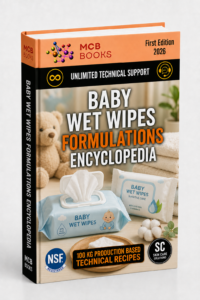
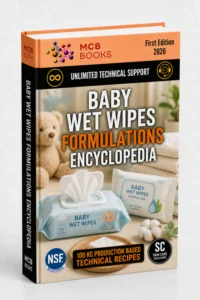
The BABY WET WIPES FORMULATIONS ENCYCLOPEDIA provides practical information for manufacturers developing newborn wipes, fragrance-free products, hypoallergenic formulations, moisturizing wipes, and extra-sensitive baby care products. It explains how different raw material groups can be combined to create stable and commercially applicable wet wipes lotions.
Fragrance-free formulation is an important consideration for products intended for newborns. Fragrances may improve the sensory appeal of conventional baby wipes, but they may also increase the possibility of sensitivity in some users. A fragrance-free claim allows manufacturers to position the product as simple, gentle, and suitable for delicate skin. However, fragrance-free does not necessarily mean completely odorless, because raw materials may have their own natural odors.
Preservation remains essential even when the formula is designed with minimal ingredients. Baby wet wipes are water-rich products that can support the growth of bacteria, yeast, and mold if inadequately protected. The preservative system must be compatible with the final pH, packaging material, nonwoven fabric, botanical ingredients, and expected shelf life. Preservative efficacy testing should be conducted on the complete finished product, not only on the liquid lotion.
The pH of an extra-sensitive newborn wet wipes formula should be carefully adjusted and monitored during production. A skin-compatible pH can support comfort, product stability, and preservative performance. Quality control tests may include appearance, odor, pH, viscosity, density, microbiological quality, stability, and lotion distribution within the nonwoven fabric.
The nonwoven material should be soft, absorbent, strong when wet, and free from rough fibers. Cotton-based, viscose-based, or biodegradable nonwoven fabrics may be selected depending on the intended product quality, cost, and environmental positioning. The amount of lotion applied to each wipe must also be controlled to prevent dryness or excessive leakage.
Protective packaging is another critical production factor. Resealable labels and plastic lids help reduce moisture loss and contamination after opening. The packaging material should remain compatible with the formula throughout the intended shelf life.
The BABY WET WIPES FORMULATIONS ENCYCLOPEDIA supports producers with professional formulation concepts, production methods, raw material functions, and technical product-development information. Developing a successful newborn wipe requires a balanced combination of gentle cleansing agents, moisturizers, suitable preservatives, skin-compatible pH, soft fabric, hygienic production, and reliable packaging.
With the guidance provided in the BABY WET WIPES FORMULATIONS ENCYCLOPEDIA, manufacturers, entrepreneurs, and private-label producers can develop fragrance-free and extra-sensitive wet wipes designed for newborn care. A professionally balanced formulation can help create a gentle, stable, practical, and commercially competitive product for the growing sensitive baby care market.