Alcohol-based disinfectant wet wipes are widely used for the rapid treatment of small, hard, nonporous surfaces in healthcare facilities, laboratories, cleanrooms, offices, industrial plants, and other professional environments. Their popularity comes from convenient application, fast evaporation, and the ability to deliver a controlled amount of disinfectant solution through a ready-to-use nonwoven wipe. However, professional production requires much more than simply combining alcohol, water, and fabric. The formulation, contact time, packaging, workplace safety, regulatory status, and intended product claims must all be evaluated together.
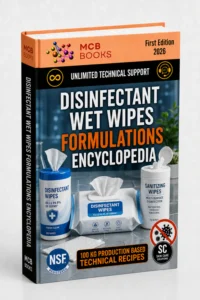
The DISINFECTANT WET WIPES FORMULATIONS ENCYCLOPEDIA is prepared for manufacturers, formulation specialists, private-label producers, chemical suppliers, investors, and entrepreneurs seeking structured technical information about commercial disinfectant wipes. It covers the relationship between active ingredients, supporting raw materials, manufacturing methods, nonwoven materials, filling systems, packaging performance, and quality-control procedures.
Ethanol and isopropyl alcohol are common active ingredients in professional surface disinfectant wipes. Official guidance notes that ethyl or isopropyl alcohol in the 60–90% range is often used for small-surface disinfection, although rapid evaporation can make longer wet-contact periods difficult to maintain. For this reason, the required alcohol concentration and contact time should not be selected only from a general formula. They must be supported by efficacy testing, product authorization, and the approved label requirements of the intended market.
A typical alcohol-based wet wipes solution may include purified or deionized water, ethanol or isopropyl alcohol, and carefully selected auxiliary ingredients. Depending on the intended application, manufacturers may also use low-residue surfactants, chelating agents, corrosion-control additives, stabilizers, or other compatible functional materials. Every additive must be evaluated because it can influence antimicrobial performance, evaporation rate, surface residue, odor, fabric compatibility, and package stability.
During production, purified water and compatible water-soluble ingredients are introduced into a clean mixing vessel. Alcohol is generally added through a controlled system designed to limit vapor loss and ignition risks. Ethanol and isopropanol are flammable liquids, so ventilation, grounding, bonding, suitable electrical equipment, safe storage, spill control, and employee training are essential parts of production-facility design and operation.
The prepared disinfectant solution should be tested for appearance, odor, density, alcohol concentration, chemical stability, and compatibility with the selected wipe material. The DISINFECTANT WET WIPES FORMULATIONS ENCYCLOPEDIA explains why the nonwoven substrate is not merely a liquid carrier. Fiber composition, absorbency, wet strength, liquid retention, and release behavior can affect how much disinfectant reaches the surface and whether the wipe keeps that surface visibly wet for the required contact time.
After impregnation, the wipes are folded, cut, counted, and packed in canisters, soft packs, refill packages, or individually sealed sachets. Packaging must reduce alcohol evaporation and prevent contamination throughout storage and repeated opening. Accurate liquid loading is also critical. Too little solution may reduce surface coverage, while excessive loading can cause leakage, increased production costs, and package deformation.
Professional disinfectant claims require validated performance and market-specific authorization. In the United States, users must follow the registered product label, including the stated surface-contact time. In the European Economic Area, disinfectant products are governed by the Biocidal Products Regulation and must meet the applicable authorization requirements before being placed on the market.
The DISINFECTANT WET WIPES FORMULATIONS ENCYCLOPEDIA provides a practical technical foundation for developing alcohol-based wipes for professional applications. By combining a validated formulation, controlled manufacturing, compatible nonwoven fabric, protective packaging, fire-safe facility design, and documented quality testing, producers can create stable and commercially competitive disinfectant wet wipes for approved professional uses.