Alcohol-free disinfectant wet wipes are increasingly used for cleaning and disinfecting hard, nonporous surfaces in homes, offices, schools, healthcare facilities, hotels, laboratories, food-service environments, and industrial workplaces. These products are developed without ethanol or isopropyl alcohol and may provide longer surface wetness, lower flammability risk, and improved compatibility with certain materials. However, alcohol-free does not automatically mean non-irritating or suitable for every surface. The complete formulation, active ingredient, concentration, contact time, intended use, and regulatory classification must be evaluated carefully.
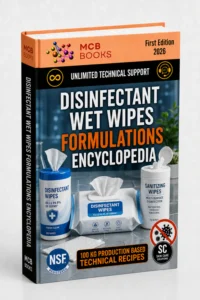
The DISINFECTANT WET WIPES FORMULATIONS ENCYCLOPEDIA provides technical information for manufacturers, formulation specialists, private-label producers, chemical suppliers, entrepreneurs, and investors seeking professional disinfectant wipes production formulas. It covers active systems, supporting raw materials, production processes, nonwoven fabric selection, quality control, packaging, and commercial product development.
Alcohol-free disinfectant wipes may be formulated using legally approved quaternary ammonium compounds, hydrogen peroxide systems, organic acids, chlorine-releasing ingredients, or other suitable antimicrobial technologies. The selected system depends on the target microorganisms, required efficacy claims, application area, surface type, contact time, packaging compatibility, and regulations of the intended market. Quaternary ammonium compounds are commonly used as low-level disinfectants for environmental surfaces and certain noncritical equipment that contacts intact skin.
Purified or deionized water is generally the main carrier in an alcohol-free disinfectant wipes solution. The formulation may also contain compatible surfactants, chelating agents, pH regulators, corrosion inhibitors, stabilizers, solvents, fragrance materials, and other functional additives. Surfactants help remove dirt, oils, and organic residues, but excessive levels may cause foam, streaking, sticky residues, or interference with antimicrobial activity.
Compatibility testing is especially important when quaternary ammonium compounds are used. Certain surfactants, raw materials, or nonwoven fibers may reduce the amount of active ingredient released onto the treated surface. Manufacturers must therefore evaluate the disinfectant solution together with the selected substrate and packaging rather than testing the liquid formulation alone.
During production, purified water is transferred into a sanitized stainless-steel mixing tank. Water-soluble supporting materials are incorporated under controlled agitation, followed by surfactants, active ingredients, pH regulators, and other additives in the correct production sequence. Excessive foam formation and uncontrolled temperature changes should be avoided. The final solution should remain homogeneous and stable without sedimentation, discoloration, phase separation, or unacceptable odor changes.
The DISINFECTANT WET WIPES FORMULATIONS ENCYCLOPEDIA explains how formulation parameters such as pH, active ingredient concentration, water quality, surfactant selection, and substrate compatibility can influence finished-product performance. The prepared solution should be tested for appearance, odor, pH, density, active content, chemical stability, and microbiological quality.
The nonwoven material should provide suitable absorbency, wet strength, liquid retention, and controlled release. Accurate impregnation is necessary to ensure that each wipe delivers enough solution to cover the intended area and keep it visibly wet for the required contact time. EPA guidance emphasizes that a surface must remain visibly wet for the full contact time specified on the registered disinfectant label.
After impregnation, the wipes are folded, cut, counted, and packaged in canisters, soft packs, refill packages, or individually sealed sachets. Packaging must prevent moisture loss, contamination, leakage, and changes in active ingredient concentration throughout the intended shelf life.
Commercial disinfectant claims require validated efficacy testing and authorization under the regulations of the target market. In the European Economic Area, hard-surface disinfectants not intended for direct application to humans or animals are generally classified under Biocidal Product Type 2.
The DISINFECTANT WET WIPES FORMULATIONS ENCYCLOPEDIA offers a practical foundation for developing alcohol-free disinfectant wipes for household, institutional, professional, and industrial applications. By combining a validated active system, compatible raw materials, controlled manufacturing, suitable nonwoven fabric, protective packaging, and documented quality testing, manufacturers can produce stable, effective, and commercially competitive alcohol-free disinfectant wet wipes.