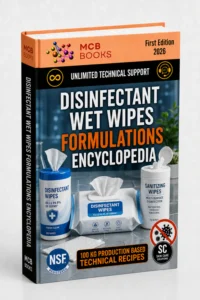
Disinfectant wet wipes are ready-to-use products designed to clean and disinfect hard, nonporous surfaces in healthcare facilities, offices, schools, hotels, laboratories, homes, and industrial environments. Their effectiveness depends on more than the selected antimicrobial substance. A professional formulation must combine compatible active ingredients, cleaning agents, stabilizers, water-quality controls, nonwoven fabric, and protective packaging.
The DISINFECTANT WET WIPES FORMULATIONS ENCYCLOPEDIA provides structured technical information about the raw materials used in disinfectant wipes, their functions, manufacturing procedures, and finished-product quality requirements. Understanding the role of each ingredient is essential for developing stable and commercially viable disinfectant wet wipes.
Purified or deionized water is commonly used as the primary carrier in water-based formulations. Water quality can influence solution clarity, chemical stability, antimicrobial performance, and shelf life. Minerals and impurities may react with active ingredients or contribute to sedimentation, discoloration, and formulation instability.
Antimicrobial active ingredients provide the principal disinfecting effect. Depending on the intended product and applicable authorization, these may include ethanol, isopropyl alcohol, quaternary ammonium compounds, hydrogen peroxide, chlorine-releasing substances, organic acids, or other approved biocidal systems. Different active technologies have different activity ranges, contact-time requirements, safety characteristics, and surface-compatibility limitations.
Surfactants improve cleaning performance by loosening grease, dirt, and organic residues from surfaces. Nonionic or other compatible surfactants may be selected according to the active system. Their concentration must be carefully controlled because excessive surfactant can produce foam, streaking, sticky deposits, or incompatibility with antimicrobial ingredients.
Solvents may be included to improve the removal of oily contamination, accelerate or regulate drying, and support the solubility of certain ingredients. Ethanol and isopropyl alcohol can function as both antimicrobial agents and solvents. Alcohol-containing formulations require suitable ventilation, fire precautions, storage procedures, and packaging designed to limit evaporation.
Chelating agents bind metal ions that may be present in water or raw materials. They can improve formulation stability, reduce discoloration, and support the performance of certain preservative or disinfectant systems. Their suitability must be confirmed within the complete formula.
pH regulators are used to adjust and maintain the solution within the range required for active-ingredient stability, surface compatibility, and antimicrobial performance. Common formulation approaches may use acids, alkaline materials, or buffer systems. The final pH must be measured during production and monitored throughout stability testing.
Corrosion inhibitors may be added when a disinfectant could negatively affect metals or equipment surfaces. Their role is to reduce corrosion while maintaining the required antimicrobial performance. Compatibility testing remains essential because no disinfectant formulation is suitable for every material.
Stabilizers and antioxidants can help protect sensitive active ingredients from decomposition caused by temperature, light, oxygen, or contamination. Oxidizing disinfectant systems may require especially careful selection of stabilizers, equipment materials, and packaging components.
The DISINFECTANT WET WIPES FORMULATIONS ENCYCLOPEDIA also explains the importance of nonwoven fabric. The substrate must provide suitable absorbency, wet strength, liquid retention, and controlled release. Certain fibers can retain part of an active ingredient, so the complete wipe must be evaluated rather than testing only the liquid solution.
Fragrance and colorants are optional. Although they can improve product identity, they may affect stability, leave residues, or interfere with professional-use requirements. Many institutional products are therefore developed with low fragrance or without added perfume.
Packaging materials must prevent leakage, contamination, moisture loss, and active-ingredient evaporation. The wipes must deliver sufficient liquid to keep the treated surface visibly wet for the full contact time stated on the authorized product label.
The DISINFECTANT WET WIPES FORMULATIONS ENCYCLOPEDIA offers a practical foundation for selecting and combining disinfectant-wipe raw materials. However, antimicrobial claims must be supported by appropriate efficacy testing and market-specific authorization. In the European system, products intended for disinfecting surfaces without direct application to humans or animals generally fall under Biocidal