Water-soluble NPK and micronutrient foliar fertilizer formulations are developed to provide plants with essential nutrients through direct application to leaf surfaces. These products may contain nitrogen, phosphorus, potassium, secondary nutrients, and trace elements in soluble and compatible forms. They are widely used in field crops, vegetables, fruit trees, vineyards, greenhouse plants, and intensive agricultural production systems to support balanced growth, correct nutrient deficiencies, and improve crop quality.
Nitrogen plays an important role in chlorophyll formation, protein synthesis, leaf development, and vegetative growth. Urea and potassium nitrate are frequently used nitrogen sources because of their high solubility. Phosphorus supports energy transfer, flowering, root development, and early plant establishment. Monopotassium phosphate and monoammonium phosphate may be selected as soluble phosphorus sources. Potassium contributes to water regulation, enzyme activity, stress tolerance, fruit development, color formation, and storage quality.
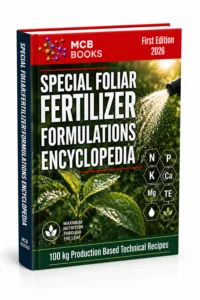
The nutrient ratio should be selected according to the intended application. High-nitrogen foliar fertilizers may be developed for vegetative growth, while phosphorus-rich products may support early development and flowering. Potassium-rich formulations are commonly designed for fruit enlargement, ripening, quality improvement, and resistance to environmental stress. The SPECIAL FOLIAR FERTILIZER FORMULATIONS ENCYCLOPEDIA provides practical information for developing different water-soluble NPK ratios for professional agricultural use.
Micronutrients such as iron, zinc, manganese, copper, boron, and molybdenum are required in smaller quantities but perform essential functions in plant metabolism. Iron supports chlorophyll formation, zinc contributes to enzyme activity and growth regulation, manganese is involved in photosynthesis, and copper participates in several physiological processes. Boron supports flowering and reproductive development, while molybdenum contributes to nitrogen metabolism.
Iron, zinc, manganese, and copper may be added as soluble mineral salts or chelated compounds. Chelating agents such as EDTA or DTPA can improve micronutrient solubility and reduce precipitation within suitable pH ranges. Raw material compatibility must be evaluated carefully because calcium may react with phosphate or sulfate sources and form insoluble compounds.
Production begins with clean process water, accurate weighing, and controlled mixing. Macronutrients are dissolved gradually before micronutrients, chelates, stabilizers, surfactants, preservatives, and pH regulators are incorporated. Each ingredient should dissolve completely before the next material is added. The final solution is adjusted to the required batch weight, mixed until homogeneous, filtered, tested, and packaged.
Quality-control parameters may include nutrient content, pH, density, appearance, solubility, sediment formation, dilution stability, and storage performance. The SPECIAL FOLIAR FERTILIZER FORMULATIONS ENCYCLOPEDIA helps manufacturers understand how nutrient sources, chelated micronutrients, additives, and process conditions influence product stability.
With practical production formulas and technical manufacturing guidance, the SPECIAL FOLIAR FERTILIZER FORMULATIONS ENCYCLOPEDIA is a valuable resource for fertilizer manufacturers, agricultural engineers, researchers, production managers, and entrepreneurs seeking to produce stable, effective, and marketable water-soluble foliar fertilizers.