 Raw materials used in foliar fertilizer formulations determine the nutrient content, physical stability, compatibility, absorption performance, and commercial quality of the finished product. Because foliar fertilizers are applied directly to plant leaves, manufacturers must select highly soluble, low-residue, and compatible ingredients. Each raw material should be evaluated according to its nutrient concentration, purity, solubility, pH effect, storage stability, and behavior when mixed with other formulation components.
Nitrogen is commonly supplied by urea, ammonium salts, or nitrate-based raw materials. Urea is frequently used because of its high nitrogen content and good water solubility. Nitrogen supports chlorophyll formation, protein synthesis, leaf development, and vegetative growth. The concentration must be controlled carefully because excessive salt levels may increase the risk of leaf damage under unsuitable application conditions.
Phosphorus may be provided by monopotassium phosphate, monoammonium phosphate, or phosphite-based materials in specialized products. Phosphorus supports energy transfer, root development, flowering, and early plant establishment. Monopotassium phosphate also supplies potassium and is widely used in fully water-soluble foliar fertilizer formulations.
Potassium nitrate, potassium sulfate, and monopotassium phosphate are common potassium sources. Potassium contributes to water regulation, enzyme activity, fruit development, stress tolerance, color formation, and crop quality. The selected potassium source should dissolve completely and remain compatible with the other nutrients in the solution.
Secondary nutrients such as calcium, magnesium, and sulfur are also important. Calcium salts may be used to support cell-wall strength, fruit firmness, and tissue development. Magnesium sulfate is a common source of both magnesium and sulfur. Magnesium is essential for chlorophyll formation, while sulfur contributes to amino acid and protein synthesis. Calcium-containing materials must be formulated carefully because they may react with phosphates or sulfates and create precipitation.
Micronutrients such as iron, zinc, manganese, copper, boron, and molybdenum are required in smaller quantities but perform essential physiological functions. Iron, zinc, manganese, and copper may be supplied as water-soluble salts or chelated compounds. Chelating agents such as EDTA and DTPA help maintain micronutrient solubility and reduce precipitation under suitable pH conditions. Boric acid and soluble boron compounds support flowering and reproductive development, while sodium molybdate may be used as a molybdenum source.
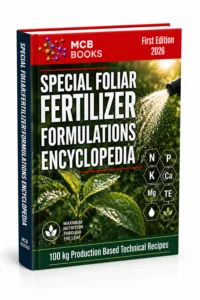
The SPECIAL FOLIAR FERTILIZER FORMULATIONS ENCYCLOPEDIA also explains the roles of supporting ingredients such as amino acids, seaweed extracts, humic substances, organic acids, surfactants, wetting agents, stabilizers, preservatives, antifoaming agents, and pH regulators. Surfactants improve spreading and wetting on leaf surfaces, while stabilizers help maintain solution uniformity. Preservatives may be required in water-based products containing organic ingredients.
Process water is another critical raw material. Excessive hardness, unsuitable pH, or high mineral content may reduce solubility and create sediment. Manufacturers should therefore evaluate water quality before production.
The SPECIAL FOLIAR FERTILIZER FORMULATIONS ENCYCLOPEDIA provides practical guidance for selecting compatible nutrients and additives for commercial manufacturing. Understanding the function of each ingredient helps producers develop stable, effective, and marketable foliar fertilizers for different crops, growth stages, and agricultural applications.