
 Potassium fulvate powder manufacturing requires a carefully selected combination of preparation, reaction, separation, concentration, drying, powder handling, and quality control equipment. The correct machinery depends on the chosen raw material, production capacity, desired product specification, automation level, and whether the process begins with purified fulvic acid or with a more complex fulvic acid-rich raw material.
In a typical industrial process, production starts with raw material storage and dosing. Fulvic acid, fulvic acid-rich extract, potassium-containing reagents, and process water must be stored under suitable conditions and transferred accurately into the production system. Storage tanks, hoppers, weighing platforms, dosing pumps, and metering systems are therefore important for consistent batch preparation.
The first main production stage generally uses a preparation or reaction vessel equipped with an industrial agitator. The vessel should provide sufficient mixing to disperse or dissolve fulvic materials and allow controlled addition of the potassium reagent. Depending on the process, the reactor may also include heating or cooling jackets, pH measurement, temperature sensors, level indicators, and automated dosing controls.
Mixing performance is particularly important because uneven potassium addition may create localized high-pH zones and reduce batch uniformity. Agitator design should therefore be selected according to liquid viscosity, solids concentration, vessel size, and the required mixing intensity.
When the process begins with leonardite, lignite, or another mineral-based fulvic source, additional pretreatment machinery may be required. Crushers, grinders, mills, screening equipment, extraction tanks, and solid-liquid separation units can be incorporated into the process before the potassium conversion stage.
After reaction and extraction, insoluble particles must be removed from the liquid. Filtration equipment may include filter presses, bag filters, cartridge filters, rotary filtration systems, or other industrial separation technologies. Centrifuges may also be used where rapid solid-liquid separation is required.
The selection of filtration equipment depends on solids loading, particle size, liquid viscosity, production volume, and the desired clarity of the potassium fulvate solution. Effective filtration is important because excessive insoluble residue can negatively affect product solubility and customer acceptance.
Once the solution has been purified, it is generally concentrated before drying. Evaporators are commonly used to remove part of the process water and increase solids content. Vacuum evaporation can be advantageous when lower processing temperatures are desired. Increasing the solids concentration before drying reduces the amount of water that must be removed by the dryer and can improve overall process efficiency.
Drying is one of the most important stages in potassium fulvate powder manufacturing. Spray dryers are commonly used because they can convert a concentrated liquid feed into dry powder continuously. A typical spray drying system includes a feed tank, pump, atomizer or nozzle system, drying chamber, heated air system, cyclone separator, powder collection system, and exhaust air treatment equipment.
Dryer operating conditions must be carefully controlled. Feed solids, inlet temperature, outlet temperature, feed rate, atomization pressure, airflow, and residence time can all affect powder moisture, solubility, particle structure, and bulk density.
After drying, the powder may require additional finishing operations. Milling systems can reduce oversized agglomerates, while vibrating or rotary sieves can provide a more uniform particle-size distribution. Blenders may then be used to homogenize multiple batches before packaging.
Powder transfer systems should be designed to minimize moisture exposure and dust formation. Screw conveyors, pneumatic transport systems, sealed transfer lines, and enclosed storage bins may be used depending on plant scale.
Packaging equipment is another important component of the production line. Potassium fulvate powder may be packed in small bags, industrial sacks, or bulk containers depending on the target market. Semi-automatic or fully automatic weighing, filling, sealing, coding, and palletizing systems can be integrated into larger production facilities.
Because potassium fulvate powder may be hygroscopic, packaging materials should provide adequate moisture protection. Finished products should also be stored in a dry environment away from excessive heat and humidity.
A properly equipped quality control laboratory is essential for industrial production. Typical laboratory equipment may include pH meters, moisture analyzers, laboratory balances, sieves, drying ovens, spectrophotometric instruments, and suitable analytical systems for potassium and fulvic substance determination.
Routine quality control may include pH, moisture, water solubility, insoluble matter, potassium content, fulvic substance content, particle size, bulk density, appearance, and packaging integrity. Process samples should also be tested during production so that deviations can be corrected before final drying and packaging.
Automation can significantly improve production consistency. Modern plants may integrate programmable logic controllers, automated reagent dosing, digital pH monitoring, temperature control, flow measurement, dryer control, and batch data recording. These systems reduce operator variability and make it easier to maintain consistent production conditions.
Equipment selection should always be based on actual production requirements rather than maximum theoretical capacity. Oversized equipment can increase investment and operating costs, while undersized machinery can create bottlenecks in filtration, concentration, drying, or packaging.
The overall process flow typically includes raw material preparation, dissolution or extraction, potassium conversion, filtration, concentration, drying, milling, sieving, blending, quality control, and packaging. Each stage should be designed so that production capacity remains balanced across the complete line.
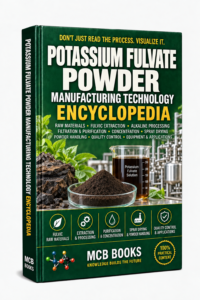
The POTASSIUM FULVATE POWDER MANUFACTURING TECHNOLOGY ENCYCLOPEDIA provides detailed technical information about production machinery, equipment selection, process flow, raw material handling, reaction systems, filtration, evaporation, drying, powder finishing, quality control, troubleshooting, and industrial potassium fulvate powder manufacturing.