
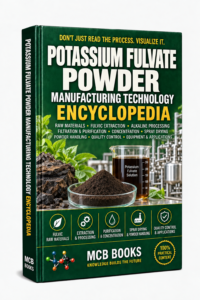
 Starting a potassium fulvate powder manufacturing plant requires careful planning of raw materials, process equipment, production capacity, quality control, energy consumption, and final product specifications. Potassium fulvate powder is widely used in water-soluble fertilizers, foliar fertilizers, fertigation products, soil conditioners, and specialty agricultural formulations. Because final product quality depends strongly on raw material purity and process control, plant design should begin with clearly defined technical specifications.
The main raw material is generally a fulvic acid-rich feedstock. Depending on the selected manufacturing route, producers may use purified fulvic acid, concentrated fulvic acid solution, leonardite-derived extract, lignite-derived material, or another suitable humic source. A potassium-containing alkaline reagent is used to convert the fulvic acid fraction into potassium fulvate. Potassium hydroxide is commonly used in many industrial systems. Process water quality should also be controlled because hardness, dissolved salts, and undesirable metal ions may affect solubility, filtration efficiency, and finished-product appearance.
A typical potassium fulvate powder production facility may contain raw material storage systems, weighing equipment, preparation tanks, reaction vessels, industrial mixers, transfer pumps, filtration units, evaporation systems, drying equipment, milling machines, sieves, blending systems, and packaging equipment. When production starts directly from mineral-based fulvic sources, additional crushing, grinding, extraction, solid-liquid separation, and residue-handling equipment may also be necessary.
The manufacturing process generally begins with preparation or extraction of the fulvic acid fraction. When purified fulvic acid is already available, it can be dispersed or dissolved directly in process water. The potassium reagent is then introduced gradually under controlled agitation. pH, temperature, addition rate, and reaction time should be monitored carefully to achieve uniform conversion and avoid local over-alkalinity.
After the reaction is completed, the liquid may be filtered, clarified, or centrifuged to remove suspended solids and mineral residues. Efficient purification is important because excessive insoluble material can negatively affect water solubility and finished-product quality.
The purified potassium fulvate solution is normally concentrated before drying. Removing part of the water at this stage reduces the thermal load on the dryer and can improve overall energy efficiency. Vacuum evaporation or another suitable concentration method may be used, particularly when lower processing temperatures are desirable.
The concentrated potassium fulvate solution is then converted into powder. Spray drying is commonly used in industrial production because it allows continuous conversion of liquid feed into relatively uniform dry particles. Feed solids, inlet temperature, outlet temperature, atomization conditions, and residence time should be balanced to obtain the required moisture content, solubility, and powder structure.
After drying, the powder may be milled to break oversized particles and then passed through sieving equipment to obtain a more consistent particle-size distribution. Final blending may be used to homogenize multiple batches before packaging. Because potassium fulvate powders may absorb moisture from the atmosphere, packaging materials should provide effective moisture protection.
Quality control should be integrated into the manufacturing process. Typical tests may include moisture content, pH, water solubility, insoluble matter, potassium content, fulvic substance content, bulk density, particle size, and physical appearance. Incoming raw materials should also be checked because variations in fulvic acid concentration and mineral impurities can influence production efficiency and finished-product consistency.
Plant capacity should be selected according to expected production volume and market demand. Smaller facilities may use batch reactors and compact filtration and drying systems, while large industrial plants may require automated dosing, continuous extraction, large evaporation units, industrial spray dryers, and automated powder packaging systems.
Investment cost varies considerably depending on plant capacity, automation level, equipment specification, country, and energy prices. Major capital expenditure areas generally include reaction vessels, extraction systems, filtration units, evaporators, dryers, powder-handling equipment, packaging machinery, storage tanks, laboratory equipment, and utility systems.
Operating costs typically include fulvic raw materials, potassium reagents, process water, electricity, thermal energy, labor, packaging, maintenance, laboratory testing, and waste management. Evaporation and drying can represent a significant part of energy consumption, so efficient concentration before drying can have a major impact on production economics.
Raw material quality also directly affects manufacturing cost. A low-cost raw material with high mineral contamination may result in lower fulvic recovery, higher filtration demand, increased waste generation, and reduced production yield. Manufacturers should therefore evaluate raw materials according to usable product yield and process efficiency rather than purchase price alone.
Environmental and occupational safety considerations should also be included in plant design. Appropriate systems are needed for alkaline chemical handling, ventilation, spill management, wastewater treatment, dust extraction, and operator protection. Solid residues generated during extraction and filtration should be managed according to applicable