Granulation is the core step that transforms fine fertilizer powders into durable, free-flowing granules suitable for modern agriculture. In NPK fertilizer production, advanced granulation techniques are essential for achieving consistent particle size, high mechanical strength, low dust levels, and optimal nutrient distribution. As the fertilizer industry becomes more competitive, manufacturers are increasingly adopting advanced technologies to improve product quality and process efficiency.
One of the most widely used advanced methods is rotary drum granulation. In this process, raw materials are fed into a rotating drum where they are agglomerated with the help of moisture, steam, or liquid binders. Advanced control systems allow precise adjustment of parameters such as drum speed, residence time, and moisture content. This ensures uniform granule growth and minimizes the formation of fines. Modern drum granulation systems often include automated feedback controls that optimize the process in real time.
Another highly efficient technique is pan granulation (disc granulation). This method offers excellent control over granule size and shape, making it ideal for specialty fertilizers. By adjusting the angle and rotation speed of the pan, operators can fine-tune granule formation. Advanced pan granulators also incorporate spray systems for uniform binder distribution, resulting in stronger and more spherical granules.
Compaction granulation, also known as dry granulation, is gaining popularity in situations where water addition is not desirable. In this process, powdered raw materials are compressed under high pressure using roller presses to form flakes or sheets, which are then crushed into granules. This technique eliminates the need for drying, reduces energy consumption, and is suitable for heat-sensitive materials. However, it requires precise control of pressure and material characteristics to achieve good granule strength.
Fluidized bed granulation represents a more advanced and technologically sophisticated approach. In this method, particles are suspended in an upward flow of air while a liquid binder is sprayed onto them. This creates uniform coating and granule growth under controlled conditions. Fluidized bed systems offer excellent control over particle size distribution and are often used for high-value or specialty fertilizer products.
Binder technology is another critical aspect of advanced granulation. Modern formulations use specialized binders such as lignosulfonates, molasses, polymers, or ammonium-based solutions to improve granule strength and durability. The selection of binder type and dosage directly affects granule hardness, resistance to breakage, and storage stability.
Process optimization plays a key role in advanced granulation. Parameters such as moisture level, temperature, mixing efficiency, and recycle ratio must be carefully controlled. Advanced plants often use process automation and monitoring systems to maintain consistent production conditions. This reduces variability, improves product quality, and increases overall efficiency.
Granule size distribution is a major quality factor in NPK fertilizers. High-quality products typically have a uniform size range of 2–5 mm, which ensures even spreading in the field. Advanced screening and recycling systems are used to maintain this specification by returning oversized and undersized particles back into the process.
In addition to physical properties, advanced granulation techniques also enable the incorporation of micronutrients and functional additives. Elements such as zinc, boron, and iron can be integrated into the granule structure, while coatings can be applied to enhance nutrient release characteristics or prevent caking during storage.
As sustainability becomes more important, energy-efficient granulation methods and reduced emissions are gaining attention. Technologies that minimize dust generation, lower energy consumption, and improve raw material utilization are increasingly preferred by modern fertilizer manufacturers.
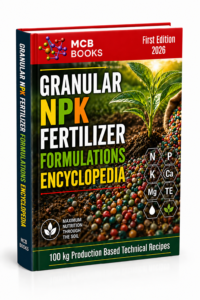
For professionals looking to master advanced granulation techniques and access real industrial formulations, the Granular NPK Fertilizer Formulations Encyclopedia provides detailed 100 kg production-based recipes, raw material strategies, and step-by-step manufacturing insights. It is an essential guide for producing high-performance granular fertilizers in today’s competitive agricultural market.