Granular NPK fertilizer production is a complex industrial process that requires precise control over raw materials, formulation, and processing conditions. Even small mistakes can lead to poor granule quality, inconsistent nutrient content, storage problems, and customer complaints. For manufacturers, identifying common production errors and understanding how to prevent them is essential for maintaining product quality and market competitiveness.
One of the most common errors is incorrect raw material selection. Using incompatible or low-quality materials can cause chemical instability, caking, or nutrient loss. For example, selecting the wrong nitrogen source or combining materials with conflicting pH characteristics may reduce product performance. To avoid this, manufacturers should carefully evaluate raw material purity, compatibility, and suitability for the intended formulation.
Another frequent issue is inaccurate formulation and dosing. Small deviations in weighing raw materials can significantly alter the final NPK ratio. This leads to inconsistent nutrient content and can result in products that fail to meet regulatory standards. The solution is to use precise dosing systems and regularly calibrate weighing equipment to ensure accuracy.
Poor mixing is also a critical problem. If raw materials are not properly blended, nutrient distribution becomes uneven. This means some granules may contain more nitrogen while others contain more phosphorus or potassium, leading to inconsistent crop performance. High-quality mixing systems and sufficient mixing time are essential to achieve a homogeneous blend before granulation.
During the granulation stage, improper moisture control is one of the most damaging errors. Too much moisture can produce oversized, sticky granules and increase drying costs, while too little moisture results in weak granules and excessive dust. Maintaining the correct moisture balance—typically optimized through continuous monitoring—is key to producing strong and uniform granules.
Inadequate granulation parameters such as incorrect temperature, residence time, or binder dosage can also lead to poor granule quality. Weak granules may break during handling, while irregular particle sizes can reduce application efficiency. To prevent this, manufacturers should optimize process parameters and implement automated control systems where possible.
Another common mistake is insufficient drying. If granules retain too much moisture, they are prone to caking during storage and transportation. On the other hand, excessive drying can make granules brittle and increase dust formation. Proper control of drying temperature and residence time ensures a stable final product with optimal moisture content.
Improper screening and recycling can also reduce product quality. Failure to remove oversized and undersized particles results in inconsistent granule size distribution. High-quality fertilizers require a uniform particle size range—typically 2–5 mm—to ensure even application. Efficient screening systems and proper recycling loops help maintain this consistency.
Lack of cooling control is another overlooked issue. Hot granules that are not properly cooled can cause condensation inside packaging, leading to caking and product degradation. Cooling systems must be optimized to bring granules to a stable temperature before storage.
In addition, many manufacturers underestimate the importance of coating and anti-caking treatments. Without proper coating, granules may stick together during storage, especially in humid environments. Applying suitable anti-caking agents improves flowability, reduces dust, and extends shelf life.
Quality control failures are among the most serious errors. Without регуляр testing of nutrient content, moisture levels, granule hardness, and particle size distribution, manufacturers risk producing inconsistent products. Implementing strict quality control procedures at every stage of production is essential to ensure reliability and compliance with industry standards.
Finally, poor process optimization and cost management can impact overall efficiency. Inefficient use of raw materials, excessive energy consumption, and high waste levels reduce profitability. Continuous process improvement and monitoring can help manufacturers achieve both high quality and cost efficiency.
Avoiding these common errors allows manufacturers to produce high-performance granular NPK fertilizers that meet market expectations and deliver consistent results in the field. By focusing on precision, process control, and quality assurance, companies can strengthen their position in the competitive fertilizer industry.
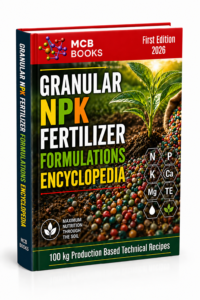
For those who want to eliminate guesswork and access proven industrial formulations, the Granular NPK Fertilizer Formulations Encyclopedia provides detailed 100 kg production-based recipes, optimized raw material combinations, and step-by-step manufacturing guidance. It is an essential resource for producing consistent, high-quality fertilizers at a commercial scale.