Brake cleaner is made to remove oil, grease, brake dust and other residues from brake components without leaving a heavy film behind. A typical brake cleaner composition is based on fast-evaporating solvents, with the exact blend changing depending on whether the product is chlorinated or non-chlorinated.
The ingredients used in a brake cleaner are selected mainly for cleaning strength, evaporation speed and residue control. For this reason, different products can have different chemical compositions even when they are designed for the same type of brake cleaning job.
In this article, we look at the main ingredients found in brake cleaner sprays, how the chemical composition works and what to consider when using brake cleaner on brake parts.
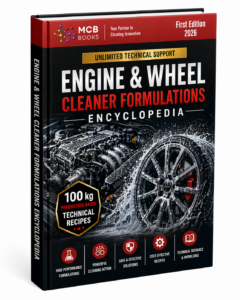
If you are working with automotive cleaning products, the
ENGINE & WHEEL CLEANER FORMULATIONS ENCYCLOPEDIA
provides practical formulation examples, raw material information and production guidance for engine cleaners, wheel cleaners and related vehicle cleaning products.
🔬 Key Properties:
| Property | Description |
|---|---|
| Base Solvents | Typically hydrocarbon-based (e.g. acetone, heptane, isopropanol, etc.) |
| Evaporation Rate | Fast drying—leaves no residue on brake surfaces |
| Cleaning Power | Strong degreasing ability for removing brake dust, oil, grime, and road dirt |
| Non-Residue Formula | Does not leave behind any film or sticky layer |
| Compatibility | Safe on most metal and ceramic components; may harm some plastics or rubber |
| Flammability | Usually flammable—must be handled with care |
| Environmental Concerns | Some contain VOCs or chlorinated solvents—eco-friendly variants are available |
| Packaging | Aerosol cans for targeted, pressurized application |
🧪 Common Ingredients (May Include):
-
Acetone
-
Heptane
-
Ethanol or Isopropanol
-
Carbon dioxide (as propellant)
-
Methylal
-
Non-chlorinated or chlorinated solvents (depending on formulation)
🧰 Applications:
-
Cleaning brake pads, calipers, rotors/discs, and drums
-
Removing grease and contaminants during brake maintenance
-
Prepping surfaces before reassembly or pad replacement
-
Reducing squeaking and brake dust buildup
🔧 Types of Brake Pad Cleaner Sprays:
| Type | Description |
|---|---|
| Chlorinated Brake Cleaners | Powerful, fast-drying cleaners with strong solvency. Their use may be restricted in some regions because of environmental and regulatory concerns. |
| Non-Chlorinated Brake Cleaners | Common alternatives formulated with fast-evaporating solvents and strong cleaning performance for brake parts and automotive components. |
| Low VOC Brake Cleaners | Designed to meet regional limits for volatile organic compounds while still providing effective cleaning performance. |
| Eco-Friendly or Bio-Based Cleaners | Formulated with selected renewable or lower-impact solvents for routine automotive cleaning applications. |
| Heavy-Duty Brake Cleaners | Developed for commercial vehicles, fleet maintenance and applications where heavier oil, grease and stubborn grime need to be removed. |
Summary
Understanding brake cleaner composition makes it easier to see why these products work so quickly on oil, grease, brake dust and other residues. Most brake cleaners rely on fast-evaporating solvents, but the exact ingredients can vary depending on the product type and intended use.
For readers working with automotive cleaning products,
the
ENGINE & WHEEL CLEANER FORMULATIONS ENCYCLOPEDIA
provides additional formulation and production guidance for engine cleaners, wheel cleaners and related vehicle care products.
You can also explore our full Car Care Books category for more formulation books covering automotive cleaners, degreasers and other car care products.
Car Care Books:
https://makingchembooks.com/product-category/car-care-books/