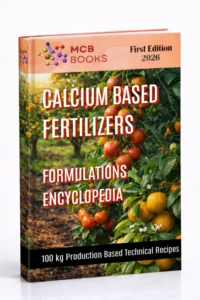
Calcium is an essential plant nutrient that supports strong cell-wall formation, healthy root development, improved fruit firmness, and better resistance to physiological disorders. For fertilizer manufacturers, agricultural suppliers, and entrepreneurs, producing effective calcium fertilizers requires more than simply dissolving a calcium source in water. Raw-material compatibility, pH control, solubility, stability, nutrient concentration, and application method must all be carefully considered. CALCIUM BASED FERTILIZERS FORMULATIONS ENCYCLOPEDIA provides practical technical information for developing commercial calcium fertilizer products for modern agricultural applications.
Calcium fertilizers are commonly manufactured as liquid concentrates, suspension fertilizers, water-soluble powders, foliar products, fertigation solutions, and calcium-containing NPK blends. These products may be based on calcium nitrate, calcium chloride, calcium carbonate, calcium acetate, calcium formate, calcium lignosulfonate, or chelated calcium complexes. Each calcium source has different solubility, nutrient content, compatibility, and application characteristics.
Liquid calcium fertilizers are widely used in foliar feeding and drip irrigation systems because they can provide calcium directly to plant tissues or root zones. However, calcium reacts easily with phosphates, sulfates, carbonates, and certain micronutrient sources. These reactions may cause precipitation, sedimentation, filter blockage, or reduced nutrient availability. Commercial production therefore requires carefully designed formulations and controlled manufacturing procedures.
The CALCIUM BASED FERTILIZERS FORMULATIONS ENCYCLOPEDIA includes professional production concepts for different calcium-based fertilizer categories. These may include calcium nitrate solutions, calcium-magnesium fertilizers, boron-enriched calcium products, amino acid-based calcium fertilizers, calcium fertilizers containing organic acids, anti-stress foliar products, and formulations developed for specific crops.
A typical calcium fertilizer manufacturing process begins with selecting clean water and suitable raw materials. Water quality is particularly important because excessive bicarbonate, sulfate, or phosphate levels can reduce product stability. The production tank should be equipped with an efficient mixing system, accurate weighing equipment, filtration units, and corrosion-resistant contact surfaces.
During liquid production, water is normally added to the mixing vessel first. Calcium salts are introduced gradually while continuous mixing is maintained. Complexing agents, organic acids, stabilizers, surfactants, humectants, preservatives, or additional nutrients may then be added according to the formulation. The pH should be measured and adjusted within the required range. After mixing, the product should be filtered and tested before filling.
Quality-control procedures are essential for achieving consistent commercial performance. Important parameters include appearance, color, odor, pH, density, calcium content, total nitrogen content, viscosity, solubility, crystallization resistance, storage stability, and compatibility with irrigation systems. Accelerated stability tests may also be performed at low and high temperatures.
Calcium fertilizer products are widely used in tomatoes, peppers, cucumbers, apples, grapes, strawberries, citrus fruits, leafy vegetables, potatoes, and ornamental crops. Proper calcium nutrition may help reduce blossom-end rot, tip burn, bitter pit, fruit cracking, weak tissue formation, and poor post-harvest quality. Nevertheless, application rates should always be determined according to crop type, growth stage, soil conditions, water quality, and local agricultural recommendations.
The main advantage of CALCIUM BASED FERTILIZERS FORMULATIONS ENCYCLOPEDIA is its focus on practical commercial production. The book can support manufacturers who want to expand their fertilizer product range, improve existing formulations, or establish a new calcium fertilizer production line.
By combining technically appropriate raw materials, correct mixing procedures, reliable quality-control methods, and suitable packaging systems, manufacturers can produce stable and effective calcium fertilizers. A well-designed calcium fertilizer product can help growers improve crop quality while creating valuable commercial opportunities for fertilizer producers and agricultural businesses.