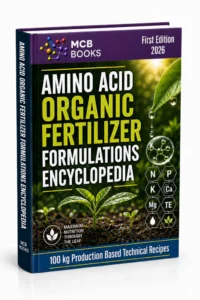
Commercial amino acid organic fertilizer production has become an important segment of modern agricultural manufacturing as growers increasingly use specialized products for plant nutrition, root development, nutrient uptake, flowering, fruit development, and crop quality. Liquid amino acid fertilizers, foliar products, fertigation solutions, and biostimulant formulations can be developed for a wide range of commercial crops. The AMINO ACID ORGANIC FERTILIZER FORMULATIONS ENCYCLOPEDIA is designed as a practical technical reference for fertilizer manufacturers, formulators, agricultural companies, and entrepreneurs interested in professional amino acid fertilizer production.
Successful commercial production begins with the selection of suitable raw materials. Amino acid fertilizer formulations may contain free amino acids, protein hydrolysates, peptides, organic nitrogen sources, seaweed extracts, humic acid, fulvic acid, potassium compounds, micronutrients, organic acids, stabilizers, preservatives, and water. Each ingredient should have a defined technical function and should be selected according to the intended application and final product specifications.
Standardized formulations are particularly important in professional fertilizer manufacturing. Manufacturers must determine appropriate ingredient ratios and establish repeatable production procedures to maintain consistent quality between batches. Production formulas based on 100 kg batches can provide a practical foundation for manufacturing and can later be adapted to larger industrial batch sizes when suitable process controls and equipment are available.
The manufacturing process generally involves controlled mixing, ingredient addition, pH adjustment, homogenization, filtration, and packaging. Amino acid concentrates or protein hydrolysates are incorporated into the liquid phase under continuous agitation, followed by additional nutrients and functional additives. Mixing order, temperature, processing time, pH, density, viscosity, and solubility should be monitored carefully because these parameters can directly affect final product stability.
Commercial amino acid fertilizers can be developed for different agricultural applications. Foliar amino acid fertilizers should provide good solubility, spreading, and compatibility with plant surfaces. Fertigation products should remain sufficiently soluble and stable to minimize sediment formation within irrigation systems. Specialized formulations can also be designed for root development, vegetative growth, flowering, fruit quality, transplant recovery, and plant performance under drought, heat, salinity, and other abiotic stress conditions.
Quality control is an essential part of commercial fertilizer manufacturing. Finished products may be evaluated for appearance, pH, density, viscosity, amino acid content, total nitrogen, nutrient concentration, solubility, sediment formation, storage stability, and packaging compatibility. Maintaining consistent specifications helps manufacturers produce reliable products for professional agricultural markets.
The AMINO ACID ORGANIC FERTILIZER FORMULATIONS ENCYCLOPEDIA provides practical information about amino acid fertilizer formulations, 100 kg production formulas, raw materials, manufacturing processes, production methods, quality control, and commercial product development. It offers fertilizer producers and entrepreneurs a comprehensive technical resource for developing professional amino acid organic fertilizers and expanding their commercial agricultural product portfolios.