Commercial calcium fertilizer production requires technically balanced formulations, reliable raw materials, controlled manufacturing procedures, and clearly defined quality standards. Calcium is an essential secondary plant nutrient that supports cell-wall formation, root development, fruit firmness, tissue strength, and post-harvest crop quality. For manufacturers planning to enter the agricultural fertilizer market or expand an existing product range, professional calcium fertilizer formulations can provide valuable commercial opportunities.
Calcium-based fertilizers can be manufactured in several forms, including liquid concentrates, water-soluble powders, suspension fertilizers, foliar sprays, fertigation products, hydroponic nutrients, soil conditioners, and specialty calcium blends. Each product type requires a different combination of raw materials, processing equipment, quality-control tests, packaging systems, and application recommendations.
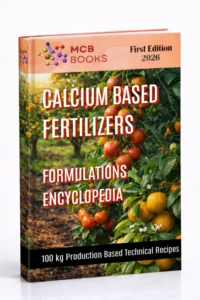
The CALCIUM BASED FERTILIZERS FORMULATIONS ENCYCLOPEDIA is developed as a practical technical resource for fertilizer producers, agricultural entrepreneurs, formulation specialists, production managers, and companies interested in manufacturing commercial calcium fertilizers. It can support the development of calcium nitrate fertilizers, calcium-boron products, calcium-magnesium blends, chelated calcium fertilizers, amino acid-complexed calcium products, organic acid-based calcium solutions, and crop-specific nutritional formulations.
Raw-material selection is one of the most important stages of commercial fertilizer production. Common calcium sources include calcium nitrate, calcium chloride, calcium acetate, calcium formate, calcium carbonate, calcium gluconate, calcium lignosulfonate, and organically complexed calcium compounds. The selected raw material determines the product’s calcium concentration, solubility, pH, compatibility, production cost, and final agricultural application.
Calcium nitrate is widely used in fertigation, greenhouse production, drip irrigation, and hydroponic systems because it provides both soluble calcium and nitrate nitrogen. Calcium chloride is highly soluble and may be suitable for concentrated formulations, although its chloride content must be carefully considered. Calcium acetate, calcium formate, gluconates, amino acids, and lignosulfonates are commonly evaluated for premium foliar and complexed calcium fertilizers.
Commercial liquid production normally begins with the addition of clean water to a corrosion-resistant mixing tank. Water quality must be controlled because sulfate, phosphate, carbonate, and bicarbonate ions can react with calcium and create insoluble deposits. Purified, softened, demineralized, or low-hardness water is generally preferred for stable liquid formulations.
The calcium source should be added gradually under continuous agitation. Complete dissolution or uniform dispersion must be achieved before additional ingredients are introduced. Depending on the product, manufacturers may add boron compounds, magnesium sources, amino acids, organic acids, chelating agents, humectants, surfactants, stabilizers, antifoaming agents, preservatives, or suspension aids.
The order of addition is critical because calcium is highly reactive with phosphate and sulfate sources. Combining concentrated calcium solutions with phosphoric acid, monoammonium phosphate, monopotassium phosphate, magnesium sulfate, potassium sulfate, or sulfate-based micronutrients may cause precipitation. Compatibility testing should therefore be performed before manufacturing combined nutrient products.
The CALCIUM BASED FERTILIZERS FORMULATIONS ENCYCLOPEDIA can help producers understand formulation design, ingredient functions, manufacturing stages, mixing procedures, quality parameters, and product applications. Standardized 100 kg production formulas can also simplify cost calculations, raw-material planning, pilot manufacturing, and industrial scale-up.
Quality control is essential for maintaining consistent commercial performance. Finished calcium fertilizers should be tested for appearance, color, odor, pH, density, viscosity, calcium content, nitrogen content, solubility, crystallization resistance, sediment formation, dilution stability, and storage performance. Foliar products may also require wetting, spreading, sprayability, and phytotoxicity tests, while fertigation products must be fully soluble and free from particles that could block irrigation equipment.
Low-temperature stability testing is especially important for concentrated calcium fertilizers because crystals may form during cold storage. High-temperature testing can reveal possible color changes, pressure development, ingredient degradation, or packaging problems. Retained samples from every production batch should be stored for traceability and future quality comparison.
Commercial packaging should protect the fertilizer against contamination, sunlight, moisture changes, and extreme temperatures. High-density polyethylene containers are commonly used for liquid products, while moisture-resistant bags or laminated packages may be preferred for powders. Every package should include the product name, nutrient declaration, batch number, production date, application instructions, storage information, and safety warnings required by the target market.
Calcium fertilizers are commonly developed for tomatoes, peppers, cucumbers, melons, strawberries, apples, grapes, citrus fruits, potatoes, leafy vegetables, ornamental plants, greenhouse crops, and hydroponic systems. Proper calcium nutrition may help reduce blossom-end rot, bitter pit, tip burn, fruit cracking, weak tissues, poor fruit firmness, and reduced shelf life.
The CALCIUM BASED FERTILIZERS FORMULATIONS ENCYCLOPEDIA provides a structured foundation for manufacturers who want to produce stable, effective, and commercially valuable calcium fertilizers. By combining suitable raw materials, controlled manufacturing methods, professional quality testing, accurate labeling, and appropriate packaging, fertilizer companies can develop reliable products for modern agricultural markets.