Commercial Plant Growth Inhibitor Formulations for High Density Farming
High density farming has become one of the most important agricultural production systems for maximizing yield, improving land efficiency, and increasing commercial profitability. In these intensive cultivation systems, controlling excessive vegetative growth is essential for maintaining crop balance, improving air circulation, and optimizing production quality. For this reason, commercial plant growth inhibitor formulations are widely used in modern agriculture and greenhouse production to support compact and controlled crop development.
Plant growth inhibitors are specialized agrochemical products designed to regulate plant hormone activity and reduce excessive stem elongation. These formulations help crops develop shorter internodes, stronger stems, improved root systems, and more efficient nutrient utilization. In high density farming systems, compact crop structure is extremely important because overcrowded vegetation can limit light penetration, reduce airflow, increase disease pressure, and negatively affect fruit quality.
Commercial plant growth inhibitor formulations commonly contain active ingredients such as paclobutrazol, chlormequat chloride, mepiquat chloride, daminozide, and other growth-regulating compounds. These active ingredients are formulated together with surfactants, stabilizers, dispersing agents, solvents, wetting agents, and pH regulators to improve biological effectiveness and long-term storage stability.
In high density greenhouse production, plant growth inhibitors are frequently used in tomatoes, peppers, cucumbers, strawberries, ornamentals, and nursery plants. Controlled crop growth allows easier harvesting, spraying, pruning, and crop maintenance while improving space efficiency and production management. In field agriculture, these technologies help reduce lodging risks, strengthen plant structure, and support more uniform crop development under intensive cultivation conditions.
The industrial manufacturing process for commercial plant growth inhibitors requires advanced formulation expertise and precise raw material balancing. Products may be manufactured as soluble concentrates, suspension concentrates, emulsifiable concentrates, or wettable powders depending on crop requirements and application methods. Proper homogenization, viscosity control, pH adjustment, and stability testing are critical for producing high-performance agricultural formulations suitable for commercial use.
As global agriculture continues to move toward intensive and technology-driven farming systems, demand for advanced plant growth inhibitor formulations is increasing rapidly. Manufacturers and agribusiness companies are searching for reliable production systems capable of delivering crop safety, formulation stability, and consistent field performance.
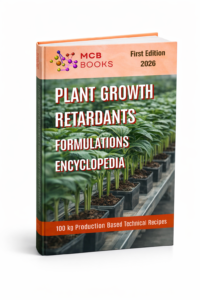
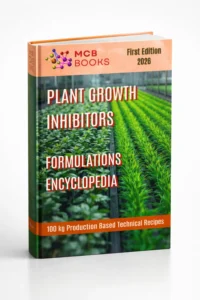
The Plant Growth Inhibitors Formulations Encyclopedia provides industrial-scale formulation technologies for commercial plant growth inhibitors used in high density farming and greenhouse production. The encyclopedia includes professional recipes, raw material details, CAS numbers, manufacturing methods, and advanced agrochemical formulation systems for modern agricultural production.