
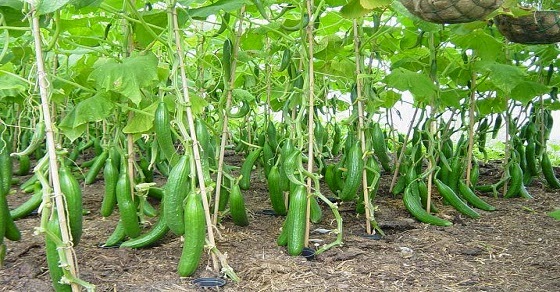
Cumcumbers for slicing and salads. Cucumbers for pickling. Burpless cucumbers for eating out of hand. Cucumbers for containers. Give cucumbers the right conditions and they will be one of your top producing garden crops.
To keep ahead of cucumber problems, pests and diseases, here is a troubleshooting list of possible cucumber problems with brief control suggestions.
Plants are eaten or cut off near soil level. Cutworms are gray grubs ½- to ¾-inch long that can be found curled under the soil. They chew stems, roots, and leaves. Place a 3-inch paper collar around the stem of the plant. Keep the garden free of weeds; sprinkle wood ash around base of plants.
Small plants turn yellow and break off. Southern corn rootworm is the larvae of the spotted cucumber beetle (See below). Cultivate the soil before planting to expose larvae and interrupt the insect’s life cycle.
Leaves curl under and become deformed and yellowish. Aphids are tiny, oval, and yellowish to greenish pear-shaped insects that colonize on the undersides of leaves. They leave behind sticky excrement called honeydew which can turn into a black sooty mold. Use insecticidal soap.
Leaves turn pale green, yellow, or brown; dusty silver webs on undersides of leaves and between vines. Spider mites suck plant juices causing stippling. Spray with water or use insecticidal soap or rotenone. Ladybugs and lacewings eat mites.
Leaves yellow; tiny white winged insects around plants. Whiteflies will congregate on the undersides of leaves and fly up when disturbed. Remove infested leaves and the whole plant if infestation is serious. Introduce beneficial insects into the garden.
Coarse white speckling or stippling on upper surface of leaves; leaves may brown.Leafhoppers are green, brown, or yellow bugs with wedge-shaped wings. They suck the juices from leaves and stems. Use floating row covers to exclude bugs; spray with insecticidal soap.
Trails and tunnels in leaves. The leafminer larvae tunnel inside leaves. Destroy infected leaves and cultivate the garden to destroy larvae and keep adult flies from laying eggs. Cover crops with floating row covers.
Water-soaked blotches on leaves–not enlarging past leaf veins; water-soaked spot can appear on fruits Angular leaf spot or bacterial spot is a waterborne bacterium which causes irregular geometric patterns on leaves. Spots may turn yellow and crisp. Avoid wetting foliage with irrigation. Prune off infected leaves and stems. Clean up garden. Plant disease-resistant varieties. Rotate crops up to 2 years.
Holes chewed in leaves, leaves skeletonized; runners and young fruit scarred. Spotted cucumber beetle is greenish, yellowish, ¼ inch (7mm) long with black spots and black head. Striped cucumber beetle has wide black stripes on wing covers. Hand pick; mulch around plants; plant resistant varieties; dust with wood ashes.
Leaves have yellow specks that turn brown, then black; vines wilt from point of attack.Squash bug is a flat, shield-shaped black or brownish bug with a triangle on its back; it sucks juices from plants. Trap adults beneath boards in spring, hand pick and destroy.
Round white powdery spots and coating on leaves. Powdery mildew is caused by fungal spores. Spores germinate on dry leaf surfaces when the humidity is high; spores do not germinate on wet leaves. Common in late summer or fall but does not result in loss of plant. Avoid water stress. Pick off infected leaves.
Irregular yellowish to brownish spots on upper leaf surfaces; grayish powder or mold on undersides. Downy mildew is caused by a fungus. Improve air circulation. Plant resistant varieties. Rotate crops. Keep garden free of plant debris.
Mottled, distorted leaves. Mosaic virus causes leaves to become thickened, brittle, easily broken from plant; plants are stunted and yields are poor. The virus is spread from plant to plant by aphids and leafhoppers. Remove diseased plants. Remove broadleaf weeds that serve as virus reservoir.
Knots, galls, or swollen beads on roots; plants wilt; poor yield. Nematodes are microscopic worm-like animals that live in the film of water that coats soil particles; some are pests, some are not. Root-knot nematodes feed in the roots and stunt plant growth. Most common in sandy soils. Rotate crops. Solarize the soil with clear plastic in mid-summer.
Plants wilt and die beginning with crown or older topmost leaves. Verticillium wilt is a soilborne fungus. Light brown streaks can be seen in stem split lengthwise. Rotate crops. Avoid soil previously planted in cucumbers and family members, potatoes, peppers, eggplant, and tomatoes.
Vines wilt suddenly and die starting with one or two leaves. Bacterial wilt clogs the circulatory system of plants. It is caused by bacteria that live in cucumber beetles and is seen often where the soil stays moist. Remove and destroy infected plants before the disease spreads. Control cucumber beetles with rotenone or sabadilla. Wash hands and clean tools with a bleach solution.
Plants are stunted and yellow; runners gradually die. Fusarium wilt is a fungal disease which infects plant vascular tissues. Fungal spores live in the soil and can be carried by cucumber beetles. Plant disease-resistant varieties. Rotate crops. Remove and destroy infected plants. Fungicides are not effective
Water-soaked spots–sunken, brown or black–on fruit. Belly rot or bacterial spot or blight. Remove and destroy infected fruits. Remove all plants and plant debris at the end of the season. Promote good drainage adding organic materials to planting beds. Avoid over-head watering. Rotate crops. Stake or cage plants to keep fruit off ground.
Water-soaked or pale green spot on leaves that turn white; fruit cracks. Scab is caused by soilborne bacterium. Disease can be cosmetic. Plant resistant varieties. If scab occurs, change varieties next year. Sulfur may be worked into soil to make it slightly acid and reduce disease.
Early flowers don’t set fruit. A couple of possible reasons: (1) the first flowers to appear are male; female flower appear next. Fruit is produced by female flowers. Wait until female flowers appear and are pollinated. Plant all-female (gynoecious) cucumber hybrids–a few male plants will be added to the seed mix. (2) There may not be enough pollinators, mostly bees, to carry the pollen from male to female flowers. Pick off male flowers and dust the pollen into the female flowers.
Plants produce few fruits, mostly foliage. Plants are likely spaced too close together. Space plants at recommended distances, 8 to 12 inches apart. Plant spaced too close or too far apart yield fewer fruits as a result of poor pollination.
Plant fruit but then stop fruiting. Pick fruit as soon as it is the right size to use. This will allow the plant to put energy into additional fruit production. If you fail to pick mature fruit, the plant will quit producing.
Fruit tastes bitter. Uneven watering will cause plants to produce bitter compounds that affect taste. Uneven temperatures–swings of temperature by 20° or more–will do the same. Keep the soil evenly moist and mulch to conserve soil moisture. Grow varieties that do not turn bitter: Marketmore 70 is a bitter-free cucumber.
RELATED TAGS: How to care cucumber, how to grow cucumber, growing of cucumber, fertilization time of cucumber, fertilization programme of cucumber,cucumber fertilizers, problems of growing cucumber, types of tomatoes, irrigation of cucumber, feeding of cucumber, seed of cucumber, cucumber plants growing, cucumber diseases,what is alternia diseases for cucumber plants, cucumber pests,
any liquid and solid organic fertilizer,
ORGANIC
FERTILIZERS
FORMULATIONS
ENCYCLOPEDİA
is enough.
This encyclopedia has many formulations about organic soil conditioner,humic acid productions,compositions,fulvic acid manufacturing,organic fertilizers,animal manure,amino acid organic fertilizers, organomineral powder fertilizers,organomineral liquid fertilizers productions,liquid root growth fertilizers formulas,granular root growth fertilizers,seaweed organic fertilizers,wermicompost fertilizers formulations,gel organic fertilizers,organomineral gel fertilizers manufacturing and any organic fertilizers etc.
All organic fertilizers in the encyclopedia are producible easily.You need no help and no technıcal support. The encyclopedia is enough to produce organic fertilizers itself.
ORGANIC
FERTILIZERS
FORMULATIONS
ENCYCLOPEDIA
is written clear and understandable.
RELATED TAGS: What is organic fertilizer,preparation of organic soil conditioner, liquid organic fertilizer manufacturing,animal manure manufacturing, manufacturing proces of animal manure,chicken manure,efficiency of humic acid in soil,effect of humic acid in plants, advantages of humic acid in agriculture, types of animal manure,seaweed fertilizer manufacturing process,production of liquid seaweed fertilizers, what is organic compost, preparation of organic compost,how to use organic compost,making organic compost, using of seaweed fertilizer,properties of seaweed organic fertilizers how to make liquid organic fertilizers, making organic compost,types of organic compost,manufacturing process of organic compost, how to make organic compost fertilizers, production of organic fertilizers, how to make organomineral fertilizer, production of organomineral fertilizers, calculating liquid organomineral fertilizers,powder organomineral fertilizers manufacturing,preparation of organomineral fertilizers,types of liquid organomineral fertilizers, manufacturing process solid humic acid, formulation of humic acid,value of humic acid,manufacturing process of fulvic acid,how to produce humic acid,what is leoardite,where to use leonardite,types of leonardite,properties of leonardite,analyzes of leonardite,specification of leonardite, values of leonardite, what is leonardite humate,what is potassium humate, liquid humic acid preparation,powder humic acid production, granular soil conditioner manufacturing process, powder soil conditioner making,formulation of organic soil conditioner, making powder humic acid,humic acid production, composition of organic fertilizers,how to use organic fertilizers,why to use organic fertilizer,types of organic fertilizer,benefits of organic fertilizers,wermicompost fertilizers making, powder organic fertilizers,how to use organic fertilizers, making wermicompost fertilizer, formulation of seaweed fertilizers, amino acid fertilizer production,granular organic fertilizer,amino acid organic fertilizer manufacturing, properties of organic fertilizers, analyzes of organic fertilizer, specification of organic fertilizers, where to use organic fertilizers, what is soil amendments, humic acid making, how to make powder humic acid, manufacturing process of fulvic acid, herbal fulvic acid making, liquid humic acid process, formulation of humic acid,organic fertilizers for plants, organic fertilizers in agriculture, how to produce organic fertilizers, animal manure manufacturing process, herbal fertilizers, what is organic fertilizer compost, what is organic agriculture, how to make organic agriculture, advantages of organic fertilizers, effects of organic fertilizer, results of organic fertilizers, indications of organic fertilizers, symptoms of organic fertilizers, preparation of organic fertilizers, calculation of organic fertilizers, compounds of organic fertilizers,composition of liquid organic fertilizers, fertilization of organic fertilizers,why to use organic fertilizers.what is humate, types of humates,benefit of humate,potassium humate manufacturing process.,using powder soil conditioner, properties of granular soil conditioner,what is pellet organic soil conditioner.what is amino acid fertilizer, how to use organic amino acid fertilizsers,making amino acid fertilizers,formulation of amino acid fertilizers,manufacturing process of amino acid fertilizers, what is organic compost, where to use organic compost, types of organic compost in plants,benefits of organic compost in soil, preparation of organic compost in agriculture.
E – BOOKS AND HARD BOOKS
HOW TO BUY
AGRICULTURE ENCYCLOPEDIAS AND VIDEOS