 Foliar fertilizer production requires carefully controlled manufacturing methods to obtain soluble, homogeneous, stable, and commercially acceptable products. Because these fertilizers are applied directly to plant leaves, unsuitable raw materials or incorrect production conditions may cause precipitation, sediment formation, nutrient incompatibility, crystallization, excessive foaming, or reduced storage life. Mixing, pH control, filtration, stability testing, and packaging are therefore essential stages in professional foliar fertilizer manufacturing.
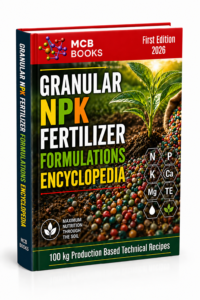
Production generally begins with the preparation of clean process water. Water quality can directly influence product performance because excessive hardness, high salt content, unsuitable pH, or microbial contamination may reduce nutrient solubility and create unwanted reactions. Demineralized, softened, or appropriately treated water may be preferred depending on the formulation. The SPECIAL FOLIAR FERTILIZER FORMULATIONS ENCYCLOPEDIA provides practical guidance for selecting raw materials and organizing production procedures for different foliar fertilizer products.
A measured portion of process water is added to the mixing tank, and agitation is started at a suitable speed. Water-soluble macronutrients such as urea, potassium nitrate, monopotassium phosphate, or magnesium sulfate are added gradually. Each ingredient should dissolve completely before the next material is introduced. Chelated micronutrients, amino acids, seaweed extracts, organic acids, stabilizers, surfactants, preservatives, and antifoaming agents are incorporated according to the required addition order.
Mixing speed and temperature must be controlled throughout production. Insufficient agitation may result in poor distribution, while excessive mixing can create foam or introduce unnecessary air into the solution. High temperatures may improve the dissolution of some salts, but they can damage heat-sensitive organic ingredients or reduce chelate stability.
pH control is one of the most important steps in foliar fertilizer manufacturing. The pH of the solution affects nutrient solubility, chemical compatibility, chelate performance, preservative effectiveness, and storage stability. Acidifying or alkalizing agents should be added slowly while the pH is monitored continuously. Rapid or excessive adjustment can cause localized reactions and precipitation.
After all raw materials are dissolved and the final batch weight is completed, the solution is filtered. Filtration removes undissolved particles, foreign materials, and insoluble residues that may block spray nozzles or reduce product appearance. The selected filter size should match the product type, ingredient characteristics, and intended application equipment.
The SPECIAL FOLIAR FERTILIZER FORMULATIONS ENCYCLOPEDIA also emphasizes stability testing before commercial release. Finished products should be evaluated for nutrient content, pH, density, appearance, color, odor, sediment formation, crystallization, dilution behavior, and temperature stability. Samples may be stored under different conditions to observe possible changes over time.
Packaging materials must be compatible with the fertilizer formulation. Suitable plastic containers, closures, seals, labels, and cartons should protect the product from leakage, contamination, moisture, and direct sunlight. Batch numbers, production dates, storage instructions, and application information should be clearly provided.
The SPECIAL FOLIAR FERTILIZER FORMULATIONS ENCYCLOPEDIA is a valuable technical resource for manufacturers, agricultural engineers, formulation specialists, production managers, and entrepreneurs seeking to produce stable and marketable foliar fertilizers. Controlled mixing, accurate pH adjustment, effective filtration, proper stability testing, and reliable packaging help ensure consistent product quality and customer satisfaction.